All species › Birds of prey › Hawks, eagles and kites › Montagu's Harrier
Montagu's Harrier | Circus pygargus
Grauwe kiekendief | Aguilucho Cenizo
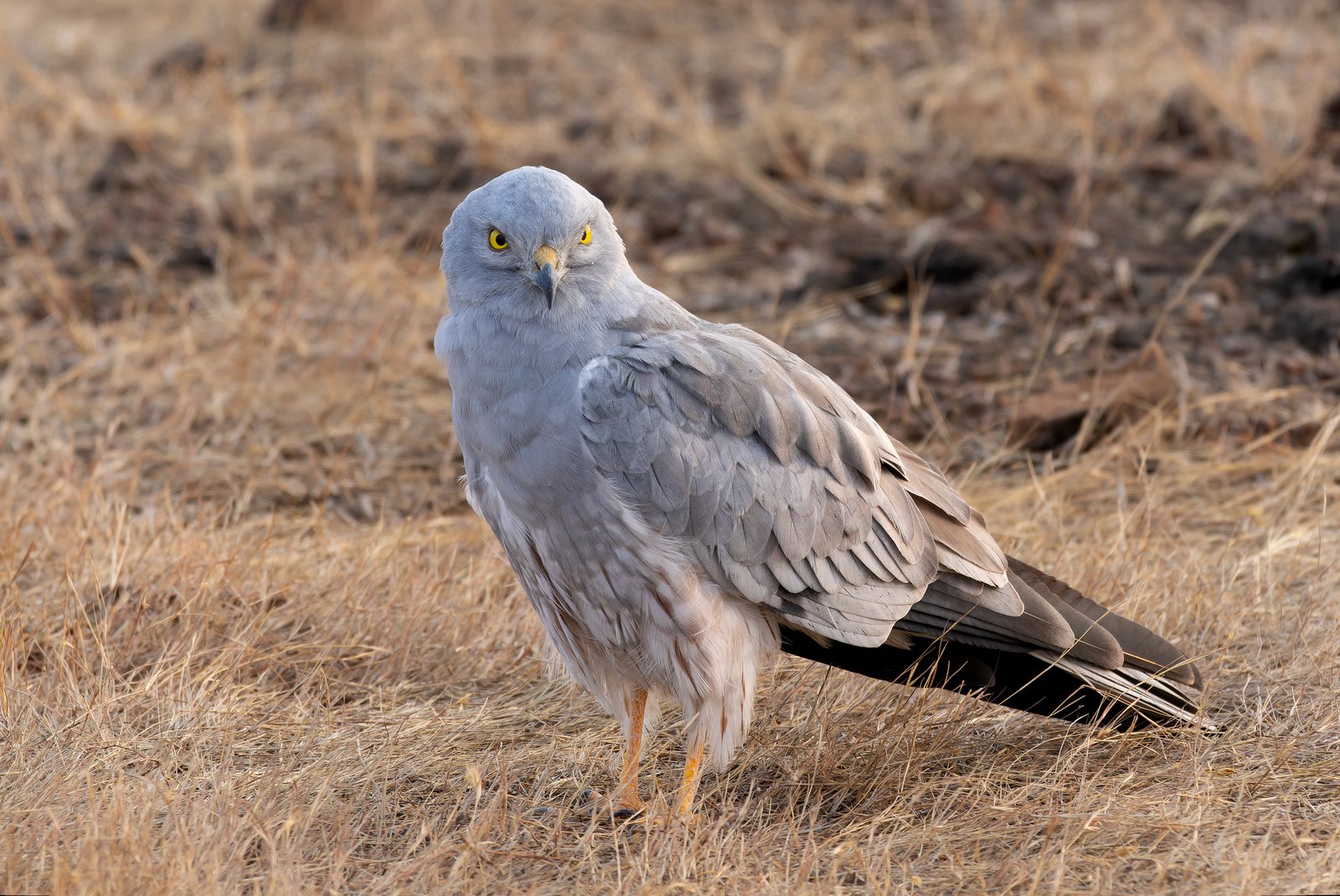
Montagu's Harrier is a lightly built, very long-winged harrier that breeds in Europe and western Asia and spends the austral summer in grasslands and open savannas south of the equator. In southern Africa it is the most frequently seen Palearctic harrier, although it remains rather scarce everywhere.
Click a thumbnail to switch the photo above.
Voice
Almost always silent in the non-breeding range. On the breeding grounds a fast chattering kek-kek-kek and a high yik-yik at the nest.
Recording: Esperanza Poveda — CC BY-NC-SA 4.0 · shortened to the first 60 s, mono · xeno-canto
Identification
40–47 cm, wingspan 97–115 cm. The adult male is mid-grey with a grey head and breast, a black bar across the upper secondaries, two black bars across the undersides of the secondaries, an extensive black wingtip and rufous streaks on belly, flanks and underwing coverts. The female is brown with a narrow white rump and a barred tail; the face is pale with a small dark ear patch, and below the secondaries are evenly barred light and dark. Juveniles are plain rufous below, with a dark face and no pale collar. A rare dark morph occurs. In flight the wings are long and narrow, with four well-projecting primaries, and the silhouette is light and slender.
Confusion species
Pallid Harrier Circus macrourus is very similar: the male is paler, without wing bars and with only a narrow black wedge in the wingtip; females and juveniles have a pale collar around a larger dark ear patch and dark secondaries below with fading bands. African Marsh Harrier Circus ranivorus is bulkier, lacks the white rump and hunts over marshes. The dark morph differs from Black Harrier Circus maurus in lacking a white rump and a silvery-barred tail.
Habitat
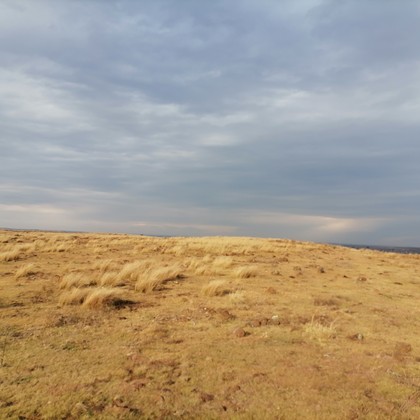
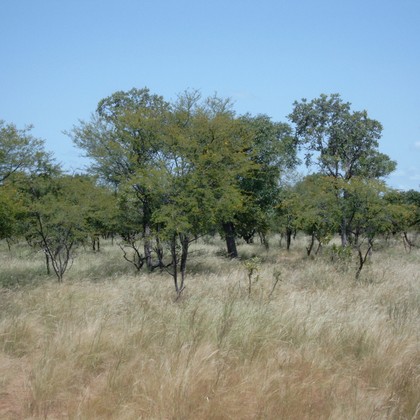
Open grassland, dry plains, cropland, fallow fields and open savanna, also dried-out floodplains and the edges of vleis. It quarters low and rocking over the grass for grasshoppers, small rodents, larks and quails, often at places with swarming locusts or termites. It roosts in small groups on the ground in tall grass, sometimes with Pallid Harriers.
Where the bird is most at home, classified by the vegetation units of southern Africa.

Range and movements
Mainly in the north and east of the region: Zambia, Malawi, Zimbabwe, Botswana, northern Namibia, southern Angola, inland Mozambique and, in South Africa, the highveld of Gauteng, Mpumalanga, North West and the Free State, extending to KwaZulu-Natal and Eswatini; rare in the Cape provinces. It breeds from north-west Africa and western Europe to western Siberia and Kazakhstan; it winters in sub-Saharan Africa and India.
- Summer visitor (c. Oct–Mar)
- Passage (Mar–Apr, Oct–Nov)
- dark = core range, pale = thinly spread
How and when to look
Best from December to February over extensive grassland on the highveld or in the Kalahari. Harriers in open country are often less active at midday; early in the morning and late in the afternoon they leave their roosts and hunt low. A bird with a white rump and a dark face without a pale collar is probably a female or juvenile of this species.
Conservation status
Not threatened. In western Europe the species depends largely on nest protection in cereal fields; on the wintering grounds, conversion of grassland, pesticides against locusts and overgrazing are risks.
Scientific name
Circus pygargus | (Linnaeus, 1758)
Linnaeus described the species in 1758 as Falco Pygargus; because it was later moved to another genus, the author and year stand in brackets. The genus Circus was introduced in 1799 by De Lacépède. Circus comes from the Greek kirkos, a partly mythical hawk named for its circling flight (from kirkos, 'circle'). pygargus goes back to the Ancient Greek pugargos 'white-rumped', from puge 'rump' and argos 'white'. The specimen the first description was based on came from England.