All species › Birds of prey › Hawks, eagles and kites › African Marsh Harrier
African Marsh Harrier | Circus ranivorus
Afrikaanse bruine kiekendief | Aguilucho Lagunero Etiópico
The African Marsh Harrier is the only harrier that breeds over most of southern Africa and is tied to marshes. It hunts low and rocking over reedbeds, vleis and wet grasslands and has become rare in many places through the loss of wetlands.
Voice
Mostly silent. In the breeding season the male displays with a plaintive fee-oo and a fast chattering kek-kek-kek; the female begs with a high squealing pee-oo at food passes.
Recording: Lynette Rudman — CC BY-NC-SA 4.0 · converted to mono · xeno-canto
Identification
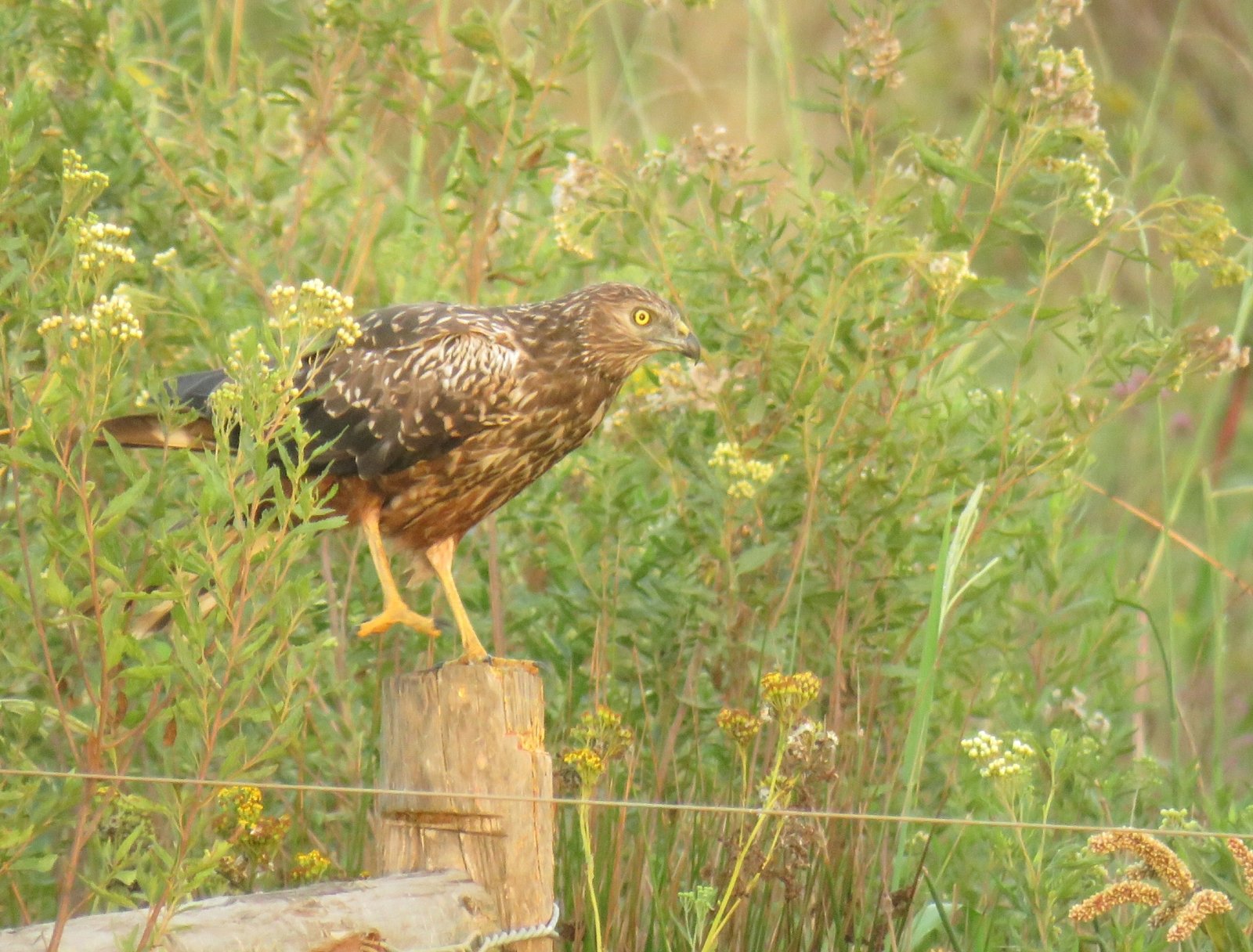
44–50 cm, wingspan 115–140 cm. Adults are mainly dark brown with rufous, dark-streaked breast and belly, a paler streaked head and often pale edges along the leading edge of the wing. The tail is grey-brown with clear dark bars, and below the flight feathers are pale with dark bars, giving a barred underwing. The rump is brown or at most slightly paler, never bright white. Iris, cere and legs are yellow. Juveniles are darker chocolate brown with a pale breast band and often a pale patch on the nape. It flies with the wings in a V and rocks low over the reeds.
Confusion species
Western Marsh Harrier Circus aeruginosus, a rare visitor from the north, has a creamy crown and throat and an unbarred tail in the female and juvenile; the male has grey wing panels and black wingtips. Females and juveniles of Montagu's Harrier Circus pygargus and Pallid Harrier Circus macrourus are slimmer and have a white rump. The juvenile Black Harrier Circus maurus has a white rump and a strongly black-and-silver barred tail.
Habitat
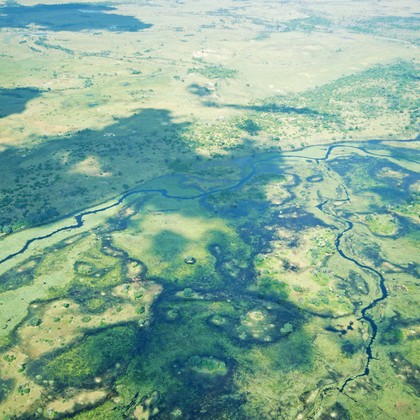
Reedbeds, bulrush marshes, vleis, floodplains and the margins of dams and lakes, also wet grasslands and fields near water. It hunts low and slowly over the reeds for rodents, frogs, young waterbirds and small birds, and also takes carrion. The nest is on the ground or in trampled reeds above water.
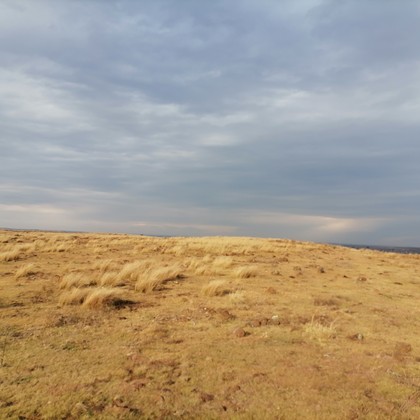
Where the bird is most at home, classified by the vegetation units of southern Africa.
Range and movements
Widespread but local over much of the region: eastern and southern South Africa, from the Western Cape along the coast to KwaZulu-Natal and on the highveld, as well as Lesotho, Eswatini, Zimbabwe, Mozambique, Malawi, Zambia, Angola, the Okavango Delta and northern Botswana, and the Caprivi Strip in north-eastern Namibia. Absent from the arid west. Beyond the region through East and Central Africa to Kenya, Uganda, Congo and Ethiopia.
- Resident
- Summer visitor (c. Oct–Mar)
- Winter visitor (c. Apr–Sep)
- Passage (Mar–Apr, Oct–Nov)
- dark = core range, pale = thinly spread
How and when to look
Search over large reedbeds and vleis, such as on the highveld around Chrissiesmeer, in the Okavango Delta and on the Bangweulu and Kafue flats in Zambia. The bird shows best in the morning, when it hunts low and slowly back and forth over the reeds. The barred tail and the lack of a white rump are the quickest features.
Conservation status
Not threatened, but regarded as regionally Endangered in South Africa. The main causes are the drainage, overgrazing and burning of marshes and poisoning. Elsewhere in the region, such as in Zambia and Botswana, it is still fairly common.
Scientific name
Circus ranivorus | (Daudin, 1800)
Daudin described the species in 1800 as Falco ranivorus; because it was later moved to another genus, the author and year stand in brackets. The genus Circus was introduced in 1799 by De Lacépède. Circus comes from the Greek kirkos, a partly mythical hawk named for its circling flight (from kirkos, 'circle'). ranivorus comes from the Latin rana, 'frog', and vorare, 'to devour' — 'frog-eater', for its life in marshes. The specimen the first description was based on came from South Africa.