All species › Kingfishers, bee-eaters and rollers › Rollers › Lilac-Breasted Roller
Lilac-Breasted Roller | Coracias caudatus
Gaffelscharrelaar | Carraca Lila
The Lilac-Breasted Roller is the most strongly patterned roller of the savanna, with a lilac breast, a turquoise belly and two elongated outer tail streamers. It perches high and in the open on dead branches and wires, which makes it visible from a long way off.

Voice
A hard, raucous grating series, zaak zaak zaak, and a rattling screech that is loudest during the display flight, in which the bird climbs steeply and then dives with rolling, rocking sweeps while calling. Short harsh cries are given in alarm.
Recording: Derek Solomon — CC BY-NC-SA 4.0 · converted to mono · xeno-canto
Identification
About 36 cm, of which the two narrow streamers make up 8 to 9 cm. Forehead and lores are white, the crown greenish, the mantle cinnamon-brown; throat and breast are lilac with fine white streaking, the belly and undertail coverts turquoise. In flight the wing pattern is striking: pale blue coverts against dark purple-blue flight feathers, with turquoise bands along the base. The sexes are alike. Juveniles are duller, with a brownish wash on the breast and no streamers.
Confusion species
European Roller (Coracias garrulus), a Palearctic migrant from November to March, lacks the lilac breast and the streamers and is wholly blue below. Purple Roller (Coracias naevius) is bulkier, purple-brown with white streaking and square-tailed. Racket-Tailed Roller (Coracias spatulatus) has blue rather than lilac underparts and streamers ending in spatules. Broad-Billed Roller (Eurystomus glaucurus) is smaller, cinnamon, with a broad yellow bill.
Habitat
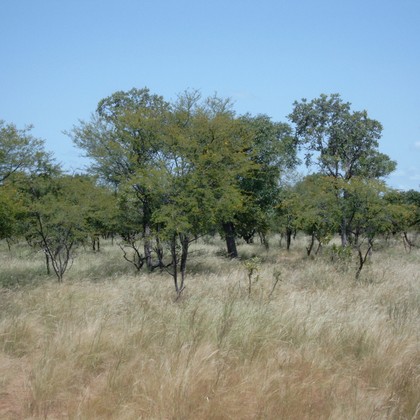
Open acacia savanna, broadleaved woodland with clearings, woodland edge and cleared farmland with scattered trees. It hunts from a perch, dropping onto grasshoppers, beetles, scorpions, lizards, small snakes and young rodents taken on the ground. Dense forest and true desert are avoided.
Where the bird is most at home, classified by the vegetation units of southern Africa.
Range and movements
Widespread through the savanna belt of the region: northern South Africa, Eswatini, Zimbabwe, northern and eastern Botswana, northern Namibia, Zambia, Malawi, Mozambique and Angola. Absent from the arid south-west, the Karoo and the Cape. Beyond the region it extends north through East and Central Africa to Ethiopia and Somalia.
- Resident
- Summer visitor (c. Oct–Mar)
- Winter visitor (c. Apr–Sep)
- Passage (Mar–Apr, Oct–Nov)
- dark = core range, pale = thinly spread
How and when to look
The dry season, May to October, when the leaves are largely gone and birds show up far off on dead crowns and roadside wires. Drive slowly and scan every bare branch. The display flight with rolling dives falls between September and December.
Conservation status
Not threatened and widespread across its range. Numbers fall locally with the clearing of savanna woodland, the loss of dead trees holding nest cavities, and the effect of insecticides on large insects. Because the species likes to hunt along roads, traffic is a recurrent cause of death.
Scientific name
Coracias caudatus | Linnaeus, 1766
Linnaeus described the species in 1766 and placed it straight away in the genus where it still stands. The genus Coracias was introduced in 1758 by Linnaeus. Coracias is the Greek word for a crow-like bird, used by Aristotle for a jackdaw or raven; later authors applied the name to the rollers, which are not related to crows in any way. caudatus is Latin for 'tailed', for the elongated outer tail feathers that stream behind the bird like ribbons. The specimen the first description was based on came from Angola.