All species › Passerines › Swallows and martins › Lesser Striped Swallow
Lesser Striped Swallow | Cecropis abyssinica
Savannezwaluw | Golondrina Abisinia
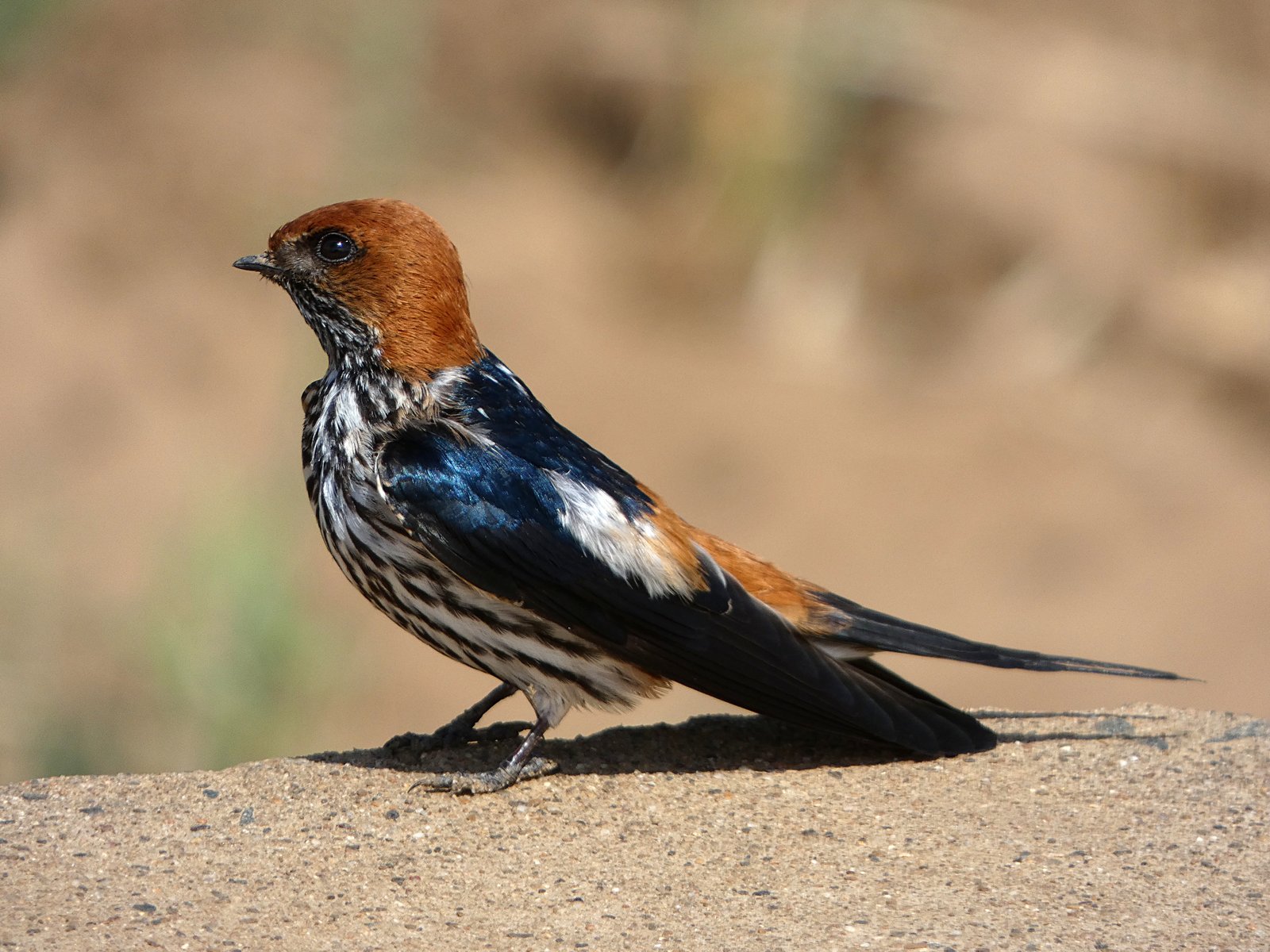
The Lesser Striped Swallow is a small, contrasting swallow with a rufous head, a rufous rump and heavily black-streaked white underparts. It likes to nest under the eaves and verandas of farmhouses and lodges, and its nasal, descending song is a familiar sound in the eastern bushveld.
Voice
The song is a series of nasal, squeaky notes falling in pitch, tee-tee-tee-teeeu, often repeated from a wire or roof edge and very characteristic. The call is a short nasal chweet or zeh.
Recording: Lynette Rudman — CC BY-NC-SA 4.0 · shortened to the first 60 s, mono · xeno-canto
Identification
15–17 cm, including the long tail streamers. The crown, nape and ear coverts are deep rufous, the rufous extending below the eye. The back and wings are glossy blue-black and the rump is bright orange-rufous. The underparts are white with broad, dense black streaks from throat to undertail coverts; the underwing coverts are warm buff. The tail is deeply forked with long outer feathers and a row of white spots. Juveniles are duller, with a browner head, shorter tail and less crisp streaking. The flight is rather slow and floating, often with short glides, and it frequently perches on wires or dead branches.
Confusion species
The Greater Striped Swallow Cecropis cucullata is larger and paler, with a paler orange-brown crown, whitish ear coverts, finer and sparser streaks and a pale orange rump; its song is softer and not descending. The Red-Breasted Swallow Cecropis semirufa and the Mosque Swallow Cecropis senegalensis have unstreaked rufous underparts. The Eastern Red-Rumped Swallow Cecropis daurica has a blue-black crown and barely streaked underparts. The combination of a dark rufous head extending below the eye and heavy streaking is diagnostic.
Habitat
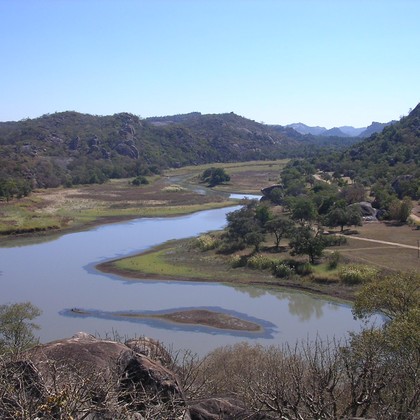
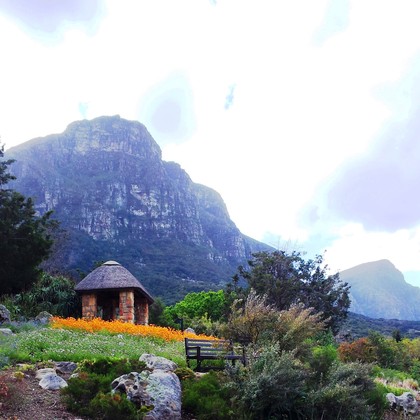
Mixed woodland, miombo, mopane and wooded savanna, especially near water, rivers, and villages, farms, lodges and bridges; also forest edges in the coastal belt. It builds a retort-shaped mud nest with a long entrance tube under eaves, verandas, bridges and culverts, and originally under rock overhangs. It hunts flying insects, often fairly low over woodland edges and clearings.
Where the bird is most at home, classified by the vegetation units of southern Africa.

Range and movements
In the north and east of the region: Angola, Zambia, Malawi, Mozambique and Zimbabwe, northern and eastern Botswana and north-eastern Namibia; in South Africa in Limpopo, Mpumalanga, Eswatini, KwaZulu-Natal and the Eastern Cape, west into the eastern Western Cape. Largely resident in the north; in the south largely absent from May to July. Otherwise widespread in Africa south of the Sahara, from Sierra Leone to Ethiopia and southwards.
- Resident
- Summer visitor (c. Oct–Mar)
- Winter visitor (c. Apr–Sep)
- Passage (Mar–Apr, Oct–Nov)
- dark = core range, pale = thinly spread
How and when to look
Check the eaves and verandas of lodges and rest camps, for example in the Kruger National Park, in Zululand or around Victoria Falls: the retort-shaped nests give the species away. The descending nasal song from a wire is often the first sign. With a striped swallow in flight, look for the rufous head extending below the eye and the bright orange rump.
Conservation status
Not threatened. The species is common and has spread south-westwards in South Africa, helped by buildings and bridges as nest sites.
Scientific name
Cecropis abyssinica | (Guérin-Méneville, 1843)
Guérin-Méneville described the species in 1843 as Hirundo abyssinica; because it was later moved to another genus, the author and year stand in brackets. The genus Cecropis was introduced in 1826 by Boie. Cecropis is from Ancient Greek Kekropis, 'Athenian woman'. abyssinica means 'from Abyssinia', the old name for Ethiopia, where the first specimen came from. The specimen the first description was based on came from Ethiopia.