All species › Woodpeckers and allies › Woodpeckers › Knysna Woodpecker
Knysna Woodpecker | Campethera notata
Knysnaspecht | Pito de Knysna
The Knysna Woodpecker is one of the few true South African endemics among the woodpeckers: a dark, heavily spotted woodpecker of coastal forest and dense thicket along the south coast. It is shy and more often heard than seen.
Voice
A high, slightly rising scream, wheeeeaa, longer and thinner than that of Golden-Tailed Woodpecker, and a soft chik. It seldom drums.
Recording: Walter Wallner — CC BY-NC-SA 4.0 · converted to mono · xeno-canto
Identification
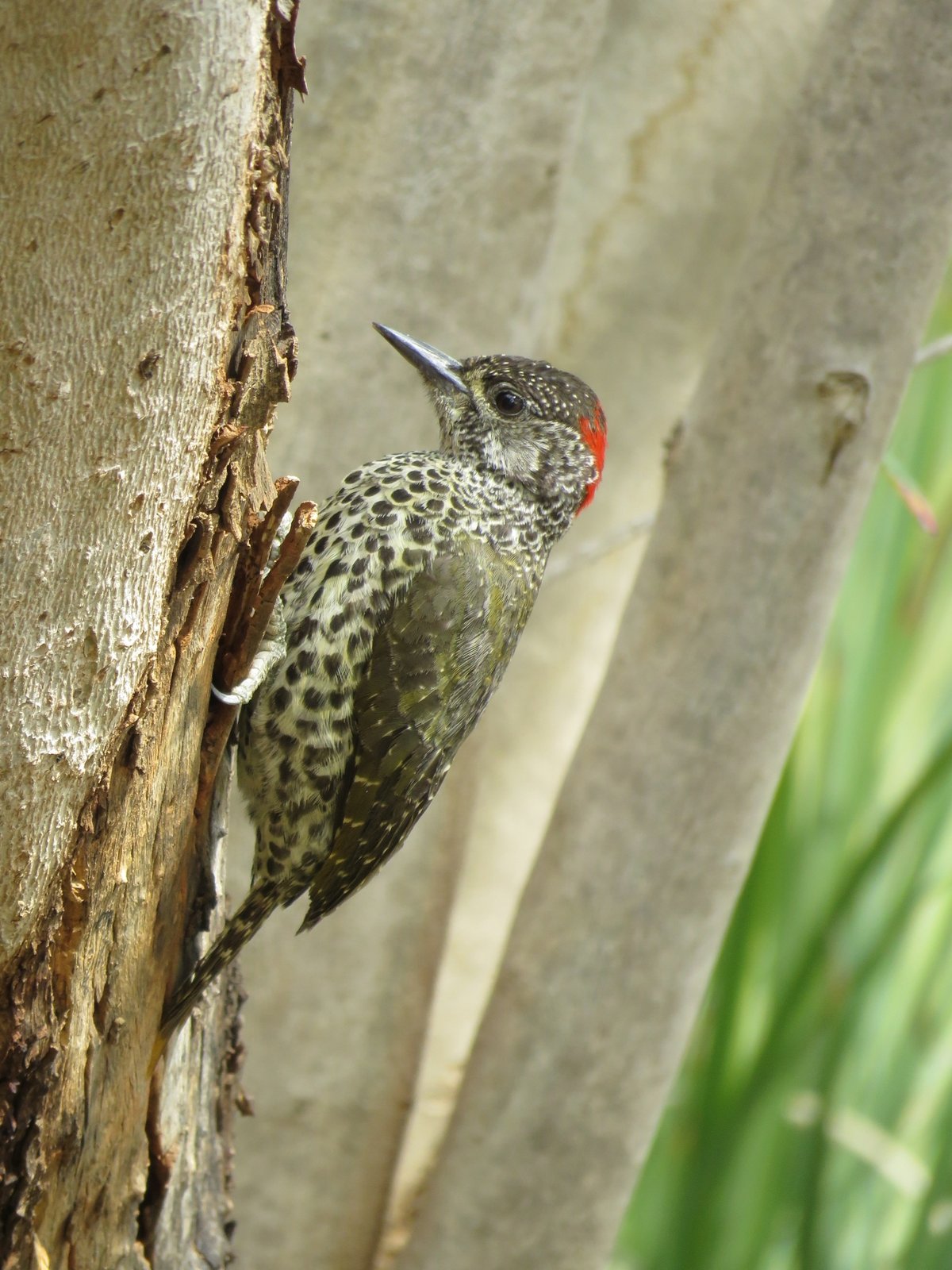
About 20 cm. The upperparts are dark olive-green with small yellowish-white dots, the tail golden-olive. The whole face, throat and underparts are yellowish to pale ochre and so densely covered in round black spots that at close range the bird looks almost black-spotted throughout. The male has a red crown and a red, black-flecked moustachial stripe; the female has a black forehead and forecrown dotted white and only a red nape. Juveniles are darker and duller still.
Confusion species
Golden-Tailed Woodpecker (Campethera abingoni) is paler, streaked rather than spotted below and whiter on the throat; intermediates occur in the Eastern Cape. Olive Woodpecker (Dendropicos griseocephalus) has a grey head and unspotted olive-green underparts. Cardinal Woodpecker (Dendropicos fuscescens) is smaller, with a barred back and brown forehead.
Habitat
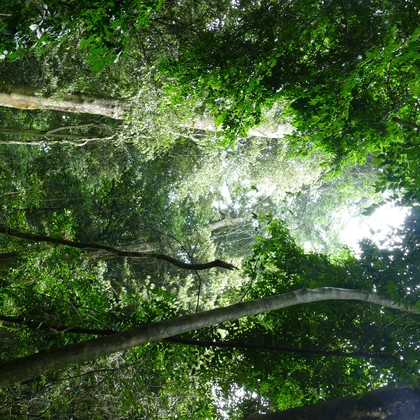
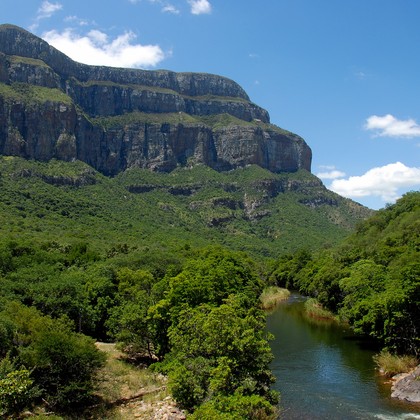
Coastal forest, dense milkwood thickets, dry Euphorbia thicket and valley bushveld in the Eastern Cape, riverine forest and overgrown gardens at the forest edge. It forages in the middle and upper storeys for ants and larvae, sometimes on the ground.
Where the bird is most at home, classified by the vegetation units of southern Africa.

Range and movements
Endemic to South Africa: a narrow belt along the south and east coast from about Swellendam in the Western Cape through Knysna, the Eastern Cape and the Wild Coast to southern KwaZulu-Natal. It does not extend far inland beyond the coastal belt and occurs nowhere else.
- Resident
- Summer visitor (c. Oct–Mar)
- dark = core range, pale = thinly spread
How and when to look
Search forest edges and dense coastal thicket between Knysna and East London, for example in the reserves along the Garden Route and in the valley bushveld near Gqeberha. The high scream is the best lead; the bird often sits still in dense foliage and must be tracked down patiently.
Conservation status
Near Threatened. The range is small and fragmented and the population is estimated at a few thousand birds. Loss of coastal forest and thicket to development, farming and plantations is the main threat.
Scientific name
Campethera notata | (Lichtenstein, 1823)
Lichtenstein described the species in 1823 as Picus notatus; because it was later moved to another genus, the author and year stand in brackets. The genus Campethera was introduced in 1841 by Gray. Campethera comes from the Greek kampē, 'caterpillar', and thēras, 'hunter' — 'caterpillar hunter', for the insect diet of these woodpeckers. notata is Latin for 'marked' — for the densely spotted underparts. The specimen the first description was based on came from eastern Cape, South Africa (not further specified).