All species › Passerines › Cisticolas › Karoo Eremomela
Karoo Eremomela | Eremomela gregalis
Karoo-eremomela | Eremomela del Karoo
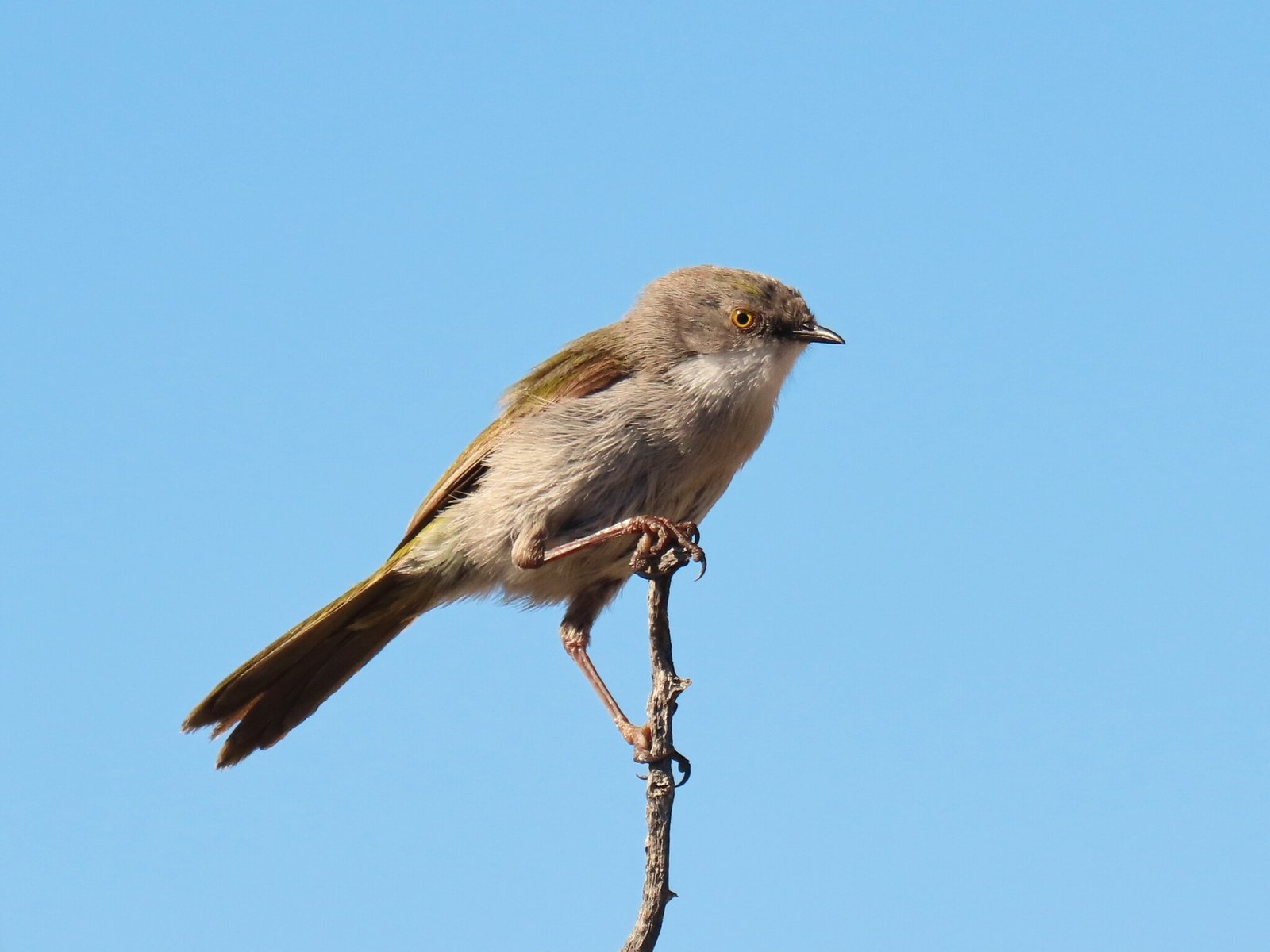
Karoo Eremomela is one of the endemics of the western arid zone: a slim, long-tailed warbler with a pale eye that moves through low Karoo scrub in groups of three to eight birds. The groups keep in constant contact with a loud, strident chorus, so they are heard more often than seen.
Voice
A loud, strident group chorus of repeated, whistled notes, such as tree-tree-tree-treee or chwee-chwee-chwee, with several birds joining in at once. The contact call is a soft tsip. The chorus carries far across the open Karoo and is the best way to find a group.
Recording: Rick Nuttall — CC BY-NC-SA 4.0 · shortened to the first 60 s, mono · xeno-canto
Identification
12 cm. Upperparts greenish-grey to olive-grey, head greyer with a faint pale supercilium. The eye is strikingly pale, cream to pale yellow. The underparts are off-white to pale grey, with pale yellow on the lower flanks and bright yellow on the undertail coverts. For an eremomela the tail is fairly long and is often slightly raised. Bill fine and dark, legs dark. The sexes are alike; juveniles are greener with a dark eye.
Confusion species
Yellow-Bellied Eremomela Eremomela icteropygialis is smaller and shorter-tailed, with a grey back, a dark eye, a dark eye-stripe and yellow over the whole lower belly, and usually occurs in pairs. Rufous-Eared Warbler Malcorus pectoralis has rufous ear patches, a black breast band in the male and a long, often cocked tail. Karoo Prinia Prinia maculosa is streaked on the breast and constantly flicks its tail. Cape Penduline Tit Anthoscopus minutus is smaller, with a short tail, a black forehead and a yellow belly.
Habitat
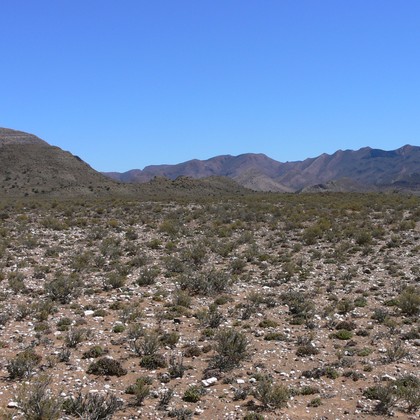
Low, varied scrub in the Succulent Karoo and Nama Karoo, especially on plains and low hills with scattered taller bushes, also along dry watercourses. It forages through the shrubs and occasionally on the ground for small insects, always in groups that stay close together.
Where the bird is most at home, classified by the vegetation units of southern Africa.

Range and movements
Endemic to the west of southern Africa: in South Africa in Namaqualand, Bushmanland and the western Karoo in the Northern Cape, and in the Tankwa and Great Karoo of the Western Cape to around Beaufort West; in Namibia in the south (Great Namaqualand), north to about Keetmanshoop and Aus. It occurs nowhere else.
- Resident
- Winter visitor (c. Apr–Sep)
- Passage (Mar–Apr, Oct–Nov)
- dark = core range, pale = thinly spread
How and when to look
Good sites are Tankwa Karoo National Park, Karoo National Park near Beaufort West, Namaqua National Park and Goegap Nature Reserve near Springbok. Drive or walk slowly through low scrub and listen for the strident group chorus, then stand still, as the group often comes closer by itself. After good rains, when the scrub is green, the species is at its most active and vocal.
Conservation status
Not threatened; fairly common within its limited range. Overgrazing by small stock and mining in Namaqualand can degrade the scrub locally, but much of its habitat is little disturbed.
Scientific name
Eremomela gregalis | (Smith, 1829)
Smith described the species in 1829 as Malcorus gregalis; because it was later moved to another genus, the author and year stand in brackets. The genus Eremomela was introduced in 1850 by Sundevall. Eremomela comes from the Greek erēmos, 'desert', and melos, 'song' — 'desert songster', for the arid regions where the first species were found. gregalis is Latin for 'living in flocks', from grex, 'flock' — for its habit of foraging in small groups. The specimen the first description was based on came from northern Little Namaqualand; later restricted to Husab on the Swakop River, Namibia.