All species › Passerines › Cisticolas › Green-Capped Eremomela
Green-Capped Eremomela | Eremomela scotops
Groenkaperemomela | Eremomela Coroniverde
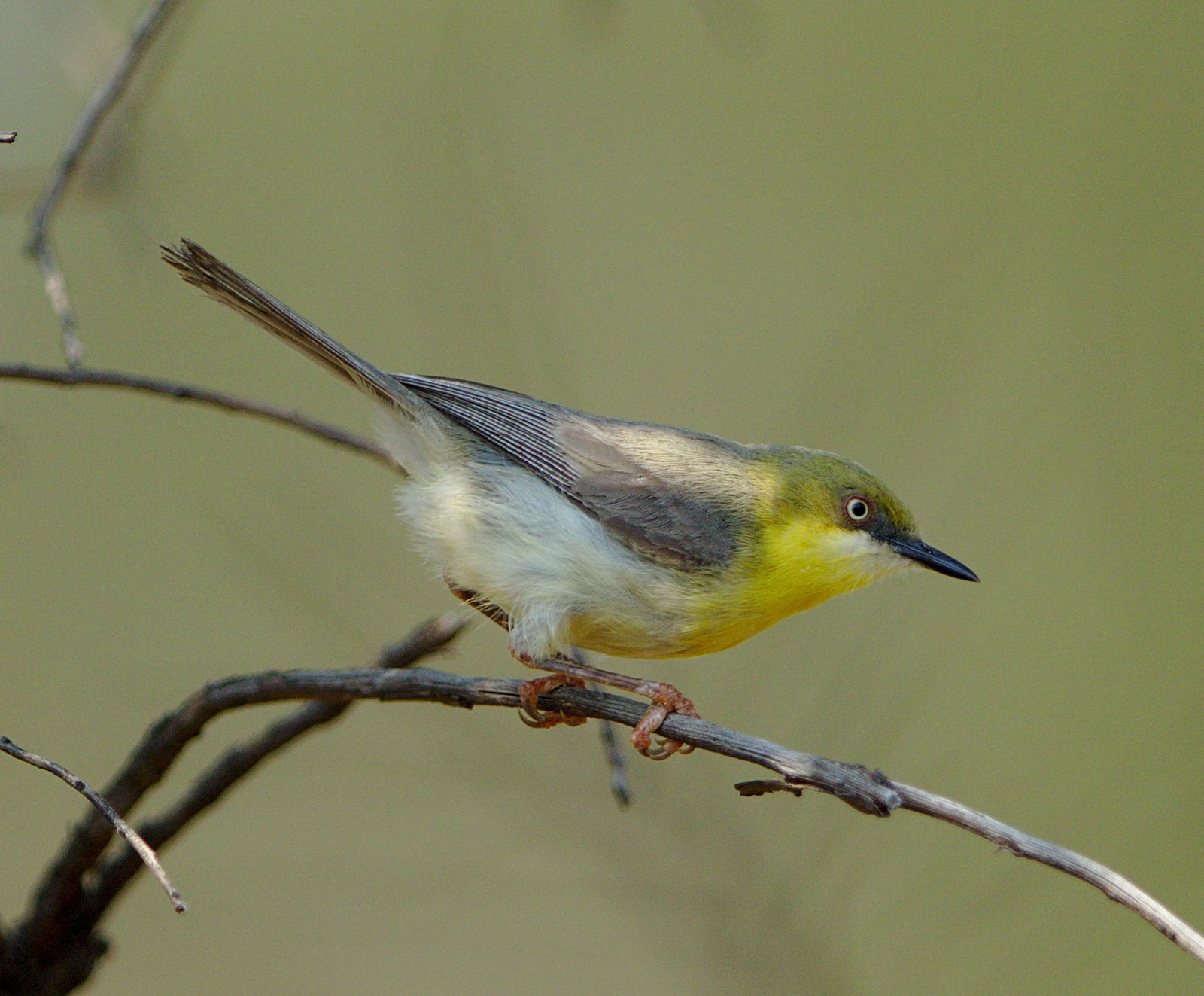
Green-Capped Eremomela is a social canopy bird of broad-leaved woodland: greenish-yellow on the crown and breast, grey on the back, and nearly always in groups of four to ten birds that move through the foliage with continuous twittering. In the region it is most numerous in the miombo of Zimbabwe, Zambia and Mozambique.
Voice
An almost continuous group twittering of high, thin notes, tsip-tsip-chirri-chirri, with fast trills from several birds overlapping. The contact call is a thin tseep. The chorus is often the first sign that a mixed flock is approaching.
Recording: isaac kilusu — CC BY-NC-SA 4.0 · converted to mono · xeno-canto
Identification
11–12 cm. Crown and forehead olive-green to yellowish-green, giving the head a green cap. Face grey, with dark lores and a pale, creamy to yellowish eye. Mantle and back grey, wings and tail grey-brown with greenish edges. Throat and breast lemon-yellow, the belly paler yellowish-white. The tail is medium-length and not cocked. Bill fine and dark, legs grey. The sexes are alike; juveniles are duller, with less yellow and a darker eye.
Confusion species
Yellow-Bellied Eremomela Eremomela icteropygialis has a grey head with no green cap, a white throat and yellow only on the belly, and lives in drier thornveld. Burnt-Necked Eremomela Eremomela usticollis is pale grey-buff with a rufous throat patch and nape. Black-Necked Eremomela Eremomela atricollis of Angola and Zambia has a rufous cap and a black throat band. African Yellow Warbler Iduna natalensis and Willow Warbler Phylloscopus trochilus are larger, not social and lack the contrast between green crown and grey back.
Habitat
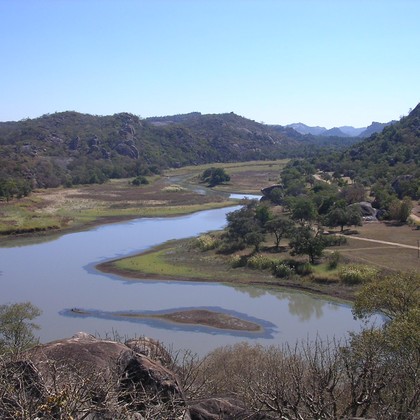
Miombo and other tall broad-leaved woodland, riverine forest along larger rivers and forest edges, especially where the canopy is closed; locally also coastal forest and tall mopane. It forages in the highest layers of the canopy through the outer foliage, almost always in groups and often with hyliotas, tits, crombecs and cuckooshrikes.
Where the bird is most at home, classified by the vegetation units of southern Africa.


Range and movements
In the region in Angola, Zambia, Malawi, central and northern Mozambique and northern and eastern Zimbabwe, with a scarce, local extension to the far north-east of South Africa (northern Kruger and adjacent Limpopo). Beyond, north to Kenya and Uganda, and in Central Africa to Congo-Brazzaville and Gabon.
- Resident
- Summer visitor (c. Oct–Mar)
- Winter visitor (c. Apr–Sep)
- Passage (Mar–Apr, Oct–Nov)
- dark = core range, pale = thinly spread
How and when to look
Best found in the miombo around Harare and Marondera and on the lower slopes of Zimbabwe's Eastern Highlands, or in Zambia in Kafue and the Copperbelt miombo. Listen for the high group twittering and scan the highest branches. Records in South Africa are rare and worth documenting.
Conservation status
Not threatened; widespread and locally common. Because it depends on tall trees and a closed canopy it is sensitive to clearing of miombo and riverine forest, but no clear decline is known.
Scientific name
Eremomela scotops | Sundevall, 1850
Sundevall described the species in 1850 and placed it straight away in the genus where it still stands. He introduced the genus Eremomela in that same work. Eremomela comes from the Greek erēmos, 'desert', and melos, 'song' — 'desert songster', for the arid regions where the first species were found. scotops comes from the Greek skotos, 'darkness', and ōps, 'eye, face' — for the dark lores around the eye. The specimen the first description was based on came from Mohapoani, Witfontein Mountains, North West, South Africa.