All species › Passerines › Crows and jays › House Crow
House Crow | Corvus splendens
Huiskraai | Corneja India
The House Crow originally comes from South Asia and has spread by ship along the coasts of the Indian Ocean. In southern Africa it lives as an alien species in a few port cities, where it depends entirely on people. Because it displaces native birds and raids their nests, it is actively controlled in South Africa.
Voice
A flat, nasal and high kaa-kaa or kwaa, endlessly repeated and a constant din at roosts, especially at dusk. Also a higher, plaintive kraa.
Recording: David Darrell-Lambert — CC BY-NC-SA 4.0 · converted to mono · xeno-canto
Identification
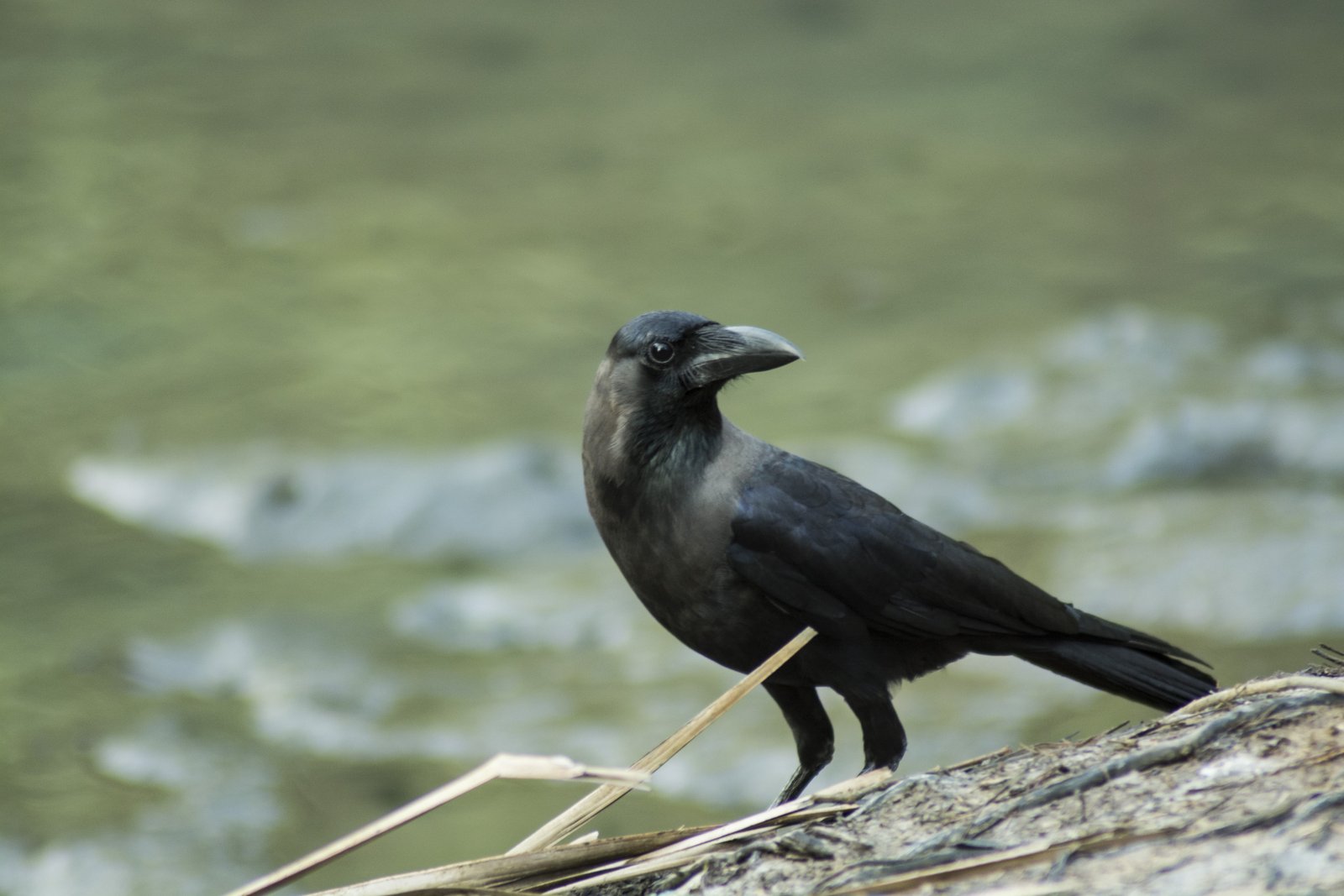
40–43 cm. A slender, fairly small crow with a black forehead, crown, face and throat and a dull grey to grey-brown nape, upper mantle and breast, merging gradually into the black of the back and belly. Wings and tail are black with a blue or green gloss. The bill is heavy and black and the forehead steep. The sexes are alike. Juveniles are duller, with a less contrasting grey collar. The flight is light and agile.
Confusion species
Pied Crow Corvus albus is larger and heavier, with a pure white rather than grey breast and collar. Cape Crow Corvus capensis is larger and all black, with a long, slender bill. At a distance and in poor light it may suggest Fork-Tailed Drongo Dicrurus adsimilis, but that is much smaller and has a forked tail.
Habitat
Only in and around built-up areas: harbours, markets, rubbish dumps, parks, gardens with tall trees and streets with refuse. It eats almost anything: refuse, carrion, insects, fruit, the eggs and young of other birds and small vertebrates. It roosts in large groups in tall trees and nests in treetops and on masts.
Where the bird is most at home, classified by the vegetation units of southern Africa.

Range and movements
In the region only as an introduced species, since the 1970s: in South Africa in and around Durban and in Cape Town, where control programmes have sharply reduced its numbers; in Mozambique in port cities such as Maputo, Beira and Nacala, where it is locally common. Native from Pakistan and India to Sri Lanka and Myanmar; introduced along the East African coast (including Mombasa, Dar es Salaam and Zanzibar), the Red Sea, the Middle East and even the Netherlands.
- Resident
- Summer visitor (c. Oct–Mar)
- Winter visitor (c. Apr–Sep)
- dark = core range, pale = thinly spread
How and when to look
Year-round, often seen around the harbours and markets of Maputo and Beira. In South Africa it has become rare; a sighting there, especially away from Durban and Cape Town, is worth reporting to the local control programmes.
Conservation status
Not threatened, and worldwide one of the most harmful invasive birds. It displaces native species, raids nests, damages crops and can transmit diseases. In South Africa it is officially listed as an invasive species and is controlled by trapping and shooting.
Scientific name
Corvus splendens | Vieillot, 1817
Vieillot described the species in 1817 and placed it straight away in the genus where it still stands. The genus Corvus was introduced in 1758 by Linnaeus. Corvus is the Latin word for 'raven'. splendens is Latin for 'gleaming, glittering', after the sheen of the plumage. The specimen the first description was based on came from Bengal.