All species › Passerines › Buntings › Cabanis's Bunting
Cabanis's Bunting | Emberiza cabanisi
Cabanis' gors | Escribano de Cabanis
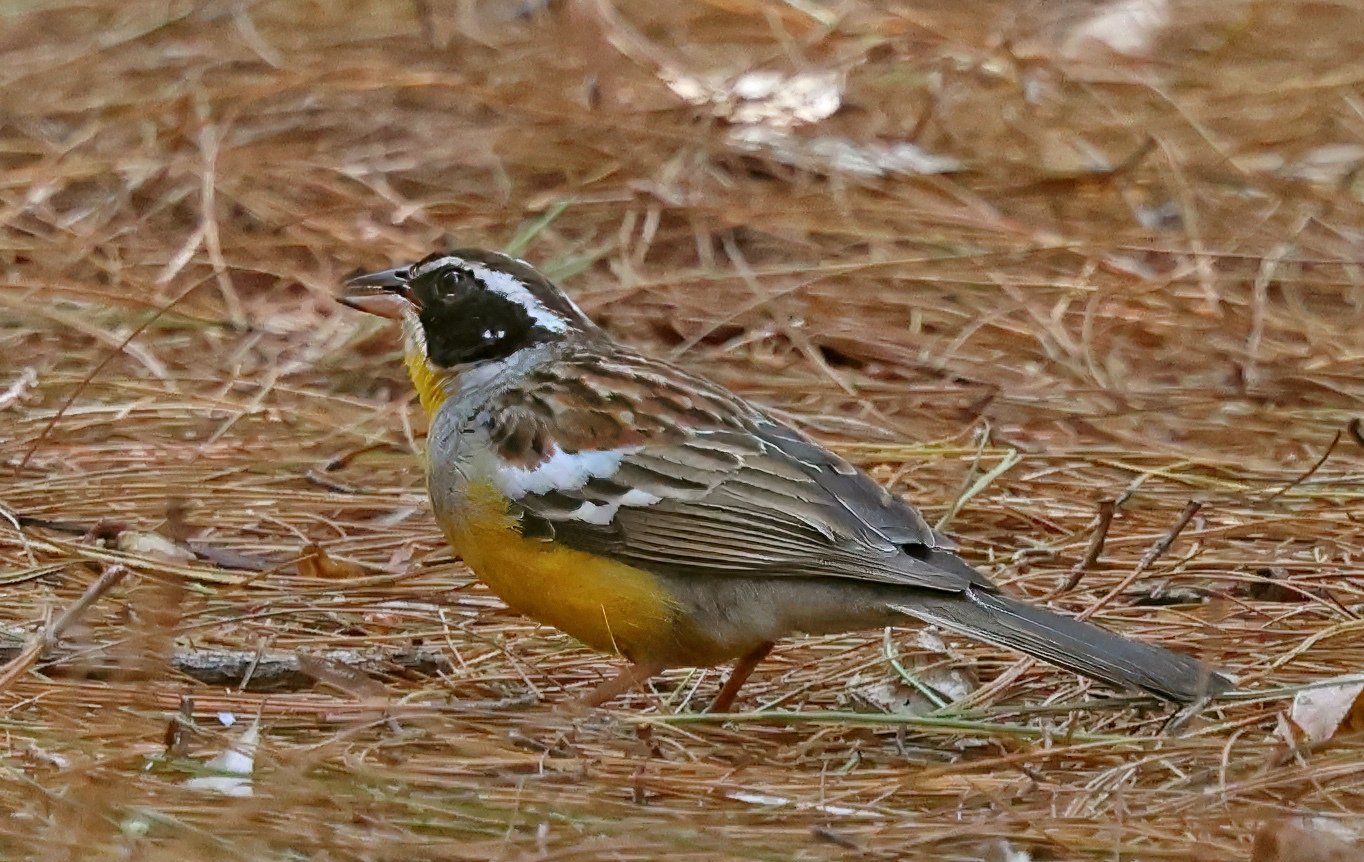
Cabanis's Bunting is the large, quiet bunting of miombo: a yellow-bellied bunting with a black head, a single broad white supercilium and a grey back. It is less conspicuous than Golden-Breasted Bunting and lives mainly in tall, closed woodland on hilly ground in the north and east of the region.
Voice
The song is a fairly slow series of clear whistled notes, chee-chee-cheeu or wee-chidder-chidder, usually from a high branch in the canopy. The call is a soft, falling tchoo or a thin tseet.
Recording: Dries Van de Loock — CC BY-NC-SA 4.0 · converted to mono · xeno-canto
Identification
16–17 cm, the largest bunting in the region, with a stout bill, dark above and pinkish-horn below. The male has a black crown, sometimes with a narrow greyish-white median stripe, a long white supercilium and wholly black lores and cheeks without a white stripe below the eye; the chin and throat are white to pale yellow. The mantle and back are grey with dark streaks, the rump greyish-brown. The wing has a narrow white or pale bar on the greater coverts. The underparts are yellow, slightly deeper yellow on the breast but without orange, with greyish flanks. The outer tail feathers show white. The female is duller, with a brownish-black head and pale yellowish stripes. Juveniles are browner and finely streaked on the breast.
Confusion species
Golden-Breasted Bunting (Emberiza flaviventris) is smaller and has a white stripe below the eye, so that the head shows three white stripes on each side, a chestnut mantle, two clear white wingbars and an orange-yellow breast. Both species occur in the same woodland, so always check the cheek pattern and the colour of the mantle. Cape Bunting (Emberiza capensis) has grey underparts without yellow.
Habitat
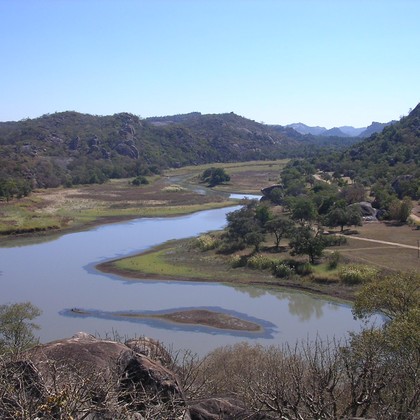
Tall miombo and other closed broadleaf woodland, often on rocky slopes and hills, locally also woodland edges and abandoned fields with trees. It forages on the woodland floor among litter and grass, but sings and rests high in the trees. The nest is placed low in a bush or among grass.
Where the bird is most at home, classified by the vegetation units of southern Africa.

Range and movements
Within the region confined to the north and east: Zambia (widespread), Malawi, central and western Mozambique, northern and eastern Zimbabwe (especially the central plateau and the eastern highlands) and eastern Angola. In South Africa there are only a few uncertain reports from the far north. Beyond the region it occurs in woodland from West and Central Africa to Uganda and Tanzania.
- Resident
- Summer visitor (c. Oct–Mar)
- Winter visitor (c. Apr–Sep)
- Passage (Mar–Apr, Oct–Nov)
- dark = core range, pale = thinly spread
How and when to look
Look for it in well-developed miombo, for example around Harare and in the eastern highlands of Zimbabwe, or in the miombo of Zambia and Malawi. It is often heard first: follow the whistled song up into the canopy. On the ground it moves slowly, and when disturbed it sits still on a branch for a long time, where the black cheek without a white stripe is the best feature.
Conservation status
Not threatened; fairly common in intact miombo, but sensitive to logging and the conversion of woodland to cropland, and it has declined locally as a result.
Scientific name
Emberiza cabanisi | (Reichenow, 1875)
Reichenow described the species in 1875 as Polymitra (Fringillaria) cabanisi; because it was later moved to another genus, the author and year stand in brackets. The genus Emberiza was introduced in 1758 by Linnaeus. Emberiza comes from Old German Embritz, a name for a bunting. cabanisi honours the German ornithologist Jean Cabanis (1816–1906), curator at the natural history museum in Berlin. The specimen the first description was based on came from Cameroon.