All species › Waterfowl › Ducks and geese › Green-Winged Teal
Green-Winged Teal | Anas crecca
Wintertaling | Cerceta Común
The Green-Winged Teal is the smallest dabbling duck of Eurasia, a fast, agile duck that winters in large numbers south to north-east Africa but almost never reaches the south of the continent. In the region it is a genuine rarity.

Click a thumbnail to switch the photo above.
Voice
The male gives a clear, whistled kreek-kreek, the female a high, nasal quack. Little vocal away from the breeding grounds.
Recording: Stanislas Wroza — CC BY-NC-SA 4.0 · converted to mono · xeno-canto
Identification
34–38 cm, small, with a short neck, a small head and a narrow dark grey bill. The breeding male has a chestnut head with a broad, yellow-bordered green band from the eye to the nape, a finely grey-vermiculated body, a horizontal white stripe along the scapulars and a creamy-yellow triangle on each side of the black undertail. The female and eclipse male are grey-brown with dark scaling, a dark eye-stripe and a pale streak at the side of the tail. Flight is fast and twisting, showing a green speculum bordered broadly white in front and narrowly white behind.
Confusion species
Female Garganey Spatula querquedula have a more strongly striped head with a pale spot at the bill base and a greyish forewing in flight. Blue-Billed Teal Spatula hottentota has a blue bill, a dark cap and a dark ear spot. Cape Teal Anas capensis is larger and paler, with a pink bill.
Habitat
Shallow fresh waters with dense fringing vegetation: marshes, vleis, flooded grassland, pans and sewage ponds. It feeds by dabbling in mud and shallow water, mainly on seeds and small invertebrates. Vagrants usually associate with other small ducks.
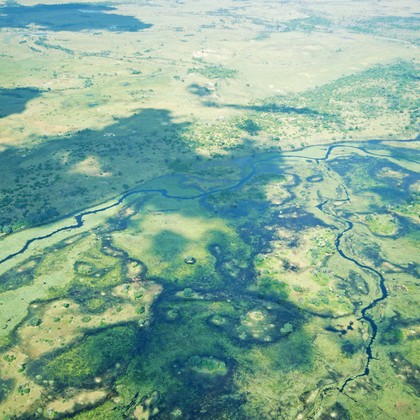
Where the bird is most at home, classified by the vegetation units of southern Africa.
Range and movements
Only a handful of records in the region, including from Zambia and South Africa; some sightings may involve escapes from captivity. It breeds across northern Europe and Asia and winters in western Europe, the Mediterranean, southern Asia and in Africa south to the Sahel and East Africa, rarely south of Kenya.
How and when to look
A sighting in the region is of national importance; note the details of head, scapulars and wing pattern and take photographs in flight if possible. The best chance is on floodplains in northern Zambia and Malawi, among flocks of Garganeys.
Conservation status
Not globally threatened, with a very large range and population. In the region a vagrant of no conservation concern.
Scientific name
Anas crecca | Linnaeus, 1758
Linnaeus described the species in 1758 and placed it straight away in the genus where it still stands. He introduced the genus Anas in that same work. Anas is the Latin word for 'duck'. crecca comes from kricka, the Swedish name for the bird, an imitation of the male's call. The specimen the first description was based on came from Sweden.