All species › Passerines › Waxbills › Green-Winged Pytilia
Green-Winged Pytilia | Pytilia melba
Melba-astrild | Estrilda Melba
The Green-Winged Pytilia is a colourful waxbill of dry thornveld, with a red face, olive-green wings and finely barred underparts. It is the host of the Long-Tailed Paradise Whydah, whose males mimic its song.

Click a thumbnail to switch the photo above.
Voice
A short, dry wick or chik as a contact call. The song is a varied, fairly long series of whistles, trills and clicks, starting with a few high notes and ending in a falling rattle, cheet-cheet-tsirrrrr-chuk. Males of the Long-Tailed Paradise Whydah copy this song almost exactly.
Recording: Dries Van de Loock — CC BY-NC-SA 4.0 · converted to mono · xeno-canto
Identification
12–13 cm, with a red, fairly long conical bill. The male has a scarlet forehead, face and throat, a grey crown and nape, olive-green back and wings, and a dark red rump and tail. Below the red lies a golden-olive breast band; the rest of the underparts are grey, densely barred and spotted white, becoming white on the belly. The female lacks red on the face: the head is plain grey and the underparts are barred grey and white up to the breast, but rump, tail and bill are red as well. Juveniles are duller, with an olive-grey breast and hardly any barring.
Confusion species
Orange-Winged Pytilia (Pytilia afra) has broad orange edges to the flight feathers, so that the closed wing shows an orange panel; in the male the red mask is smaller, the throat grey and the bill shorter. That species lives mainly in miombo and broadleaved woodland, not in thornveld. Females are separated on the wing: green in Green-winged, orange-edged in Orange-winged. Firefinches (Lagonosticta) are smaller, lack the green and are not barred.
Habitat
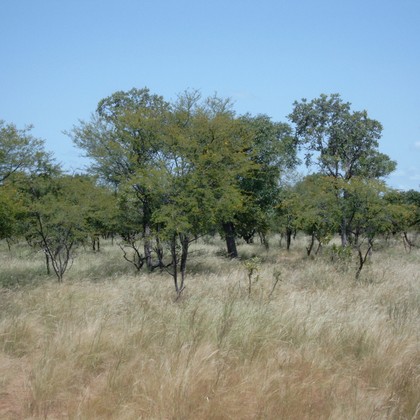
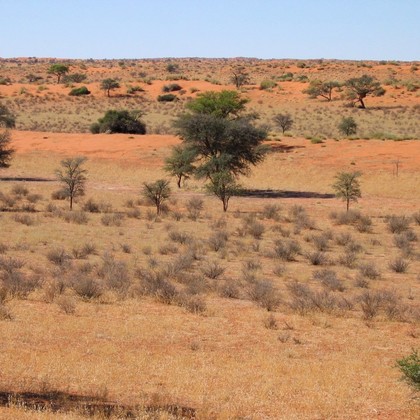
Dry acacia savanna, thornveld and Kalahari thornveld with dense bushes and a grassy understorey, often in tangled thorn scrub, along dry riverbeds and at waterholes. It forages in pairs or small family groups on the ground, usually close to cover, for grass seeds, termites and other small insects.
Where the bird is most at home, classified by the vegetation units of southern Africa.
Range and movements
Widespread in the northern half of the region: northern and central Namibia, almost all of Botswana, Zimbabwe, southern and western Mozambique, Eswatini and in South Africa Limpopo, Mpumalanga, Gauteng, North West, northern KwaZulu-Natal and the northern Northern Cape; also southern Zambia, southern Malawi and southern and western Angola. Beyond the region through East Africa to Ethiopia and Somalia and across the Sahel west to Senegal.
- Resident
- Summer visitor (c. Oct–Mar)
- Winter visitor (c. Apr–Sep)
- Passage (Mar–Apr, Oct–Nov)
- dark = core range, pale = thinly spread
How and when to look
At waterholes in the thornveld of Kruger, Pilanesberg, Etosha and the Kalahari, pairs come low out of the bushes to drink in the morning. If you see a Long-Tailed Paradise Whydah, look nearby for Green-Winged Pytilias. A singing male is often found in the heat of the day only by following the song; bear in mind that the paradise whydah may deliver the same song.
Conservation status
Not threatened; common with stable numbers. It is trapped for the cage-bird trade, but as far as known this has no noticeable effect on the population in the region. It is parasitised by the Long-Tailed Paradise Whydah, which lays its eggs in the nest without removing the pytilia's eggs or young.
Scientific name
Pytilia melba | (Linnaeus, 1758)
Linnaeus described the species in 1758 as Fringilla Melba; because it was later moved to another genus, the author and year stand in brackets. The genus Pytilia was introduced in 1837 by Swainson. Pytilia is a diminutive of Pitylus, a genus name introduced by Cuvier for grosbeaks — thus 'little grosbeak'. Linnaeus gave no explanation for melba; it may be a supposed Chinese word or place name, as the specimen was wrongly thought to come from China. The specimen the first description was based on came from Luanda, Angola (originally given in error as 'China').