All species › Waders, gulls and terns › Painted-snipes › Greater Painted-Snipe
Greater Painted-Snipe | Rostratula benghalensis
Goudsnip | Aguatero Bengalí
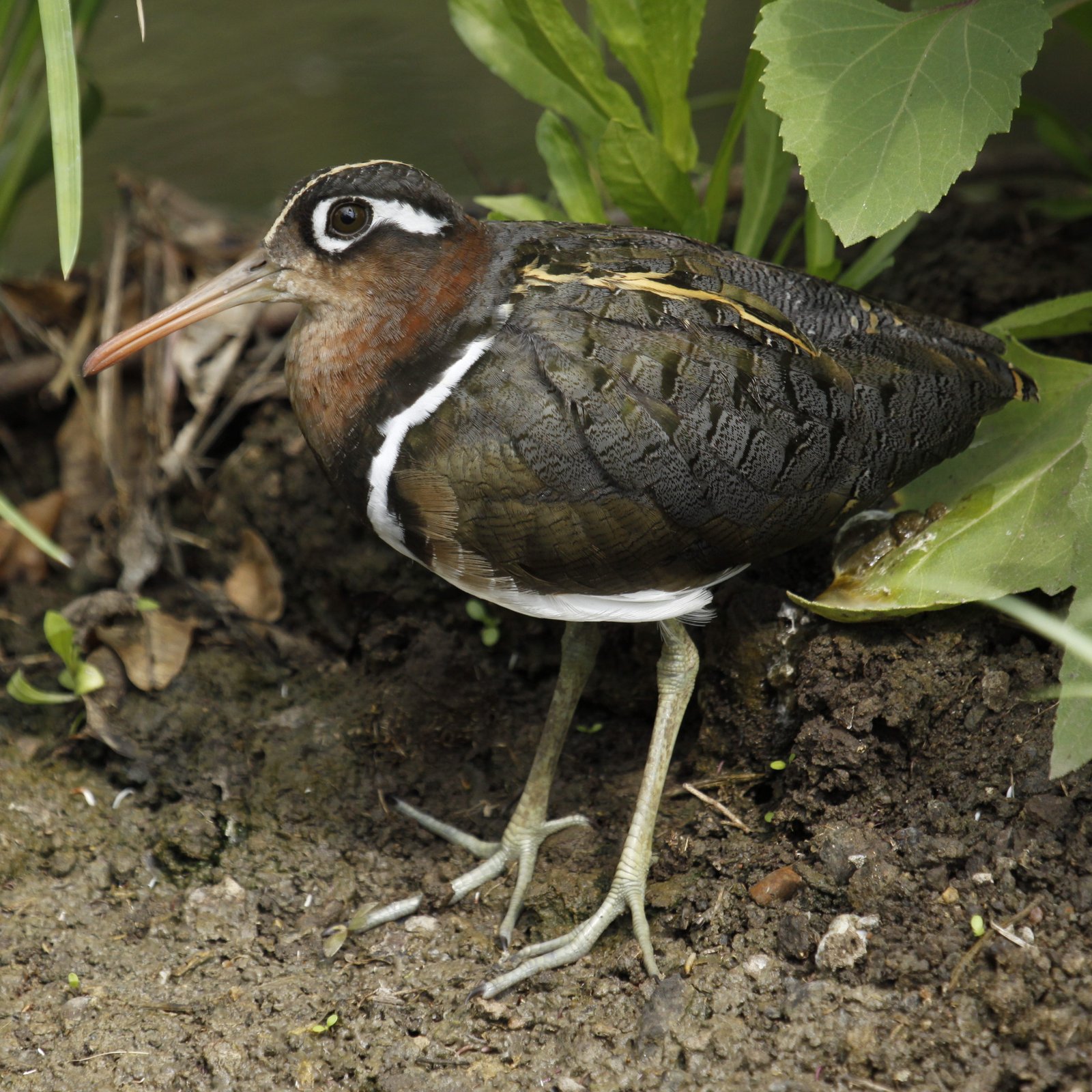
The Greater Painted-Snipe is a shy, snipe-like wader of densely vegetated marsh edges, with a striking white spectacle and a white band that curves like a brace over the shoulder. The roles are reversed: the female is larger and more brightly marked, displays and calls, while the male incubates and raises the young.
Voice
Usually silent. In display, often at dusk or at night, the female gives a series of soft, hollow notes like blowing across a bottle: wook wook wook, repeated up to twenty times. Flushed birds sometimes give a short, harsh kek.
Recording: Greg Irving — CC BY-NC-SA 4.0 · converted to mono · xeno-canto
Identification
24–28 cm. The female has a dark chestnut head, neck and breast, a white eye-ring extending backwards as a stripe, and a bronze-green back finely barred black. A black breast band separates the breast from the white belly, and a white band runs up from the flank over the shoulder. The male is smaller and duller, grey-brown with golden-buff spots on the wing coverts and a buff eye-ring. In both sexes the long bill droops slightly with a swollen tip, and the legs are greenish. In flight the wings are broad and rounded with rows of golden-buff spots, and the legs dangle, as in a rail.
Confusion species
African Snipe Gallinago nigripennis and Common Snipe Gallinago gallinago have a much longer, straight bill, head stripes rather than a spectacle, and a fast zigzag flight. Great Snipe Gallinago media is heavier, with white tail corners and heavily spotted underparts. No other wader in the region combines the white spectacle with the white shoulder brace.
Habitat
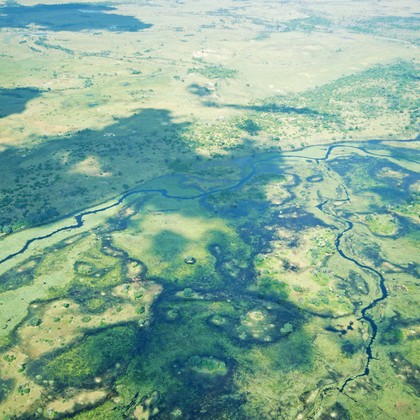
Shallow, densely vegetated edges of freshwater marshes, vleis, flooded grassland, rice fields, dams and sewage works, where mud, shallow water and low vegetation intermix. It forages mainly at dusk, probing the mud for worms, insect larvae, snails and seeds. The nest is a cup of plant material on a tussock or floating in dense vegetation.
Where the bird is most at home, classified by the vegetation units of southern Africa.
Range and movements
Over much of the region, but irregular and dependent on rainfall: most frequent in the Okavango Delta and the rest of northern Botswana, Zambia, Zimbabwe, Malawi, Mozambique, northern Namibia and Angola, and in eastern and northern South Africa and Eswatini. Scarce in western and southern South Africa and in Lesotho, and rare in the dry parts of Namibia. Beyond the region it occurs across much of sub-Saharan Africa, in Egypt, on Madagascar and in South and Southeast Asia.
- Resident
- Summer visitor (c. Oct–Mar)
- Winter visitor (c. Apr–Sep)
- Passage (Mar–Apr, Oct–Nov)
- dark = core range, pale = thinly spread
How and when to look
A bird to search for rather than wait for: in the early morning, or from a raised bank, scan vlei edges where mud meets low sedges. The bird often stands motionless with the head drawn in and is betrayed only by the white spectacle. After good rains it appears at newly flooded sites, sometimes several pairs together; once the water dries up it is gone again.
Conservation status
Not threatened, but irregular and fairly scarce in southern Africa. The species depends on shallow, vegetated wetlands, which are lost to drainage, overgrazing and dams. Because of its nomadic habits, local numbers fluctuate strongly from year to year.
Scientific name
Rostratula benghalensis | (Linnaeus, 1758)
Linnaeus described the species in 1758 as Rallus benghalensis; because it was later moved to another genus, the author and year stand in brackets. The genus Rostratula was introduced in 1816 by Vieillot. Rostratula is a diminutive of the Latin rostratus, 'beaked, large-billed', from rostrum, 'beak', for the long bill of these snipe-like birds. benghalensis means 'from Bengal', after the region in the north-east of the Indian subcontinent. The specimen the first description was based on came from Asia.