All species › Waders, gulls and terns › Sandpipers and snipes › Common Sandpiper
Common Sandpiper | Actitis hypoleucos
Oeverloper | Andarríos Chico
The Common Sandpiper is the wader most often seen alone: a small, brownish-grey bird that walks the edge of a river, dam or rocky shore with its rear end constantly bobbing. It breeds in Europe and Asia and in the southern summer is found across almost all of southern Africa, both inland and on the coast.

Voice
A high, thin and piercing swee-dee-dee, usually on take-off, in quick series of three to five notes. Also a single fluty swee-eet as a contact call.
Recording: Astrid Cervantes — CC BY-NC-SA 4.0 · converted to mono · xeno-canto
Identification
19–21 cm. Plain olive-brown above with fine dark barring on the coverts, white below. The brown breast sides are sharply demarcated from the white belly, which extends upward as a white hook in front of the bend of the wing, the best feature of the perched bird. The bill is short, straight and dark, the legs greenish-grey to yellowish. A pale supercilium and a dark eye stripe. It constantly bobs its rear and head. The flight is characteristic: low over the water, with stiff, flickering wingbeats alternating with short glides on bowed wings, showing a clear white wingbar and white tail sides.
Confusion species
Wood Sandpiper Tringa glareola is longer-legged, with spangled upperparts, a white rump and no white wingbar. Green Sandpiper Tringa ochropus is darker above with a conspicuous white rump and a black underwing. Terek Sandpiper Xenus cinereus has a long, upturned bill and orange legs and lacks the white hook in front of the wing.
Habitat
Almost any waterside: rocky river banks, dams, pans, sewage works, estuaries, mangroves and rocky shores. It avoids large open mudflats and prefers to forage along a narrow, varied shoreline. Usually solitary and territorial, also on the wintering grounds.
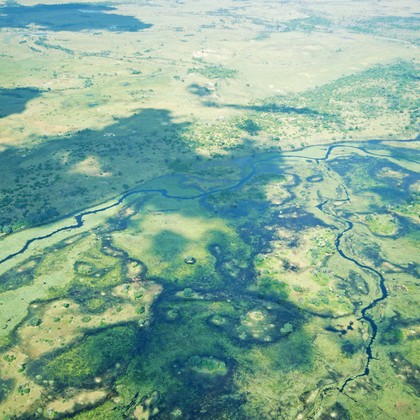
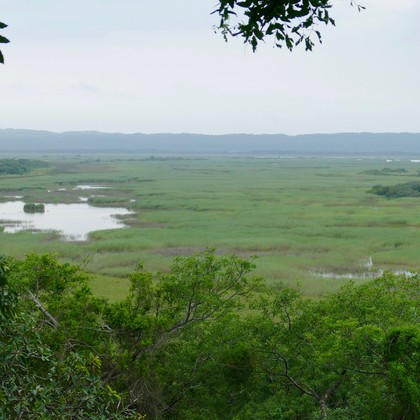
Where the bird is most at home, classified by the vegetation units of southern Africa.
Range and movements
Throughout the region: South Africa, Lesotho, Eswatini, Namibia, Botswana, Zimbabwe, Mozambique, Zambia, Malawi and Angola; most numerous along rivers and dams in the north and east, scarce in the driest parts of the Namib and Kalahari where surface water is lacking. It winters across almost all of sub-Saharan Africa, and also in southern Asia and Australia. It breeds from western Europe to Japan.
- Resident
- Summer visitor (c. Oct–Mar)
- Winter visitor (c. Apr–Sep)
- Passage (Mar–Apr, Oct–Nov)
- dark = core range, pale = thinly spread
How and when to look
In the southern summer walk along a rocky river bank or dam wall: the Common Sandpiper usually flies off low over the water with a high call and lands a few tens of metres further on. The bobbing rear gives it away from afar. It is often present at small waterholes in game reserves where other waders are absent.
Conservation status
Not threatened and common in southern Africa. In parts of the European breeding range numbers are falling through riverside recreation and river regulation. On the wintering grounds the species benefits from farm dams and sewage works.
Scientific name
Actitis hypoleucos | (Linnaeus, 1758)
Linnaeus described the species in 1758 as Tringa Hypoleucos; because it was later moved to another genus, the author and year stand in brackets. The genus Actitis was introduced in 1811 by Illiger. Actitis is Greek, from aktitēs, 'coast-dweller', from aktē, 'coast'. hypoleucos is Greek for 'white beneath', from hupo, 'beneath', and leukos, 'white'. The specimen the first description was based on came from Sweden.