All species › Woodpeckers and allies › Honeyguides › Greater Honeyguide
Greater Honeyguide | Indicator indicator
Grote honingspeurder | Indicador Grande
The Greater Honeyguide is the bird that leads people to bees' nests: with an excited chatter it flies ahead of its follower to the hive and waits there until it has been broken open, then eats the wax and larvae. It is also a brood parasite that lays its eggs in the nests of hole-nesting birds.
Voice
From a fixed call site high in a tree the male gives an endlessly repeated, loud vic-tor or whit-purr. When guiding it utters a dry, sustained chatter, chitter-chitter, like a half-full matchbox being shaken, alternating with short flights to the next tree.
Recording: GABRIEL LEITE — CC BY-NC-SA 4.0 · converted to mono · xeno-canto
Identification
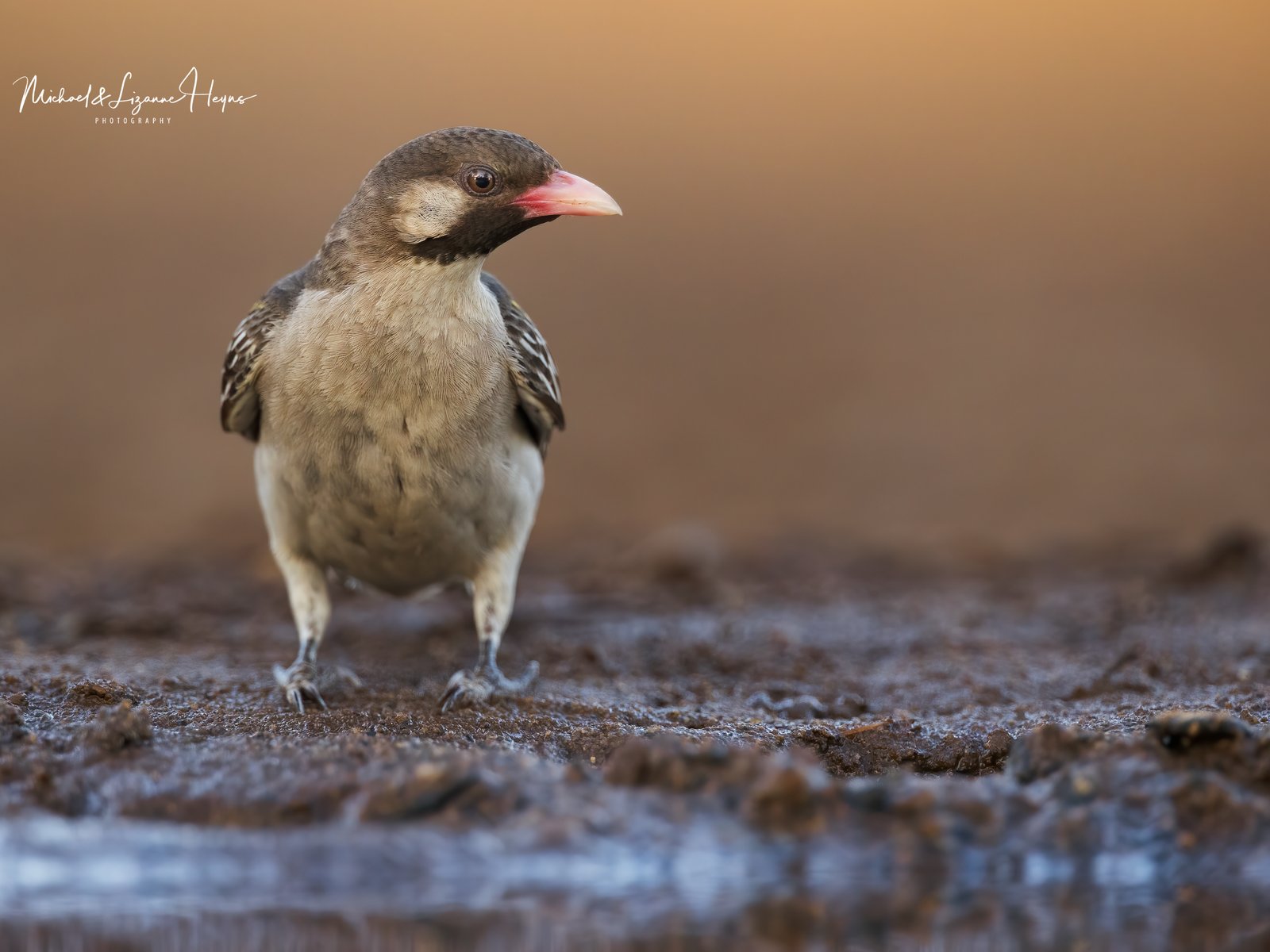
About 20 cm, with a short thick bill and white outer tail feathers that show in flight. The male has a black throat, a white ear patch, a pink bill and grey-brown upperparts with a small yellow shoulder patch; the underparts are dirty white. The female is plain grey-brown above and pale below, without black on the head, and has a dark bill. The juvenile is very different: olive-brown above with a bright golden-yellow throat and breast, and is often taken for another species.
Confusion species
Scaly-Throated Honeyguide (Indicator variegatus) is the same size but olive-green above, with a scaled or spotted throat and breast. Lesser Honeyguide (Indicator minor) is smaller, with a grey head, a black malar stripe and an olive-green back. The black-throated, pink-billed male is unmistakable; the plain female is known by its bulky build, white tail sides and pale, unstreaked underparts.
Habitat
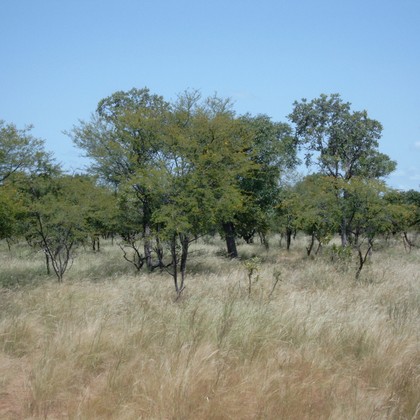
Open woodland, thornveld, miombo and savanna with large trees, down to plantations and well-wooded farmland; it avoids closed forest and true desert. It eats wax, bee larvae and insects. A brood parasite of hole-nesters such as bee-eaters, barbets, wood-hoopoes, hoopoes and starlings; the chick kills its nestmates with a sharp bill hook.
Where the bird is most at home, classified by the vegetation units of southern Africa.


Range and movements
Across most of the region: Angola, Zambia, Malawi, Mozambique, Zimbabwe, northern and eastern Botswana, northern Namibia, Eswatini and northern and eastern South Africa to the Eastern Cape. Absent from the Namib, most of the Karoo and the dry west coast. Beyond the region across almost all of sub-Saharan Africa outside the rainforest.
- Resident
- Summer visitor (c. Oct–Mar)
- Winter visitor (c. Apr–Sep)
- Passage (Mar–Apr, Oct–Nov)
- dark = core range, pale = thinly spread
How and when to look
The guiding chatter is most evident between June and September, when bee colonies hold much wax and brood. Follow the sound and the bird flies ahead from tree to tree, its white-edged tail spread. The calling male uses the same song tree year after year, so it can reliably be found there again.
Conservation status
Not threatened and widespread. Guiding behaviour disappears where people take honey from hives rather than wild nests, as in much of South Africa; in northern Mozambique, Zambia and Tanzania the partnership with honey-hunters is still very much alive.
Scientific name
Indicator indicator | (Sparrman, 1777)
Sparrman described the species in 1777 as Cuculus indicator; because it was later moved to another genus, the author and year stand in brackets. The genus Indicator was introduced in 1815 by Stephens. Indicator is Latin for 'pointer, informer' — for the famous behaviour of the Greater Honeyguide, which leads people to bees' nests. indicator is Latin for 'pointer, informer' — for its habit of leading people to bees' nests. The specimen the first description was based on came from Great Fish River near Somerset East, Eastern Cape, South Africa.