All species › Pelicans, herons and ibises › Pelicans › Great White Pelican
Great White Pelican | Pelecanus onocrotalus
Roze pelikaan | Pelícano Común
The Great White Pelican is the largest pelican in the region: a white giant with black primaries, a long bill with a yellow pouch and, in the breeding season, a pink flush over the plumage. It often fishes in groups that cooperate in a semicircle to drive fish into shallow water.

Voice
Almost silent away from the colony. In the colony it gives deep grunting and mooing sounds, mmmoo, and a low groaning; chicks beg with a hoarse bleating.
Recording: Bram Piot — CC BY-NC-SA 4.0 · converted to mono · xeno-canto
Identification
140–180 cm, wingspan 2.7 to 3.6 metres; the male is clearly larger than the female. Adults are white with a salmon-pink wash and a short drooping crest when breeding, and a yellow patch on the breast. The bill is blue-grey with a red edge and nail, the pouch yellow, the bare skin around the eye pink to orange, the legs pink to orange-yellow. The feathering on the forehead ends in a sharp point towards the bill. In flight the flight feathers are wholly black above and below and contrast sharply with the white underwing coverts. Juveniles are brown and become adult via dirty white over three to four years. It flies with the neck retracted, in V-formations or soaring in high circles.
Confusion species
The Pink-Backed Pelican Pelecanus rufescens is smaller and greyer, with a pink-tinged back, a pale pinkish-yellow bill and, in flight, a greyish underwing with much less contrast between coverts and flight feathers. Juvenile Great White Pelicans are browner than Pink-backed but already show the dark rear half of the underwing. At distance a flying flock can suggest White Stork Ciconia ciconia, but that species flies with neck and legs outstretched.
Habitat
Large shallow lakes, dams, salt pans, lagoons, estuaries and sheltered coastal bays. It fishes by day in groups, beating the water together with the bills to encircle fish, and scoops prey up with the pouch. It breeds in dense ground colonies on islands or in remote pans whenever water and fish are plentiful.
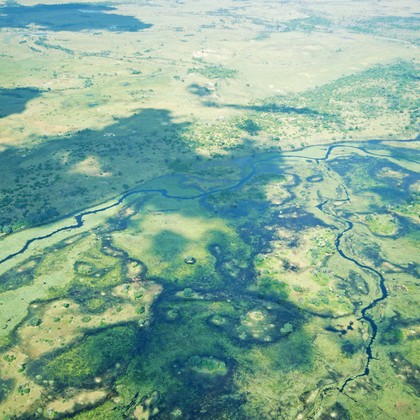
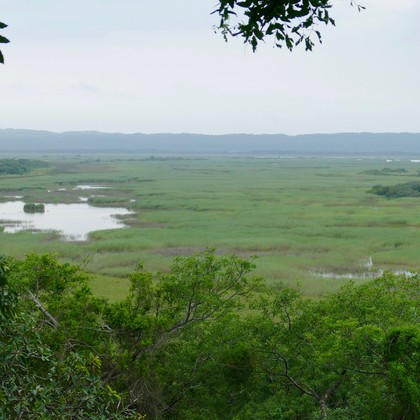
Where the bird is most at home, classified by the vegetation units of southern Africa.

Range and movements
Locally common along the coast and on large waters in Namibia (Walvis Bay, Sandwich Harbour, Etosha) and in South Africa, with breeding colonies on Dassen Island in the Western Cape and at Lake St Lucia in KwaZulu-Natal; in Botswana on the Makgadikgadi Pans and Lake Ngami, where it breeds in large numbers after good rains. More scattered in Zimbabwe, Mozambique, Zambia and Malawi and along the coast of Angola; absent from the dry interior without open water. Beyond the region in eastern and western Africa, and from south-eastern Europe and Asia Minor to Central Asia and India.
- Resident
- Summer visitor (c. Oct–Mar)
- Winter visitor (c. Apr–Sep)
- Passage (Mar–Apr, Oct–Nov)
- dark = core range, pale = thinly spread
How and when to look
Look for flocks on the Walvis Bay lagoon or on the Makgadikgadi Pans after a wet summer. A flock rising on a thermal is a conspicuous sight; check then for the black flight feathers against the white underwing to separate it from Pink-Backed Pelican.
Conservation status
Not threatened and numerous worldwide. In the region it is vulnerable to the drying of breeding pans, disturbance of colonies, poisoning and collisions with power lines. The Dassen Island colony relies on the eggs and chicks of seabirds as supplementary food, so the decline of those colonies affects the pelicans too.
Scientific name
Pelecanus onocrotalus | Linnaeus, 1758
Linnaeus described the species in 1758 and placed it straight away in the genus where it still stands. He introduced the genus Pelecanus in that same work. Pelecanus is the Latin form of the Greek pelekan 'pelican', which itself derives from pelekys 'axe'. onocrotalus is the Latin name of the pelican, taken from the Greek onokrotalos, from onos 'donkey' and krotalon 'rattle': literally 'one who brays like a donkey', for the harsh call. The specimen the first description was based on came from Africa and Asia (later restriction to the Caspian Sea suggested).