All species › Grebes › Grebes › Great Crested Grebe
Great Crested Grebe | Podiceps cristatus
Fuut | Somormujo Lavanco
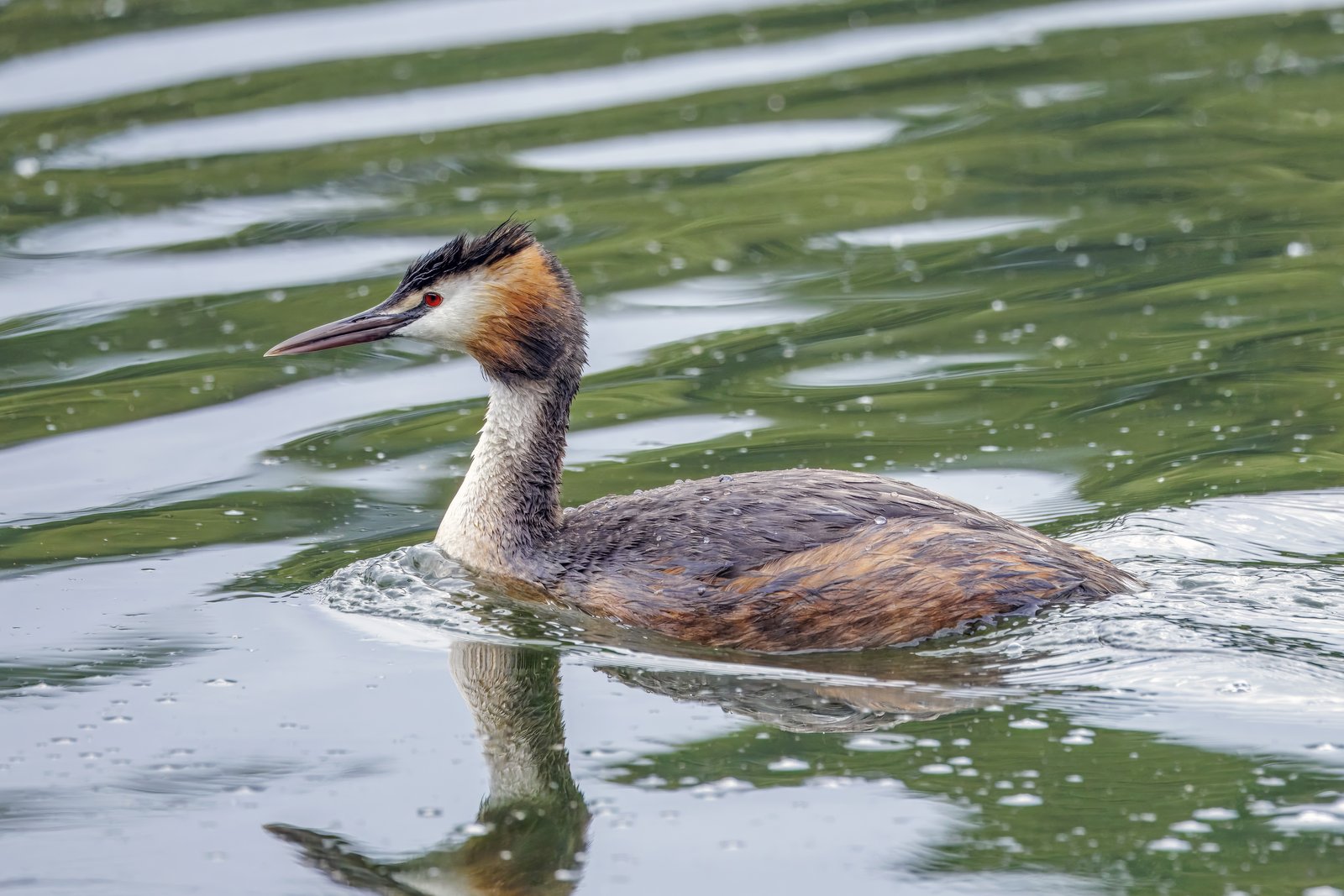
The Great Crested Grebe is the largest grebe of southern Africa, a slender diver with a long white neck, a dark crest and a chestnut ruff. In the region it is far more local than the Little Grebe and is found mainly on large, deep dams of the Highveld and the Cape.
Voice
A harsh, growling, rolling kurr-arr, and during courtship a series of raw, barking and cackling calls. Largely silent outside the breeding season.
Recording: Jarek Matusiak — CC BY-NC-SA 4.0 · converted to mono · xeno-canto
Identification
About 48 cm, long and slim, with a thin straight neck and a dagger-shaped pink bill. Foreneck, cheeks and underparts are silky white, the upperparts grey-brown. In breeding plumage the bird has a dark, double crest and a chestnut, black-edged ruff around the head; African birds keep these adornments for much of the year. Outside the breeding season crest and ruff are smaller, but the white supercilium above the red eye remains. The sexes are alike. Chicks have a black-and-white striped head and neck. In flight the white patches on the leading and trailing edges of the wing are conspicuous.
Confusion species
Black-Necked Grebe (Podiceps nigricollis) and Little Grebe (Tachybaptus ruficollis) are much smaller, with a short neck and a short bill, and lack a ruff. A cormorant or African Darter has a dark body and swims lower; a non-breeding grebe can recall a duck at a distance, but the long straight white neck and dagger bill are decisive.
Habitat
Large, deep and quiet freshwater dams and lakes with a reed fringe, also some coastal lakes and estuaries. It dives for fish, which make up most of the diet, supplemented by frogs, crustaceans and aquatic insects. The floating nest lies among reeds or anchored to submerged branches. The courtship, with head-shaking, rising together from the water and presenting of weed, is one of the celebrated displays of the waterbird world.
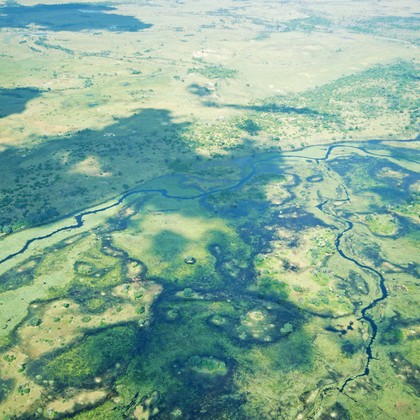
Where the bird is most at home, classified by the vegetation units of southern Africa.
Range and movements
Local and patchy: mainly on the Highveld of Gauteng, Mpumalanga, the Free State and North West, in the Western Cape, the Eastern Cape, inland KwaZulu-Natal and Lesotho; scarce and irregular in Zimbabwe, Namibia, Botswana, Zambia, Malawi and Mozambique, and very local in the Angolan highlands. Beyond the region it breeds from Europe and North Africa across Asia, on the lakes of East Africa and in Australia and New Zealand.
- Resident
- Summer visitor (c. Oct–Mar)
- Winter visitor (c. Apr–Sep)
- Passage (Mar–Apr, Oct–Nov)
- dark = core range, pale = thinly spread
How and when to look
Scan large reservoirs and farm dams on the Highveld, such as Marievale, Bronkhorstspruit and the Free State dams, or the Strandfontein ponds near Cape Town. Courtship is best seen in late winter and early spring. A telescope helps: the birds often sit far from the shore.
Conservation status
Not threatened and numerous worldwide. The small southern African population benefits from reservoirs but suffers from fluctuating water levels, disturbance by boats, drowning in fishing nets and the loss of reed fringes.
Scientific name
Podiceps cristatus | (Linnaeus, 1758)
Linnaeus described the species in 1758 as Colymbus cristatus; because it was later moved to another genus, the author and year stand in brackets. The genus Podiceps was introduced in 1787 by Latham. Podiceps is Latin, from podex, genitive podicis, 'rear end', and pes 'foot', after the legs set far back on the body. cristatus is Latin for 'crested', from crista 'crest'. The specimen the first description was based on came from Sweden.