All species › Grebes › Grebes › Black-Necked Grebe
Black-Necked Grebe | Podiceps nigricollis
Geoorde fuut | Zampullín Cuellinegro
The Black-Necked Grebe is a small, gregarious grebe of saline and brackish waters, with a red eye and, in breeding plumage, a fan of golden feathers behind the eye. In southern Africa it is nomadic and turns up in varying numbers wherever pans and saltworks are at just the right level.

Voice
A soft, whistling, rising poo-eeet and a high, short trill during courtship, mainly in breeding colonies. Almost silent outside the breeding season.
Recording: Julien Piette — CC BY-NC-SA 4.0 · converted to mono · xeno-canto
Identification
About 30 cm, slightly larger and slimmer than the Little Grebe, with a steep forehead, a high crown and a thin, slightly upturned dark bill. The eye is bright crimson. In breeding plumage head, neck and back are black, the flanks rusty and a loose fan of golden-yellow ear tufts spreads behind the eye. Outside the breeding season the bird is black-grey and white: a dark cap reaching below the eye, white throat and cheeks, a grey neck and white underparts. The sexes are alike. It often swims with fluffed-up rear feathers and dives frequently.
Confusion species
Little Grebe (Tachybaptus ruficollis) is smaller and rounder, with a straight bill with a yellow basal patch, a pale eye and a chestnut neck in breeding plumage; in non-breeding plumage it is drab buff, never so crisply black and white. Great Crested Grebe (Podiceps cristatus) is much larger, with a long neck and a dagger-shaped pink bill.
Habitat
Shallow, nutrient-rich saline and brackish pans, saltworks, coastal lagoons, sewage ponds and temporary pools on the Highveld, sometimes also at sea just offshore. It dives for aquatic insects, larvae, brine shrimps and small molluscs. It breeds in colonies with floating nests, often soon after a pan fills following heavy rain.
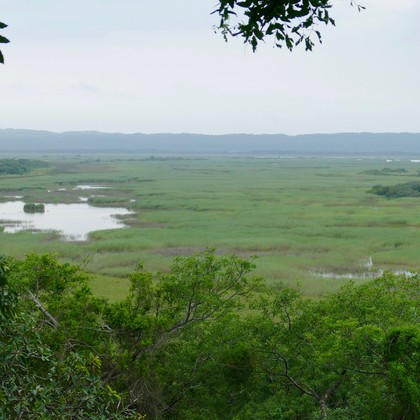
Where the bird is most at home, classified by the vegetation units of southern Africa.


Range and movements
Most numerous in the Western Cape, with large flocks on the Strandfontein ponds, the West Coast saltpans and the Berg River, and on the Namibian coast at the saltworks of Walvis Bay and Swakopmund. Otherwise irregular on pans and dams of the Highveld in Gauteng, the Free State, Mpumalanga and North West, in Lesotho and the Eastern Cape, and sporadic in Botswana and Zimbabwe; very rare further north. Beyond the region in East Africa, Europe, Asia and North America.
- Resident
- Summer visitor (c. Oct–Mar)
- Winter visitor (c. Apr–Sep)
- Passage (Mar–Apr, Oct–Nov)
- dark = core range, pale = thinly spread
How and when to look
The Strandfontein ponds near Cape Town and the Walvis Bay saltworks often hold tens to hundreds of birds all year. On the Highveld it pays to check shallow pans after a wet summer, where breeding colonies can suddenly appear. In non-breeding plumage look for the red eye and the sharply defined black cap.
Conservation status
Not threatened and numerous worldwide. The southern African population is small and fluctuates strongly with rainfall. Problems are the drying out or conversion of pans, changes in saltworks management and disturbance of breeding colonies.
Scientific name
Podiceps nigricollis | Brehm, 1831
Brehm described the species in 1831 and placed it straight away in the genus where it still stands. The genus Podiceps was introduced in 1787 by Latham. Podiceps is Latin, from podex, genitive podicis, 'rear end', and pes 'foot', after the legs set far back on the body. nigricollis is Latin, from niger 'black' and collum 'neck', after the black neck in breeding plumage. The specimen the first description was based on came from Germany.