All species › Passerines › Weavers › Fan-Tailed Widowbird
Fan-Tailed Widowbird | Euplectes axillaris
Roodschouderwidavink | Obispo de Abanico
The Fan-Tailed Widowbird is the short-tailed widowbird of rank grassland and vleis. The breeding male is all black with an orange-red shoulder patch and fans its tail in display flight. Outside the breeding season it looks like a streaky brown sparrow.

Voice
The song is a high, sizzling and scratchy twitter, chee-chee-chizzz, from a tall grass stem or in flight. The call is a sharp chik or a squeaky tseep, often from flocks.
Recording: Rolf A. de By — CC BY-NC-SA 4.0 · converted to mono · xeno-canto
Identification
15–17 cm; the breeding male's tail is barely elongated, so length with and without tail is practically the same. The breeding male is dull black with an orange-red patch on the lesser coverts, bordered below by a narrow cinnamon band on the median coverts; the bill is blue-grey and the tail fairly short and rounded. The female is warm brown with heavy black streaking above, a pale supercilium, light unstreaked to finely streaked underparts and a horn-coloured bill; a faint orange-brown tinge often shows on the shoulder. The non-breeding male resembles the female but is larger and keeps the red shoulder patch. Juveniles resemble the female.
Confusion species
The Long-Tailed Widowbird (Euplectes progne) is much larger; the male has a huge trailing tail and a red shoulder with a broad white lower border. The Red-Collared Widowbird (Euplectes ardens) has a long, narrow tail and red on the throat, not the shoulder. The Marsh Widowbird (Euplectes hartlaubi) of Angola and Zambia has an orange-yellow shoulder and a clearly longer tail. The White-Winged Widowbird (Euplectes albonotatus) and the Yellow Bishop (Euplectes capensis) have yellow shoulders, the former with a white wing patch, the latter with a yellow rump. Females and non-breeding males are often separable in the field only by size, bill shape and the remnant red shoulder; check for accompanying coloured males.
Habitat
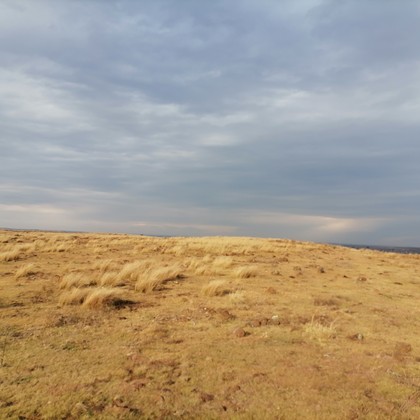
Tall rank grass and reeds in vleis, along rivers and marshes, flooded grassland and the margins of sugarcane and other crops. It breeds in scattered territories in dense grass; the nest is a ball of grass low in the vegetation. It eats mainly grass seeds, also insects.
Where the bird is most at home, classified by the vegetation units of southern Africa.


Range and movements
In eastern South Africa from the Eastern Cape coast through KwaZulu-Natal to Mpumalanga and Limpopo, and in Eswatini, Mozambique, eastern and northern Zimbabwe, the Okavango and Chobe in northern Botswana, the Zambezi Region of Namibia, Zambia, Malawi and Angola. Beyond the region it is widespread in sub-Saharan Africa from West Africa to Ethiopia and East Africa.
- Resident
- Summer visitor (c. Oct–Mar)
- Winter visitor (c. Apr–Sep)
- Passage (Mar–Apr, Oct–Nov)
- dark = core range, pale = thinly spread
How and when to look
Best from December to March, when males in full plumage call from grass stems and make a slow, fluttering display flight over the grass with the tail fanned and plumage puffed out. Sugarcane fields in KwaZulu-Natal and vleis in the eastern lowveld are good places. In non-breeding plumage the flocks consist of female-like birds; a glimpse of the red shoulder is the best feature.
Conservation status
Not threatened. Common to locally abundant; it benefits in part from sugarcane and irrigation, but vleis and wet grasslands are lost locally to drainage and overgrazing.
Scientific name
Euplectes axillaris | (Smith, 1838)
Smith described the species in 1838 as Vidua axillaris; because it was later moved to another genus, the author and year stand in brackets. The genus Euplectes was introduced in 1829 by Swainson. Euplectes joins Greek eu 'fine, good' to New Latin plectes 'weaver'. axillaris is Latin for 'of the armpit', from axilla — for the male's red shoulder patch. The specimen the first description was based on came from Eastern South Africa, some 1,100–1,300 km east of Cape Town.