All species › Tubenoses › Petrels and shearwaters › Fairy Prion
Fairy Prion | Pachyptila turtur
Duifprion | Prión Piquicorto
The Fairy Prion is the smallest and palest of the prions that occur in the region, a blue-grey seabird with a strikingly broad black tail tip. It breeds in small numbers on the Prince Edward Islands and is a scarce winter visitor off the mainland.

Voice
Silent at sea. At the breeding sites a cooing, purring koo-roo-roo and croaking sounds, mainly at night.
Recording: Todd Mark — CC BY-NC-SA 3.0 · converted to mono · xeno-canto
Identification
About 25 cm, a small, compact prion. The upperparts are bright blue-grey with a sharp black M across the wings. The head is pale, with a weak white supercilium and only a faint dark eye-stripe, so the face looks rather plain. The underparts are white, with at most a small grey patch on the side of the breast. The tail has a broad black terminal band covering a third to half of the tail length, broader than in the other prions. The bill is short, blue and narrow. It flies low and twisting over the waves, often in flocks.
Confusion species
Slender-Billed Prion (Pachyptila belcheri) has a bolder face pattern with a broad white supercilium, a weaker M and a narrow black tail band. Antarctic Prion (Pachyptila desolata) and Salvin's Prion (Pachyptila salvini) are larger, with a broader bill, darker sides to the head and a narrower tail band. Blue Petrel (Halobaena caerulea) has a white tail tip.
Habitat
Cool to cold ocean, often over the continental shelf and at fronts. It pecks krill and other small crustaceans from the surface while fluttering and pattering over the water. It breeds in rock crevices, among boulders and on cliffs on subantarctic islands, less in burrows than other prions.
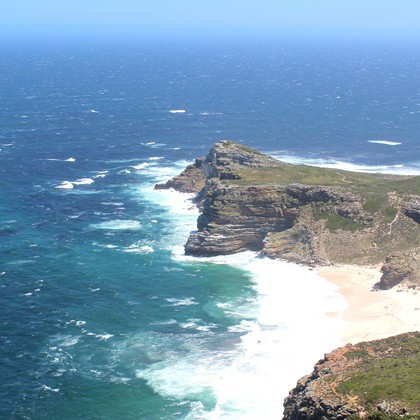
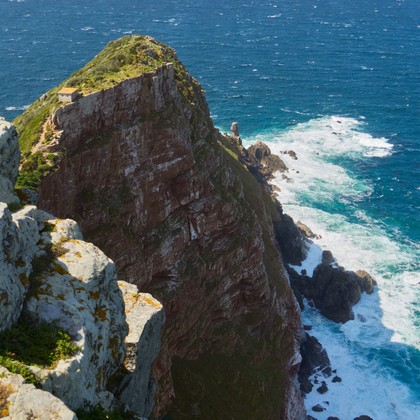
Where the bird is most at home, classified by the vegetation units of southern Africa.
Range and movements
In the region a scarce breeder on Marion and Prince Edward. Off the mainland a scarce winter visitor far off the Western and Southern Cape, sometimes washed ashore after storms. Beyond the region it breeds on the Falklands, South Georgia, the Crozet and Kerguelen islands, islands off Tasmania and New Zealand and the subantarctic islands of the Pacific.
How and when to look
Prions look very similar at sea; a Fairy Prion is best identified by the very broad black tail tip on photographs from above. On winter pelagic trips out of Cape Town it can occur among Antarctic Prions. Dead birds on the tideline can be reliably named by bill width and tail band.
Conservation status
Not threatened; the world population numbers many millions of birds. On Marion the small population is vulnerable to mice and formerly to cats; elsewhere introduced rats are the main threat to colonies.
Scientific name
Pachyptila turtur | (Kuhl, 1820)
Kuhl described the species in 1820 as Procellaria turtur; because it was later moved to another genus, the author and year stand in brackets. The genus Pachyptila was introduced in 1811 by Illiger. Pachyptila comes from the Greek pakhus, 'dense, thick', and ptilon, 'feather' — for the dense, soft plumage of the prions. turtur is Latin for 'turtle dove' — for the soft blue-grey plumage and dove-like appearance. The specimen the first description was based on came from Not given.