All species › Passerines › Larks › Eastern Long-Billed Lark
Eastern Long-Billed Lark | Certhilauda semitorquata
Oostelijke langsnavelleeuwerik | Alondra de Transvaal
The Eastern Long-Billed Lark is the long-billed lark of the grasslands on the eastern highveld: a warm rufous-brown bird with a fairly long, decurved bill and a long tail, living on rocky, grassy slopes. It is smaller, more rufous and less streaked than its western relatives. The species is endemic to eastern South Africa, Lesotho and Eswatini.

Voice
In display the male climbs and then drops with closed wings to a long, descending whistle, pheeeeeoo, much like that of the other long-billed larks. It also sings from a rock or termite mound. The call is a short, whistled tcheep.
Recording: Maarten Sluijter — CC BY-NC-SA 4.0 · converted to mono · xeno-canto
Identification
17–20 cm; the male is larger than the female. The bill is fairly long and slightly decurved, shorter than in Karoo and Cape Long-Billed Larks. The head shows a pale supercilium and a dark eye-stripe; the throat is white. Upperparts are warm rufous-brown with dark centres, less heavily streaked than in the western species. Underparts are plain warm buff to rufous with at most fine streaks on the upper breast; a dark patch at the breast sides sometimes forms a half-collar, to which the scientific name refers. The tail is long and dark with pale outer edges.
Confusion species
Karoo Long-Billed Lark Certhilauda subcoronata is larger, with a longer bill and heavily streaked breast, and lives in the Karoo; in the transition zone of the eastern Karoo, range is the main clue. Rufous-Naped Lark Corypha africana has a small crest, a shorter and heavier bill and much rufous in the wing. Short-Clawed Lark Certhilauda chuana lives in flat thorn savanna and has a shorter bill and a bold white supercilium. Richard's Pipit Anthus richardi and other pipits have a thin straight bill and wag the tail.
Habitat
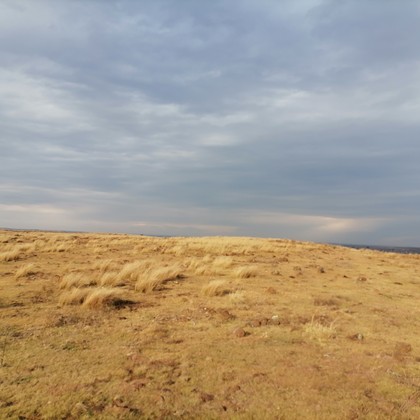
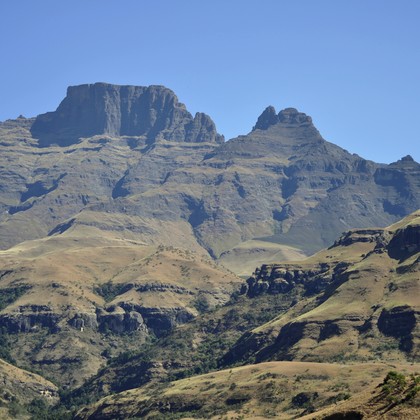
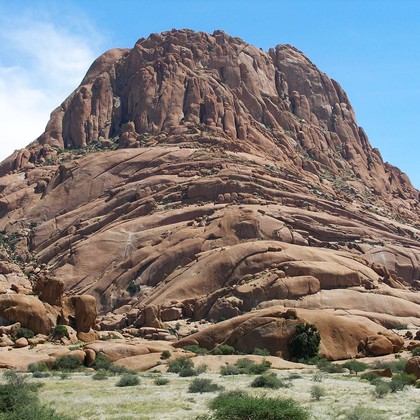
Rocky slopes and plateaus with short to medium grass on the highveld and in the montane grassland of the Drakensberg and adjacent ranges, mostly above 1000 metres and often on burnt or grazed slopes. It forages on the ground for insects, especially termites and larvae, and seeds.
Where the bird is most at home, classified by the vegetation units of southern Africa.
Range and movements
Endemic to eastern southern Africa: in South Africa from the interior of the Eastern Cape north through the eastern Free State, the KwaZulu-Natal interior and Mpumalanga into Gauteng and Limpopo; also in Lesotho and the western highlands of Eswatini.
- Resident
- Summer visitor (c. Oct–Mar)
- Winter visitor (c. Apr–Sep)
- dark = core range, pale = thinly spread
How and when to look
Year-round; search rocky, grassy slopes, for example around Wakkerstroom and Dullstroom, in the Golden Gate Highlands or along Sani Pass. Early in the morning and in spring (August–November) the display flight is the best lead. Note the rufous, unstreaked underparts and the somewhat shorter bill.
Conservation status
Not threatened; fairly common in suitable grassland. Conversion of grassland to plantations and cropland and mining on the highveld remove habitat locally.
Scientific name
Certhilauda semitorquata | Smith, 1836
Smith described the species in 1836 and placed it straight away in the genus where it still stands. The genus Certhilauda was introduced in 1827 by Swainson. Certhilauda combines Certhia, 'treecreeper', with Alauda, 'lark' — a lark with a long, decurved bill like a treecreeper's. semitorquata is Latin for 'half-collared', from semi, 'half', and torquatus, 'collared' — for the pale band on the side of the neck. The specimen the first description was based on came from Eastern Cape Colony and the Orange River area (unspecified).