All species › Passerines › Weavers › Eastern Golden Weaver
Eastern Golden Weaver | Ploceus subaureus
Goudwever | Tejedor Dorado Africano
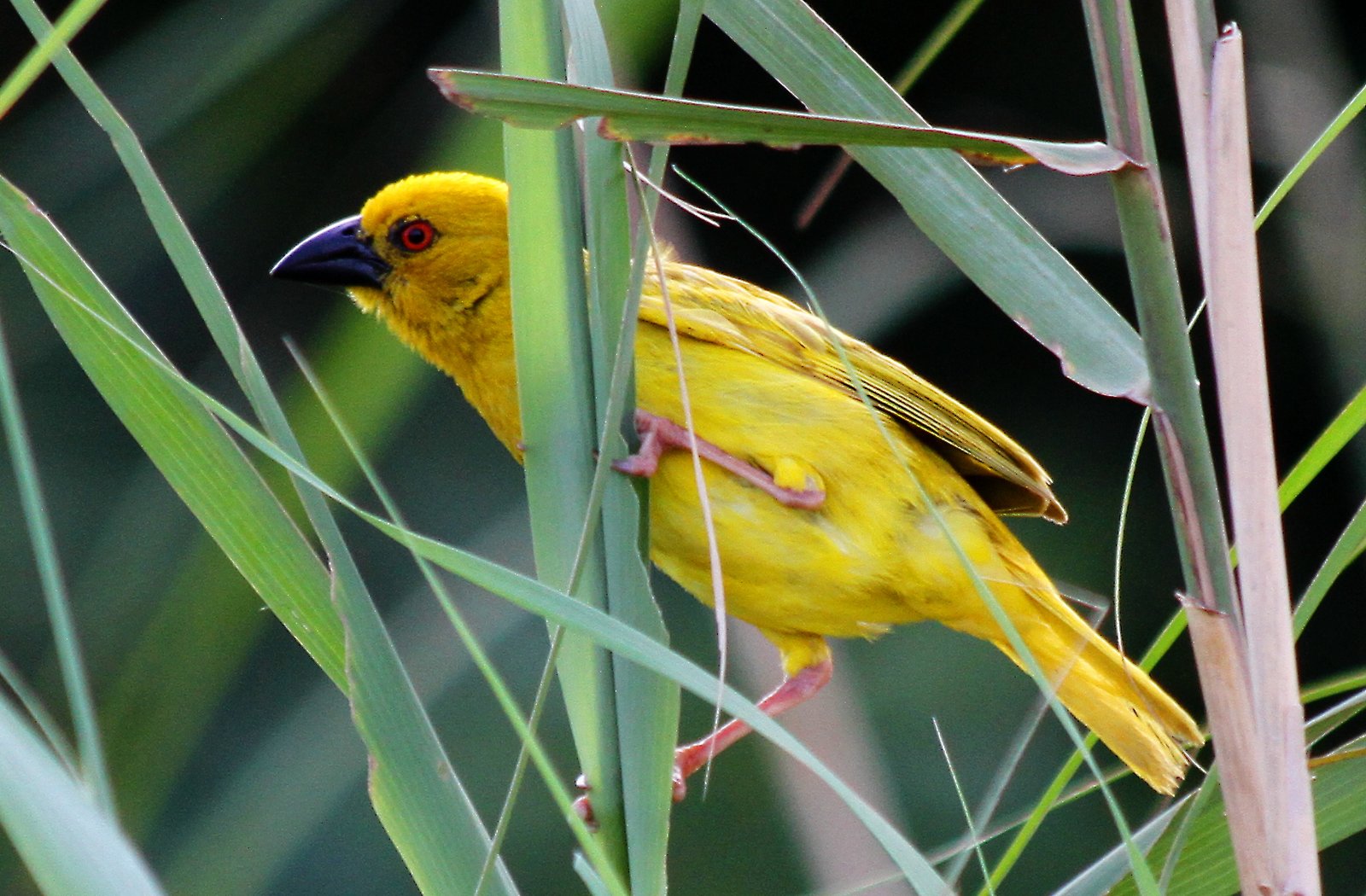
The Eastern Golden Weaver is the medium-sized yellow weaver of the eastern lowlands, from the KwaZulu-Natal coast into East Africa. The breeding male is bright yellow with an orange wash on the head and a reddish eye. It breeds colonially in reeds and bushes along water.
Click a thumbnail to switch the photo above.
Voice
A soft, sizzling, chattering song of grating notes, softer than that of Southern Masked Weaver, and a short chet or chuk contact call. The colony produces a sustained, rustling chatter.
Recording: isaac kilusu — CC BY-NC-SA 4.0 · converted to mono · xeno-canto
Identification
14–16 cm, with a fairly slender bill. The breeding male is bright golden yellow, with an orange wash over forehead, face and throat, a yellow-green, barely streaked back and a black bill; the eye is reddish to orange-red. Outside the breeding season the male is greener and duller, with a horn-coloured bill. The female is olive-green above with faint streaking, yellowish on throat and breast and whitish on the belly, with a pale horn bill. Juveniles resemble the female.
Confusion species
Holub's Golden Weaver (Ploceus xanthops) is larger, with a much heavier bill and a pale yellow eye in both sexes, and breeds solitarily. Cape Weaver (Ploceus capensis) is larger and longer-billed; the male has a pale eye and a browner face. Southern Masked Weaver (Ploceus velatus) and Lesser Masked Weaver (Ploceus intermedius) have a black mask in breeding plumage; their females resemble it more closely, but the female Lesser Masked Weaver has a pale eye and blue-grey legs. The female Southern Brown-Throated Weaver (Ploceus xanthopterus) is paler and browner. In females look at bill size, eye colour and the colonial breeding site in reeds.
Habitat
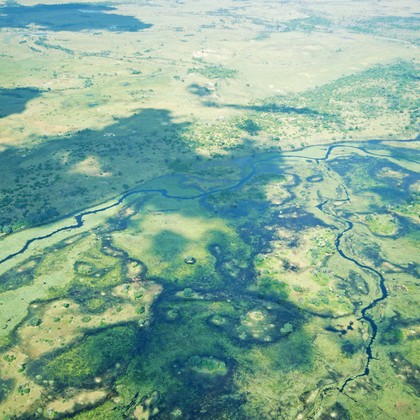
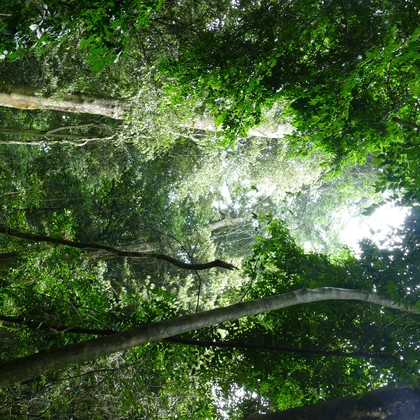
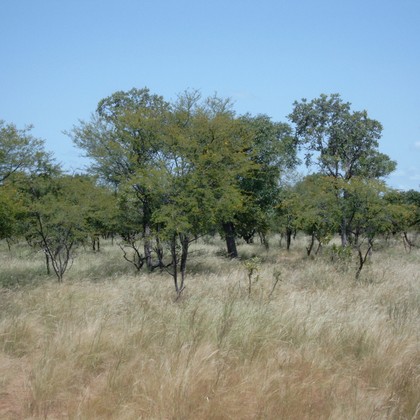
Reedbeds, riverine scrub, marsh edges and damp rank growth, also sugarcane fields, coastal forest with clearings and gardens in the coastal belt. It breeds in colonies of tens to hundreds of nests in reeds, papyrus or bushes over water. The nest is a compact, round nest of fine grass with a short entrance tube or porch. Outside the breeding season it forages in flocks in grassland and fields, sometimes with bishops. It eats seeds and insects.
Where the bird is most at home, classified by the vegetation units of southern Africa.
Range and movements
Within the region mainly in the east: the coastal plain of the Eastern Cape and KwaZulu-Natal, the lowveld of Mpumalanga and Eswatini, southern and central Mozambique, eastern and south-eastern Zimbabwe and southern Malawi. Beyond the region north to Tanzania and the Kenyan coast.
- Resident
- Summer visitor (c. Oct–Mar)
- Winter visitor (c. Apr–Sep)
- Passage (Mar–Apr, Oct–Nov)
- dark = core range, pale = thinly spread
How and when to look
Best in the breeding season at dams and rivers with reedbeds in coastal KwaZulu-Natal and Mozambique. Colonies are noisy and can be located by ear; in males look for the reddish eye and orange head. In winter the flocks of female-plumaged birds in grassland are good practice in identifying yellow weavers on bill shape and eye colour.
Conservation status
Not threatened; common in suitable habitat. It benefits locally from dams and sugarcane. It is parasitised by the Diederik Cuckoo.
Scientific name
Ploceus subaureus | Smith, 1839
Smith described the species in 1839 and placed it straight away in the genus where it still stands. The genus Ploceus was introduced in 1816 by Cuvier, GLCFD. Ploceus comes from the Greek plokeus, 'plaiter, weaver', for the tightly woven, ball-shaped nest that gives weavers their name. subaureus is Latin for 'somewhat golden', from sub, 'somewhat', and aureus, 'golden' — for the golden-yellow plumage. The specimen the first description was based on came from Algoa Bay, Eastern Cape (South Africa).