All species › Passerines › Weavers › Bocage's Weaver
Bocage's Weaver | Ploceus temporalis
Bocages wever | Tejedor de Bocage
Bocage's Weaver is a little-known weaver of the Angolan highlands and north-western Zambia. It lives in rank riverside vegetation where tall grass, shrubs and trees meet. The male is yellow with a pale eye and a long, pointed bill, and in build resembles a small Cape Weaver.
No photograph of a living wild bird of this species with a suitable Creative Commons licence exists. Do you have one that meets the rules? Send it in.
Voice
Typical weaver sounds: a rasping, chattering song of grating notes, and a dry chek contact call.
Recording: Derek Engelbrecht — CC BY-NC-SA 4.0 · converted to mono · xeno-canto
Identification
14–15 cm, with a long, thin, pointed bill. The breeding male has a golden-yellow head and crown, a brownish wash on the ear-coverts, a narrow dusky olive throat patch and an olive-green back; the underparts are yellow. The eye is pale, cream to yellowish. The female and the non-breeding male are duller, olive-green above and paler below, without the throat patch; the female has a darker eye. Juveniles resemble the female. Plumage details are only sparsely described in the literature.
Confusion species
Spectacled Weaver (Ploceus ocularis) has a narrow black eye-stripe and an orange-brown head, and lives in pairs in dense riverine forest. Holub's Golden Weaver (Ploceus xanthops) is larger and uniformly golden yellow with a heavy bill. Black-Necked Weaver (Ploceus nigricollis) has a black eye-stripe and a dark nape and mantle. Males can be identified by the pale eye, brown ear wash and long thin bill; females and non-breeding birds only with caution, on size, bill shape and habitat.
Habitat
Swamps, vleis, reedbeds and riverside vegetation along streams and rivers, usually where tall grass is interspersed with shrubs and trees, on the high plateau and in grassy valleys between miombo. It nests close to water. Its diet is poorly studied; presumably seeds and insects as in related weavers.
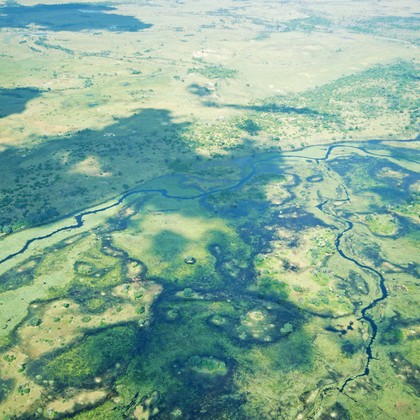
Where the bird is most at home, classified by the vegetation units of southern Africa.

Range and movements
Within the region on the central and western highlands of Angola (including Huambo, Bié, Cuanza Sul, Malanje, Huíla and Benguela, with scattered records north to Uíge and Lunda) and in north-western Zambia, for instance on the Chitunta Plain. Beyond the region only in adjacent southern DR Congo.
- Winter visitor (c. Apr–Sep)
- dark = core range, pale = thinly spread
How and when to look
Present all year but seldom seen. In Angola search along highland streams around Huambo and Mount Moco, or in Zambia in the grassy plains of North-Western Province, for yellow weavers with a pale eye in riverside shrubs. Note bill shape, eye colour and head and throat pattern, and make sound recordings if possible: the species is poorly documented.
Conservation status
Not threatened according to the IUCN; the range is limited, but much of its habitat remains intact. There are few data on numbers and trends.
Scientific name
Ploceus temporalis | (Bocage, 1880)
Bocage described the species in 1880 as Hyphantornis temporalis; because it was later moved to another genus, the author and year stand in brackets. The genus Ploceus was introduced in 1816 by Cuvier, GLCFD. Ploceus comes from the Greek plokeus, 'plaiter, weaver', for the tightly woven, ball-shaped nest that gives weavers their name. temporalis is Latin for 'of the temples', from tempora, 'temples' — probably for the markings on the sides of the head. The specimen the first description was based on came from Caconda, Angola.