All species › Falcons › Falcons › Dickinson's Kestrel
Dickinson's Kestrel | Falco dickinsoni
Dickinsons torenvalk | Cernícalo Dorsinegro
Dickinson’s Kestrel is a small grey falcon of the hot lowland savannas of south-central Africa, closely tied to palms and baobabs. Its pale head and rump against a dark back make it unmistakable once seen well.

Voice
A high, plaintive kee-kee-kee and a drawn-out keeeeh, mainly around the nest in the breeding season.
No recording with a suitable Creative Commons licence is available for this species yet.
Identification
About 28 cm, stocky with a large head. The head, neck and rump are pale silvery grey, almost whitish, and contrast with the dark slate back and wings. The underparts are grey, the tail grey with narrow black bars and a broad black terminal band. The cere, a narrow bare eye-ring and the legs are yellow. The juvenile is browner, with a less pale head and finely barred flanks.
Confusion species
Grey Kestrel (Falco ardosiaceus) is uniform dark grey without a pale head or rump and has an almost unbarred tail. Sooty Falcon (Falco concolor) is long-winged and uniformly grey. The male Amur Falcon has a rufous vent and red legs. Black-Winged Kite (Elanus caeruleus) is paler, with black shoulders and red eyes.
Habitat
Hot, open savanna with palms (Borassus and Hyphaene), mopane, miombo and baobabs, often near rivers, pans and floodplain grassland. It hunts from a high perch for large insects, lizards, frogs and small rodents, and also follows bush fires. It nests in cavities in palms and baobabs or in old Hamerkop nests.
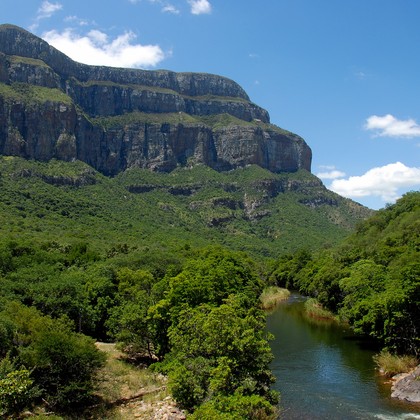
Where the bird is most at home, classified by the vegetation units of southern Africa.


Range and movements
In the north and east of the region: Zambia, Malawi, Mozambique, Zimbabwe (mainly the Zambezi Valley and the lowveld), northern Botswana (Okavango and Chobe), the Zambezi Region of Namibia, eastern Angola and sparsely in north-eastern South Africa (northern Kruger National Park and Limpopo). Beyond the region north to Tanzania and the southern Democratic Republic of the Congo.
- Resident
- Summer visitor (c. Oct–Mar)
- Winter visitor (c. Apr–Sep)
- Passage (Mar–Apr, Oct–Nov)
- dark = core range, pale = thinly spread
How and when to look
Drive through palm savanna along the Zambezi, the Okavango Delta or Mana Pools and check the crowns of dead palms and the branches of baobabs. The pale head stands out at long range against the dark back.
Conservation status
Not threatened, but rather scarce and dependent on old palms and baobabs for nest sites. The felling of palms for palm wine and building material may matter locally.
Scientific name
Falco dickinsoni | Sclater, 1864
Sclater described the species in 1864 and placed it straight away in the genus where it still stands. The genus Falco was introduced in 1758 by Linnaeus. Falco is the Latin word for 'falcon', possibly related to falx, 'sickle', for the curved shape of the claws or wings. dickinsoni honours the British physician John Dickinson (died 1863), a member of the Universities' Mission working with Livingstone in the Shire valley. The specimen the first description was based on came from Chibisa on the Shire River, Malawi.