All species › Hoopoes and hornbills › Hornbills › Crowned Hornbill
Crowned Hornbill | Lophoceros alboterminatus
Gekroonde tok | Toco Coronado
The Crowned Hornbill is the dark hornbill of the eastern forests, with a red bill bearing a tall casque and a white belly. It lives in pairs or small groups in the canopy of coastal, riverine and montane forest and draws attention with its slow, undulating flight over the treetops.

Voice
A series of plaintive whistles, chleeoo chleeoo chleeoo, given with the bill raised, and a soft clucking chatter within the group.
Recording: James Bradley — CC BY-NC-SA 4.0 · converted to mono · xeno-canto
Identification
About 54 cm. Head, neck, breast, upperparts and tail are dark sooty brown, the belly is white and all but the central pair of tail feathers are tipped white. The bill is orange-red with a narrow yellow band at the base and a tall, serrated casque along the upper mandible, smaller in the female. The iris is yellow, the bare skin around the eye and on the throat blackish. Juveniles have a smaller orange-yellow bill without a casque and grey eyes. Flight is on slow wingbeats interspersed with glides.
Confusion species
Bradfield's Hornbill (Lophoceros bradfieldi) of the dry west is paler brown and has an orange bill without a distinct casque; the ranges barely overlap. African Grey Hornbill (Lophoceros nasutus) is grey-brown with pale wing edges and a dark bill. Trumpeter Hornbill (Bycanistes bucinator) is much larger and black-and-white, with a grey bill and pink facial skin. Pale-Billed Hornbill (Lophoceros pallidirostris) of miombo has a pale horn-coloured bill.
Habitat
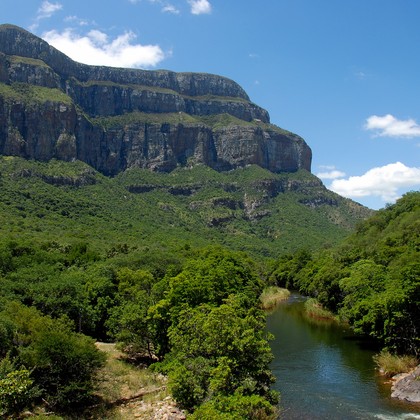
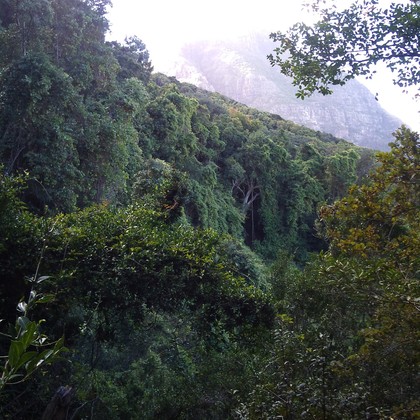
Coastal forest, riverine forest, dry and moist lowland forest, montane forest and densely wooded gorges, also adjacent dense bushveld and gardens with fruiting trees. It eats fruit, insects and small vertebrates, taken in the canopy or in flight. It nests in tree holes, in which the female seals herself with mud.
Where the bird is most at home, classified by the vegetation units of southern Africa.

Range and movements
In the east of the region: the Eastern Cape, KwaZulu-Natal, Mpumalanga and Limpopo in South Africa, Eswatini, Mozambique, eastern Zimbabwe and the Zambezi valley, Malawi, Zambia and much of Angola. Absent from the dry west and interior. Further north through Tanzania and Kenya to Ethiopia and in the Democratic Republic of the Congo.
- Resident
- Summer visitor (c. Oct–Mar)
- Winter visitor (c. Apr–Sep)
- Passage (Mar–Apr, Oct–Nov)
- dark = core range, pale = thinly spread
How and when to look
Present all year; regularly recorded in the coastal forests of KwaZulu-Natal and the Eastern Cape and in the wooded gorges of Mpumalanga. Outside the breeding season groups, sometimes of more than ten birds, wander to fruiting trees, which gives a good chance of seeing several together.
Conservation status
Not threatened and fairly common in suitable forest. It depends on indigenous forest and on trees with cavities, so the clearing of coastal and lowland forest has reduced it locally.
Scientific name
Lophoceros alboterminatus | Büttikofer, 1889
Büttikofer described the species in 1889 and placed it straight away in the genus where it still stands. The genus Lophoceros was introduced in 1833 by Hemprich & Ehrenberg. Lophoceros comes from the Greek lophos, 'crest', and keras, 'horn' — for the ridge-like casque on the bill. alboterminatus comes from the Latin albus, 'white', and terminatus, 'ended, tipped' — for the white tips to the outer tail feathers. The specimen the first description was based on came from Gambos, upper Cunene, Angola.