All species › Hoopoes and hornbills › Hornbills › Bradfield's Hornbill
Bradfield's Hornbill | Lophoceros bradfieldi
Bradfields tok | Toco de Bradfield
Bradfield's Hornbill is a near-endemic hornbill of the Kalahari sandveld in the heart of southern Africa, brown with a white belly and an orange bill. It lives in pairs and loose groups in mopane and Zambezi teak woodland and calls with the bill pointing steeply upward.

Voice
A series of high plaintive whistles, chee-oo chee-oo chee-oo, given with head and bill raised, often from a high perch; also a soft chatter.
Recording: András Schmidt — CC BY-NC-SA 4.0 · shortened to the first 60 s, mono · xeno-canto
Identification
About 54 cm. Head, neck and upperparts are grey-brown, the head a little paler, the breast brown and the belly white. The long tail is dark brown, the outer feathers tipped white. The bill is orange with a paler base and only a low ridge along the upper mandible rather than a casque; it is smaller in the female. The iris is yellow. Juveniles have a shorter, paler bill. Flight is in deep undulations.
Confusion species
Crowned Hornbill (Lophoceros alboterminatus) is darker sooty brown, with a red bill bearing a tall casque; it lives in eastern forest and barely overlaps. African Grey Hornbill (Lophoceros nasutus) is smaller and greyer, with a white eyebrow and a dark bill. Monteiro's Hornbill (Tockus monteiri) and Southern Yellow-Billed Hornbill (Tockus leucomelas) are spotted black and white.
Habitat
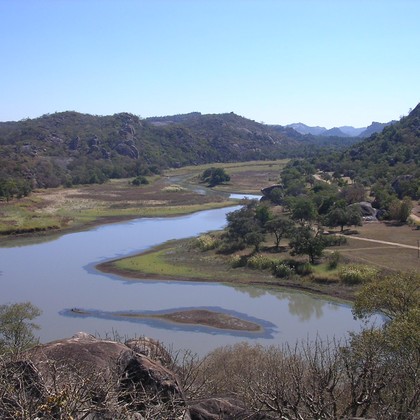
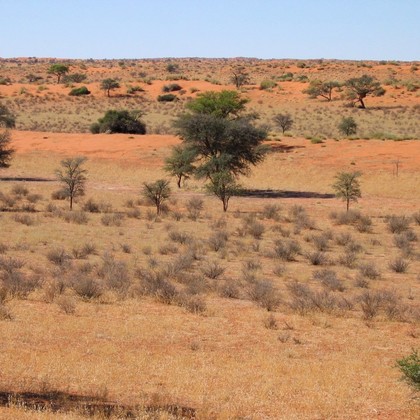
Dry deciduous woodland on Kalahari sand, especially mopane, Zambezi teak (Baikiaea) and mixed woodland, also wooded dunes and riverine woodland in dry savanna. It eats fruit, seeds, insects and small vertebrates, both in trees and on the ground. In the dry season groups wander to fruiting trees.
Where the bird is most at home, classified by the vegetation units of southern Africa.

Range and movements
Close to endemic in the region: north-eastern Namibia (from the Otavi highlands to Kavango and the Zambezi Region), northern Botswana, western and north-western Zimbabwe, south-western Zambia and south-eastern Angola.
- Resident
- Winter visitor (c. Apr–Sep)
- Passage (Mar–Apr, Oct–Nov)
- dark = core range, pale = thinly spread
How and when to look
Found in Hwange and around Victoria Falls, in Chobe and in the parks of Namibia's Zambezi Region, such as Mahango. Listen for the whistled series and search the crowns of tall mopane and teak; in the dry winter groups gather at fruiting trees.
Conservation status
Not threatened and locally fairly common within its restricted range. It depends on dry woodland on Kalahari sand; logging of Zambezi teak and more frequent fires can degrade its habitat.
Scientific name
Lophoceros bradfieldi | (Roberts, 1930)
Roberts described the species in 1930 as Rhyncaceros bradfieldi; because it was later moved to another genus, the author and year stand in brackets. The genus Lophoceros was introduced in 1833 by Hemprich & Ehrenberg. Lophoceros comes from the Greek lophos, 'crest', and keras, 'horn' — for the ridge-like casque on the bill. bradfieldi honours the South African naturalist Rupert Dudley Bradfield (1882–1949), who collected birds while farming in Namibia. The specimen the first description was based on came from Waterberg, Namibia.