All species › Passerines › Weavers › Crested Malimbe
Crested Malimbe | Malimbus malimbicus
Kuifprachtwever | Malimbo Crestado
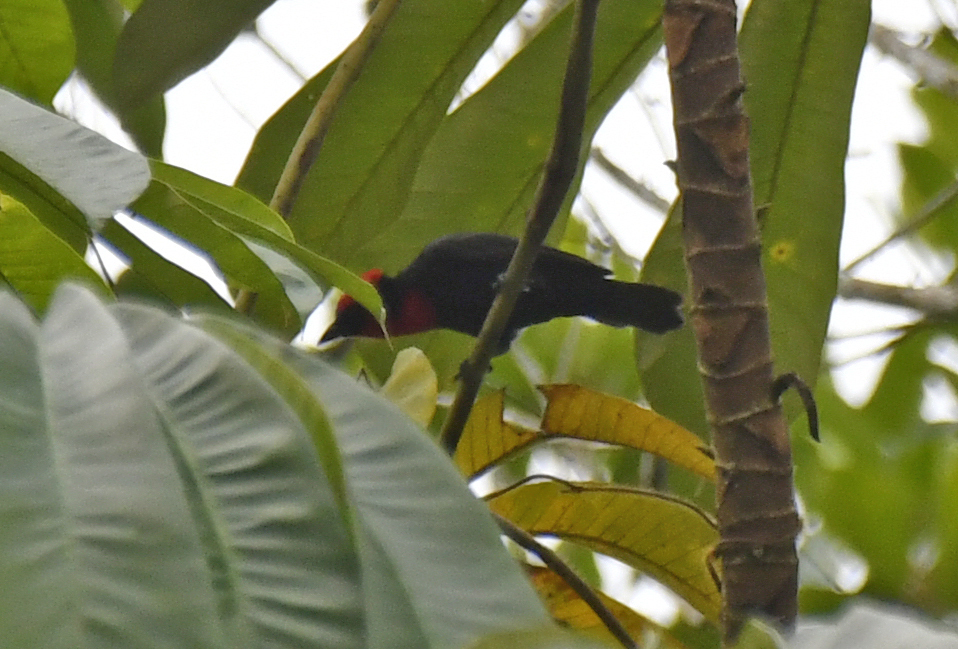
The Crested Malimbe is a glossy black rainforest weaver with a red head and a short red crest. In the region it occurs only in the far north of Angola, on the southern edge of the Guineo-Congolian forest.
Voice
Dry mechanical rasps, dry chatters and complex combinations of the two; also a hoarse chrrr and a short chik contact call.
Recording: Matthew L. Brady — CC BY-NC-SA 4.0 · shortened to the first 60 s, mono · xeno-canto
Identification
17–18 cm, stocky, with a heavy, pointed black bill. The male is glossy black with a scarlet crown and nape, a short, often flattened red crest that is sometimes barely visible from the side, and a red throat and upper breast; the forehead and a small mask around the eye are black, as are the undertail coverts. The female resembles the male, but the crown is black and the red is largely restricted to the chin, throat and upper breast. Juveniles are duller, with brownish-red or orange on the head.
Confusion species
The Red-Headed Malimbe (Malimbus rubricollis) is larger and has a black throat and a black face; the red is confined to the crown, nape and sides of the neck. The male Vieillot's Black Weaver (Ploceus nigerrimus) is wholly black without red and has a yellow eye. The combination of red throat, black undertail coverts and red crested crown rules out all other weavers in the region for males.
Habitat
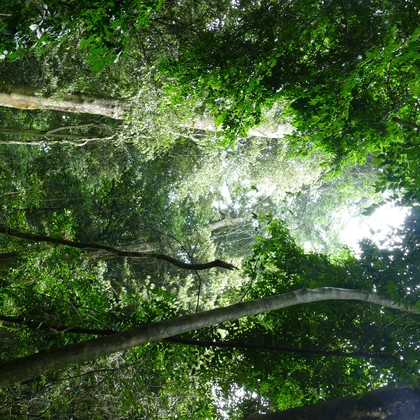
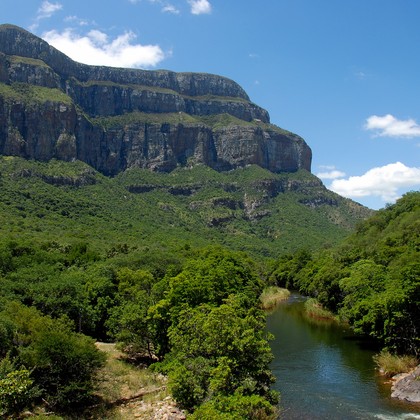
Humid lowland and hill forest, forest edges, secondary forest, riverine forest and plantations with shade trees and oil palms, sometimes into village yards. It forages in pairs or small groups on thick branches and among creepers, often in mixed flocks, searching bark and leaves for insects. The nest is a hanging ball with a long entrance tube on a branch or palm frond.
Where the bird is most at home, classified by the vegetation units of southern Africa.
Range and movements
In the region only in northern Angola: in Cabinda and in the forest remnants of Uíge, Cuanza Norte and northern Bengo, south to about the Luanda area. Beyond the region in the Guineo-Congolian forest from Sierra Leone and Guinea through Ghana, Nigeria and Cameroon to DR Congo and Uganda.
- Resident
- dark = core range, pale = thinly spread
How and when to look
Best in forest edges and shaded coffee plantations in Uíge and Cuanza Norte, in mixed flocks of weavers, bulbuls and sunbirds. Listen for the dry rasping chatter and look for the red head on the thicker branches; the crest usually shows only when the bird is excited.
Conservation status
Not threatened and widespread in the Guineo-Congolian forest. In Angola the species is restricted to a small, highly fragmented strip of forest and plantation that is under pressure from logging, agriculture and the decline of shade coffee.
Scientific name
Malimbus malimbicus | (Daudin, 1802)
Daudin described the species in 1802 as Tanagra malimbica; because it was later moved to another genus, the author and year stand in brackets. The genus Malimbus was introduced in 1805 by Vieillot. Malimbus is derived from Malimba (Malimbe), a place on the coast of present-day Cabinda (Angola), where the first specimens were collected. malimbicus means 'of Malimba', after Malimbe on the coast of present-day Cabinda (Angola), where the first specimens were collected. The specimen the first description was based on came from Malimbe, Cabinda (Angola).