All species › Passerines › Weavers › Compact Weaver
Compact Weaver | Pachyphantes superciliosus
Bruinstuitwever | Tejedor Piquigrueso
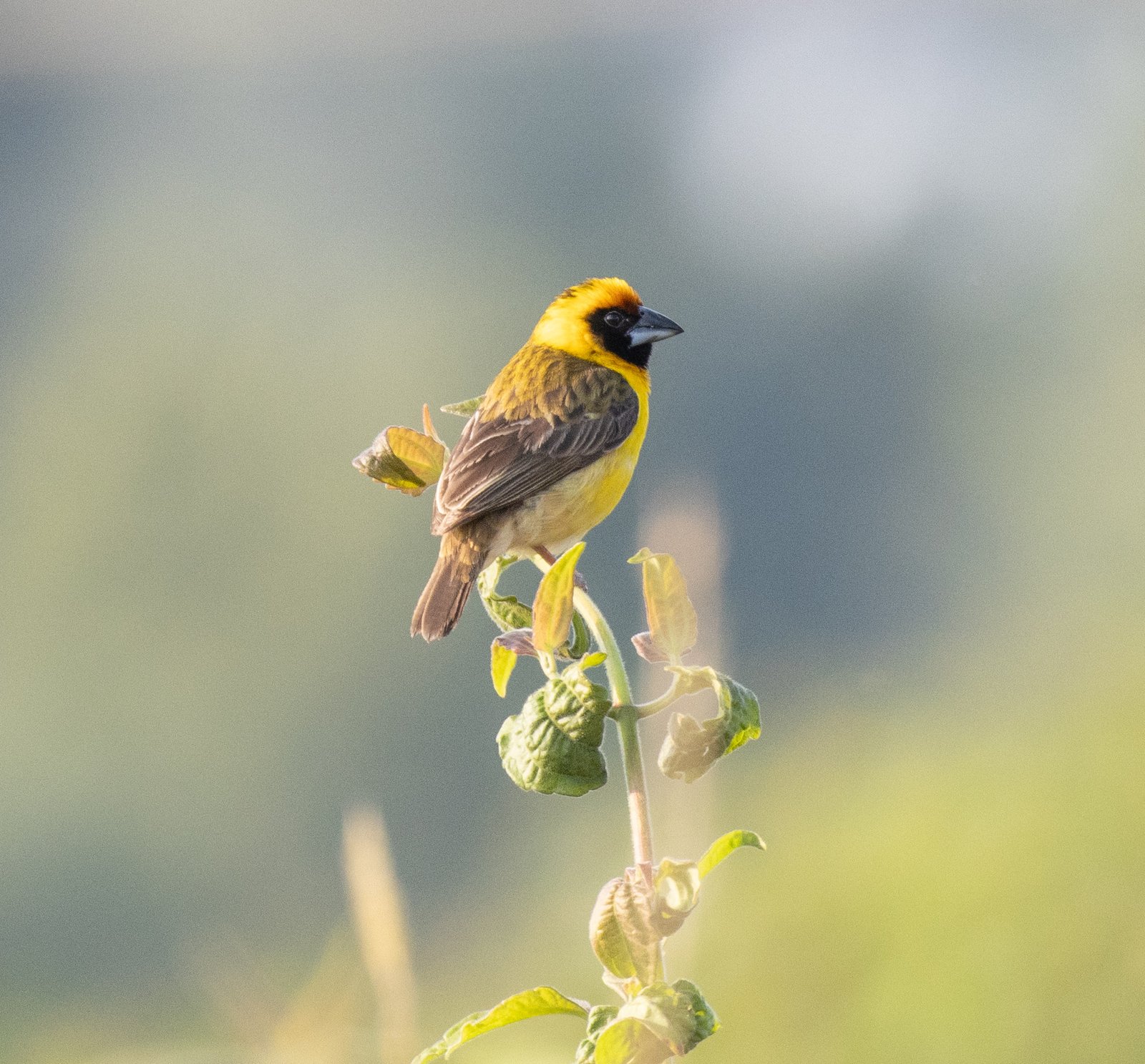
The Compact Weaver is a stocky, short-tailed weaver with a strikingly heavy bill, found in the region only along its extreme northern edge. Outside the breeding season, with its brown plumage, dark eye-stripe and pale supercilium, it looks more like a bunting or a female bishop than a weaver.
Voice
A sharp, sparrow-like cheep call, often from small flocks in flight, and as song a soft, grating, chirping chatter typical of weavers.
No recording with a suitable Creative Commons licence is available for this species yet.
Identification
About 13 cm, stocky, with a short tail and a thick, deep black conical bill. The breeding male has a yellow crown, a black mask over face and throat and yellow underparts; the upperparts are dark brown with paler streaking. The breeding female is similar but has a black crown, so the whole head looks dark. Outside the breeding season both sexes are brown above and warm buff below, with a dark crown, a dark eye-stripe and a pale supercilium; this striped head pattern is unusual for a weaver. Juveniles resemble non-breeding birds.
Confusion species
Males of Lesser Masked Weaver (Ploceus intermedius) and Southern Masked Weaver (Ploceus velatus) also have yellow-and-black heads, but a yellow-green back, a longer tail and a slimmer bill, and nest in colonies in trees or reeds. Thick-Billed Weaver (Amblyospiza albifrons) has an equally heavy bill but is larger and dark chocolate-brown with white patches on forehead and wing. Non-breeding birds suggest female bishops (Euplectes), but these have a slimmer, pale bill, a streaked crown and a longer tail.
Habitat
Moist, grassy places in savanna and along forest edges: wet grassland, vleis, reed margins, rank growth along streams and fallow or lightly cultivated fields. Outside the breeding season it lives in small flocks feeding on grass seeds. It nests singly or in loose groups; the nest is small and finely woven from grass strips, attached to a few upright grass or reed stems, with an entrance at the side near the top.
Where the bird is most at home, classified by the vegetation units of southern Africa.

Range and movements
Within the region very scarce and only along the extreme northern edge: northern Angola and the far north-west of Zambia, with few recent records. Beyond the region widespread in a broad belt from Senegal and Gambia east to Ethiopia, and south to southern DR Congo, Uganda, western Kenya and western Tanzania.
- Resident
- dark = core range, pale = thinly spread
How and when to look
On the northern edge of the region search wet grassland and rank growth along streams in the rainy season, when the males wear their yellow crown and black mask. Note the compact shape with short tail and heavy bill; in non-breeding plumage the dark eye-stripe below a pale supercilium is the best feature.
Conservation status
Not threatened. Widespread and locally common in West and Central Africa; in the region a peripheral species whose status is poorly known.
Scientific name
Pachyphantes superciliosus | (Shelley, 1873) (GBIF: Ploceus superciliosus)
Shelley described the species in 1873 as Hyphantornis superciliosus; because it was later moved to another genus, the author and year stand in brackets. The genus Pachyphantes was introduced in 1896 by Shelley. Pachyphantes comes from the Greek pakhus, 'thick', and huphantēs, 'weaver' — for this weaver's thick bill. superciliosus is Latin for 'eyebrowed', from supercilium, 'eyebrow' — for the pale supercilium. The specimen the first description was based on came from West Africa (not specified).