All species › Kingfishers, bee-eaters and rollers › Kingfishers › Chocolate-Backed Kingfisher
Chocolate-Backed Kingfisher | Halcyon badia
Witkeelijsvogel | Alción Castaño
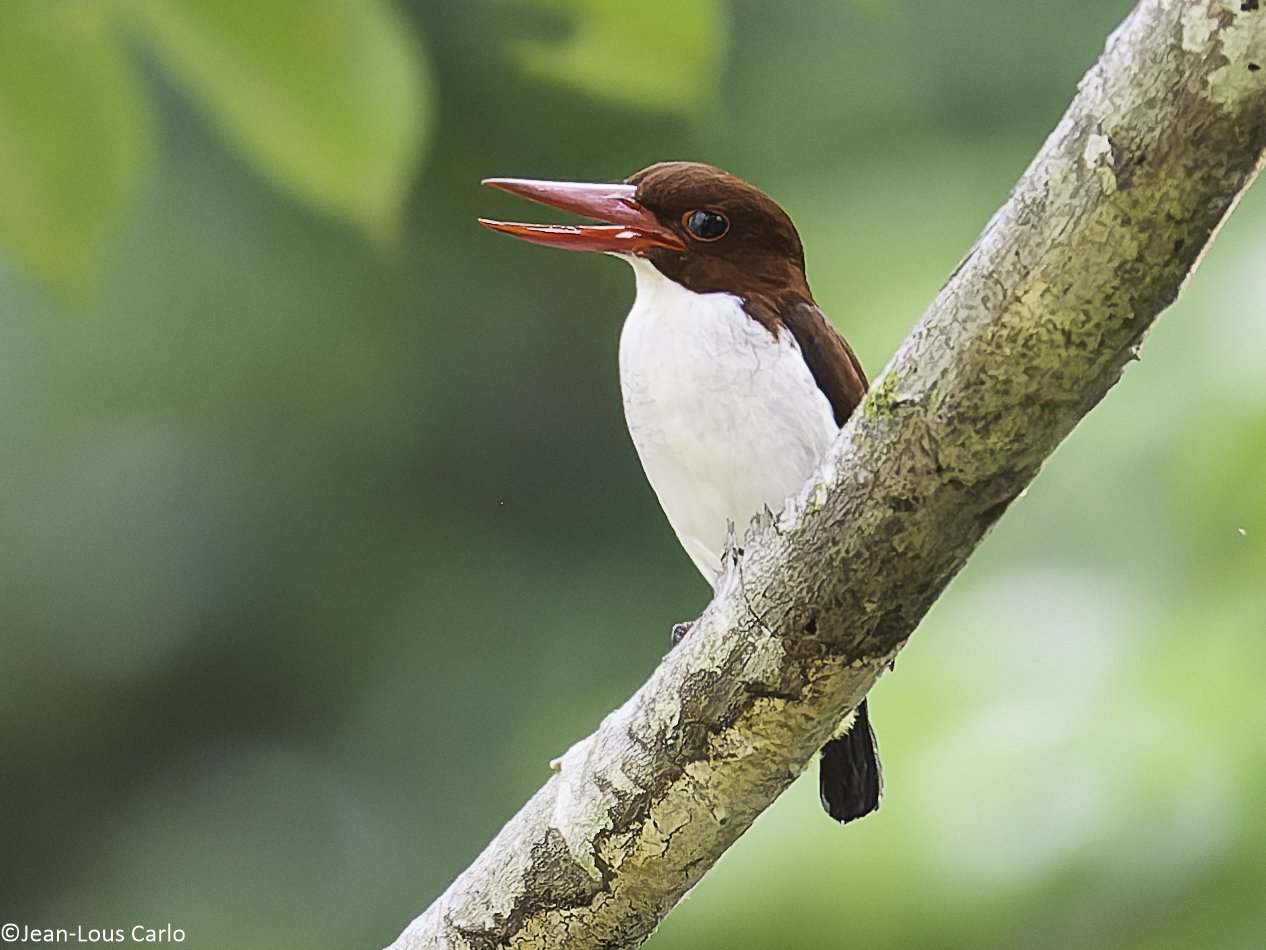
The Chocolate-Backed Kingfisher is a forest kingfisher of the Central African lowland rainforest, with a chocolate-brown head and back, white underparts, bright blue wings and tail and a red bill. It lives not on fish but on insects, far from open water, and in the region occurs only in the far north of Angola.
Voice
A long, plaintive series of whistles, hu-hu-hu-hu-hu-huu, first slowly rising, then falling away and slowing; often sustained for long periods and the best clue in dense forest, where the bird is seldom seen. Also a sharp chik.
Recording: Jonathan Onongo — CC BY-NC-SA 4.0 · converted to mono · xeno-canto
Identification
About 20 cm. Head, nape and mantle are deep chocolate brown; wings, rump and tail bright cobalt to sky blue, with black flight feathers. Throat and underparts are white, with a brownish wash on the breast sides. The bill is bright red, the legs red. The sexes are alike. Juveniles have a dark bill, a paler brown back and fine dark scalloping on the breast.
Confusion species
Blue-Breasted Kingfisher (Halcyon malimbica) is larger, with a grey head, a blue breast band and a red-and-black bill, and keeps more to forest edges and water. Woodland Kingfisher (Halcyon senegalensis) has a pale blue back, a grey-blue head and a two-toned bill, and lives in open woodland. The combination of chocolate back and red bill is unique in the region.
Habitat
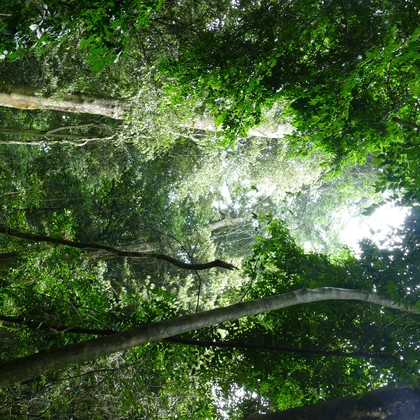
The interior of humid evergreen lowland forest and old secondary forest, often in the mid-canopy, sometimes along forest tracks and clearings. It sits motionless on a branch for long periods and drops onto insects, spiders and small lizards on the ground or in foliage. It nests in arboreal termite nests.
Where the bird is most at home, classified by the vegetation units of southern Africa.
Range and movements
In the region only in the far north of Angola, mainly in the Cabinda enclave (Maiombe forest) and locally in the forest areas of Zaire and Uíge provinces. Beyond the region from Sierra Leone and Guinea through the Guinean and Congolian forest belt to Uganda and western Tanzania.
How and when to look
Practically only found in the Maiombe forest in Cabinda. Listen in the early morning for the plaintive whistled series and then patiently scan the mid-canopy; the bird sits motionless and, despite the blue, is well camouflaged.
Conservation status
Not threatened and common in the central part of its range. In the region it is confined to a small area of forest, where logging and conversion of forest to farmland are the main threats.
Scientific name
Halcyon badia | Verreaux & Verreaux, 1851
Verreaux & Verreaux described the species in 1851 and placed it straight away in the genus where it still stands. The genus Halcyon was introduced in 1821 by Swainson. Halcyon goes back to Greek alkyon, the bird of legend that nested at sea and calmed the waves; the name later came to be used for kingfishers generally. badia comes from the Latin badius, 'chestnut-brown' — for the chocolate-brown head and back. The specimen the first description was based on came from Gabon.