All species › Kingfishers, bee-eaters and rollers › Kingfishers › Blue-Breasted Kingfisher
Blue-Breasted Kingfisher | Halcyon malimbica
Teugelijsvogel | Alción Pechiazul
The Blue-Breasted Kingfisher is a large, colourful forest kingfisher with a grey head, a black loral stripe, bright blue back and breast band, and a red upper mandible over a black lower one. In the region it is a species of the northern gallery and rain forests of Angola and Zambia.

Voice
A loud, penetrating whistled series, tchoo tchoo tu-tu-tu-tu-tu, starting slowly, accelerating, then dropping in pitch and trailing off; similar to the song of Woodland Kingfisher but without the rolling trill at the end. Also a sharp chik.
Recording: Sven Kransel — CC BY-NC-SA 4.0 · converted to mono · xeno-canto
Identification
About 24 cm. The head is pale grey with a black stripe from the bill to behind the eye. Mantle, rump and tail are bright turquoise blue, the scapulars and wing coverts black, giving a striking black 'saddle'. Throat and belly are white, and a broad pale blue band runs across the breast and flanks. The upper mandible is red, the lower black; the legs are black. In flight a white patch shows on the primaries. Juveniles are duller, with dark scalloping on the breast and a brownish bill.
Confusion species
Woodland Kingfisher (Halcyon senegalensis) is smaller, lacks the blue breast band and has a narrower black eye-stripe; it lives in open woodland and is a summer visitor in the south of the region. Mangrove Kingfisher (Halcyon senegaloides) has an all-red bill and a grey breast and occurs only on the east coast. Chocolate-Backed Kingfisher (Halcyon badia) has a chocolate-brown back and an all-red bill.
Habitat
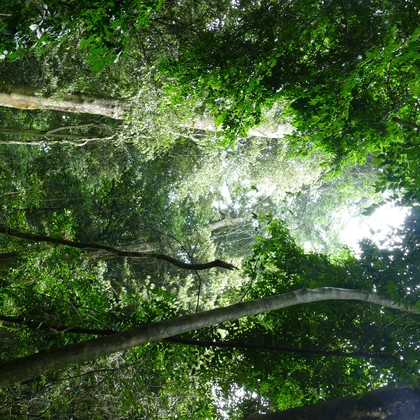
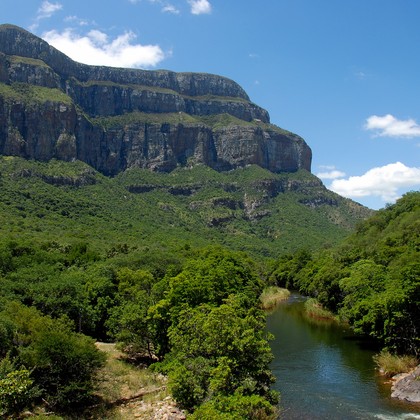
Edges and clearings of humid lowland forest, gallery forest along rivers, swamp forest, mangroves and wooded plantations, usually near water. It perches in the mid-canopy and drops onto insects, crabs, frogs, lizards and small fish. It nests in arboreal termite nests or in holes in a bank.
Where the bird is most at home, classified by the vegetation units of southern Africa.
Range and movements
In the region in northern Angola (Cabinda, Zaire, Uíge, Cuanza Norte, Malanje and the Lundas) and in north-western and northern Zambia, mainly around Mwinilunga and in the Luapula and Mweru area. Beyond the region from Senegal through West and Central Africa to South Sudan, Uganda and western Tanzania.
- Resident
- dark = core range, pale = thinly spread
How and when to look
In Zambia best in the gallery forests of Mwinilunga District; in Angola in the forests of the north, from Kissama northwards. The loud whistled series is often the first clue; the bird often sits high and still, but in good light the blue and the red-and-black bill are unmistakable.
Conservation status
Not threatened and fairly common in the central part of its range. In the region it is confined to the northern forest areas, where loss of gallery forest to logging and agriculture is the main threat.
Scientific name
Halcyon malimbica | (Shaw, 1812)
Shaw described the species in 1812 as Alcedo Malimbica; because it was later moved to another genus, the author and year stand in brackets. The genus Halcyon was introduced in 1821 by Swainson. Halcyon goes back to Greek alkyon, the bird of legend that nested at sea and calmed the waves; the name later came to be used for kingfishers generally. malimbica refers to Malimba (now Malembo) in Cabinda, Angola, where the first specimen came from. The specimen the first description was based on came from Malembo, Cabinda (Angola).