All species › Passerines › Chats and flycatchers › Chat Flycatcher
Chat Flycatcher | Agricola infuscatus
Lijstervliegenvanger | Papamoscas Tarabilla
The Chat Flycatcher is the largest flycatcher of the region, a greyish-brown, chat-like bird of the dry western plains. It perches upright on a bush, post or wire and drops to the ground to seize prey, looking more like a chat than a flycatcher.

Voice
The song is a varied, rich mix of whistled, scratchy and chattering notes, often before dawn and sometimes at night. The call is a harsh chirrp and a soft tchuk.
No recording with a suitable Creative Commons licence is available for this species yet.
Identification
A large, long-winged flycatcher of 18–20 cm. The upperparts are plain greyish brown, the underparts paler sandy brown to off-white. Broad pale fringes to the greater coverts and secondaries form a conspicuous pale wing panel at rest. The tail is fairly long and uniformly dark brown, with no rufous or white. The bill is black and fairly stout. The sexes are alike; juveniles are lightly spotted. It drops from a lookout to the ground or catches insects in the air, then returns to the same or a nearby perch.
Confusion species
Marico Flycatcher (Bradornis mariquensis) is smaller, with clean white underparts contrasting sharply with the brown back, and lives in acacia savanna. Pale Flycatcher (Agricola pallidus) is smaller and more softly marked, without a pale wing panel, and lives in moister woodland in the north and east. Karoo Chat (Emarginata schlegelii) is smaller and greyer, with white outer tail feathers; Sickle-Winged Chat (Emarginata sinuata) and Familiar Chat (Oenanthe familiaris) show rufous in the rump or tail. Size, the pale wing panel and the plain dark tail are decisive.
Habitat
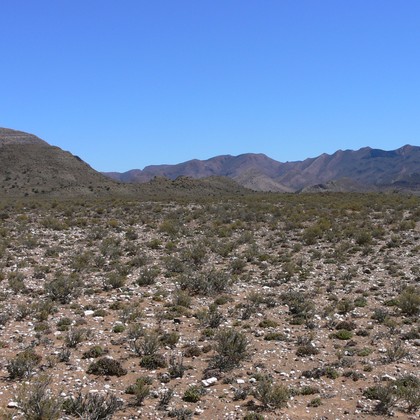
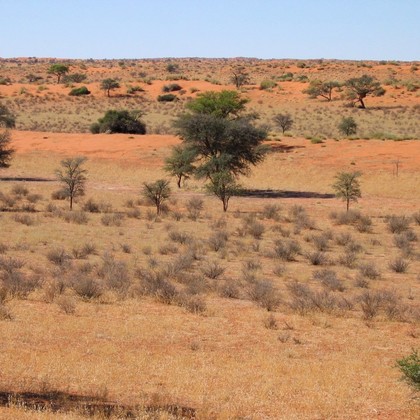
Nama Karoo, fringes of the Succulent Karoo, Kalahari thornveld and other dry, open shrub plains with scattered bushes, trees or fences as lookouts. Avoids dense vegetation.
Where the bird is most at home, classified by the vegetation units of southern Africa.

Range and movements
A species of the arid south-west of Africa. Widespread in Namibia except the north-east, and further in south-western and central Botswana, in South Africa in the Northern Cape, western Free State and the Karoo of the Western and Eastern Cape, and in south-western Angola. Partly nomadic; after rain it moves locally to areas rich in insects. The species occurs nowhere outside southern Africa.
- Resident
- Summer visitor (c. Oct–Mar)
- Winter visitor (c. Apr–Sep)
- Passage (Mar–Apr, Oct–Nov)
- dark = core range, pale = thinly spread
How and when to look
Drive through the Karoo or the Kalahari thornveld and watch for large brown birds on fence posts and telephone wires that keep dropping to the ground. The pale wing panel is visible at rest. A thrush-sized ‘flycatcher’ in open, dry country is almost always this species.
Conservation status
Not threatened. The species is widespread and locally common, and numbers appear stable. Drought strongly affects local density, but the species moves to areas that have received rain.
Scientific name
Agricola infuscatus | (Smith, 1839) (GBIF: Bradornis infuscatus)
Smith described the species in 1839 as Saxicola infuscata; because it was later moved to another genus, the author and year stand in brackets. The genus Agricola was introduced in 1854 by Bonaparte. Agricola is Latin for 'farmer, tiller of the fields', from ager, agri, 'field', and -cola, 'dweller' (from colere, 'to dwell in'). infuscatus is Latin for 'darkened, dusky' — for the uniform dark brown plumage. The specimen the first description was based on came from Booisberg, near Nuwerus, Western Cape, South Africa.