All species › Passerines › Rockjumpers › Cape Rockjumper
Cape Rockjumper | Chaetops frenatus
Kaapse rotsspringer | Saltarrocas del Cabo
The Cape Rockjumper is a long-tailed, boldly marked bird of rocky mountain slopes in the fynbos. It bounds from boulder to boulder rather than flying, and lives in small groups in which helpers assist the breeding pair. The species is confined to the Cape Fold Mountains.
Voice
A high, piercing whistle, peeeu-peeu or a series of pee-pee-pee, carrying far across the slopes though its direction is poorly defined because of its high pitch. Also a rapid harsh rattle. Group members answer one another, so the sound travels from slope to slope.
Recording: Nick Talbot — CC BY-NC-SA 4.0 · converted to mono · xeno-canto
Identification
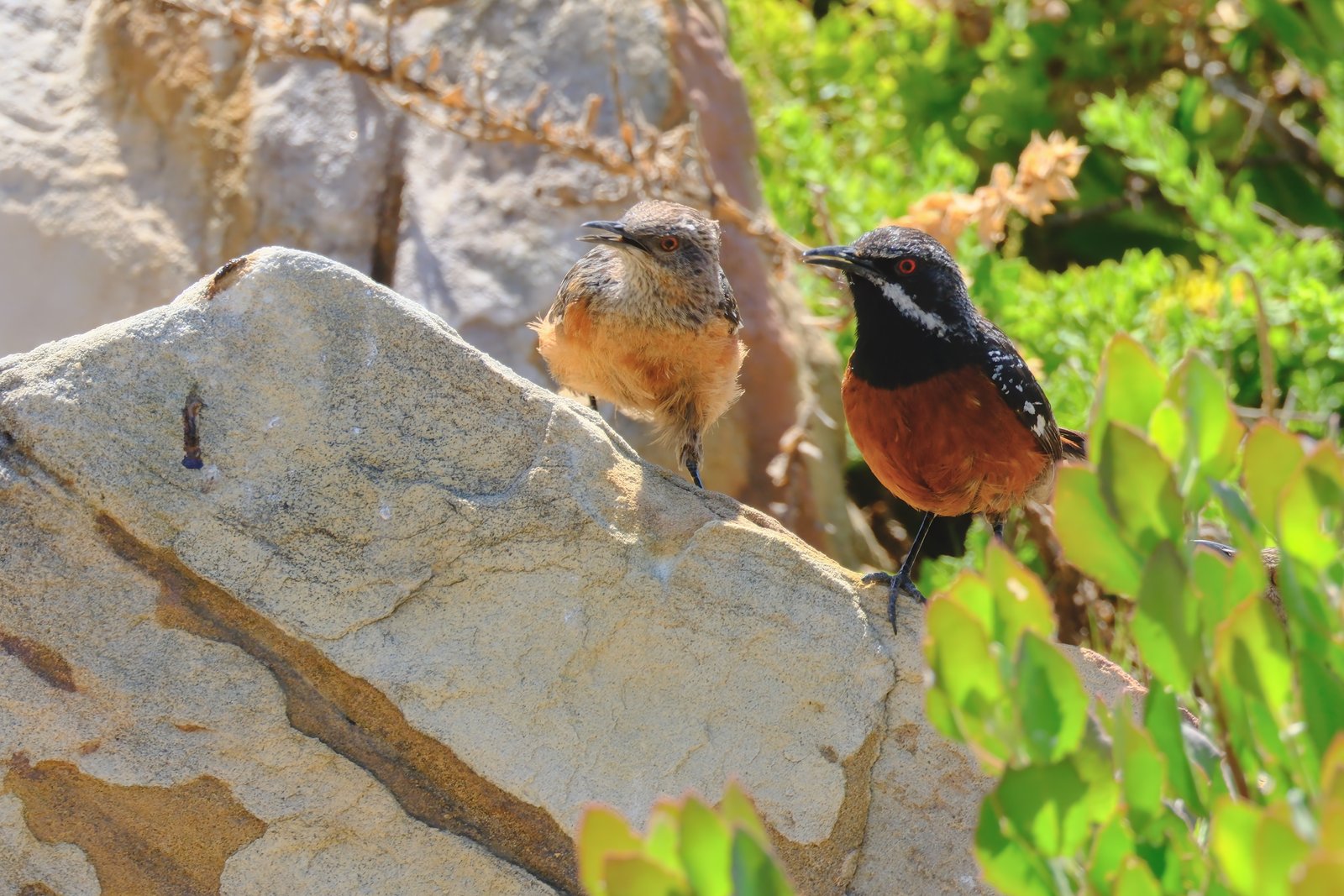
Between 23 and 25 cm long, much of it tail. The male has a slate-grey head with a broad black mask, a white malar stripe and a white throat band, rust-orange breast, belly and rump, and a long black tail with white tips to the outer feathers. The eye is red, the bill and the strong legs black. The female is duller: grey-brown above, paler cinnamon below, with buff instead of white facial stripes. It rarely flies far, moving instead in long bounds over the rocks with the tail cocked.
Confusion species
Drakensberg Rockjumper (Chaetops aurantius) of the Lesotho highlands and the Drakensberg also has a black throat with a white moustachial stripe, but its underparts are a much paler orange to ochre (the female paler than the Cape's); the ranges of the two do not meet. Cape Rock Thrush (Monticola rupestris) shares the rocky slopes but has a shorter tail, a blue-grey head without a black mask or white stripes, and flies readily.
Habitat
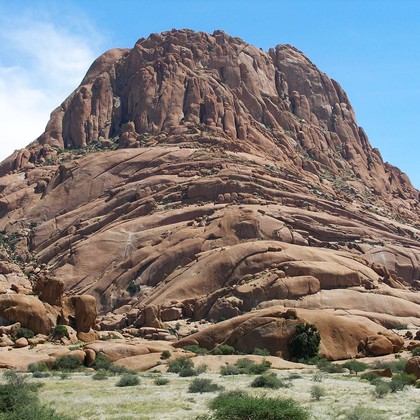
Rocky mountain slopes with short, low fynbos of restios and ericas, usually above about 600 metres and most numerous on cool slopes at greater altitude. Searches the ground among boulders for insects, spiders and small lizards, turning stones over as it goes.
Where the bird is most at home, classified by the vegetation units of southern Africa.

Range and movements
Endemic to the Cape Fold Mountains of south-western and southern South Africa, from the Cederberg in the north southwards over Hottentots-Holland and Kogelberg and eastwards along the Langeberg, Swartberg and Outeniqua to about the Baviaanskloof. It occurs nowhere else in southern Africa or in the world.
- Resident
- Passage (Mar–Apr, Oct–Nov)
- dark = core range, pale = thinly spread
How and when to look
Come early in the morning, before the heat, and walk slowly along a path across a rocky slope; stop and listen for the thin whistle first. The birds move in parties of two to five and give themselves away by movement on the boulders rather than by flight. The coastal track at Rooi-Els and the slopes at Sir Lowry's Pass and in the Cederberg are the most used sites. In mist or strong wind the birds fall silent and are seldom detected.
Conservation status
Near Threatened. The range is small and numbers are declining. The species is tied to cool high-altitude fynbos and is sensitive to heat stress, so the lower edge of its range is shifting onto higher slopes. Too-frequent or late-season fires, and the spread of alien pines and hakea, degrade the low vegetation between the rocks.
Scientific name
Chaetops frenatus | (Temminck, 1826)
Temminck described the species in 1826 as Malurus frenatus; because it was later moved to another genus, the author and year stand in brackets. The genus Chaetops was introduced in 1832 by Swainson. Chaetops comes from the Greek khaitē, 'hair', and ōps, 'face': 'bristle eye', referring to the presence of eyelashes (Hockey et al., 2005). frenatus is Latin for 'bridled', for a bridle-like stripe pattern on the face. The specimen the first description was based on came from the Riviersonderend Mountains, Cape Province.