All species › Passerines › Wagtails and pipits › Cape Longclaw
Cape Longclaw | Macronyx capensis
Kaapse langklauw | Bisbita del Cabo
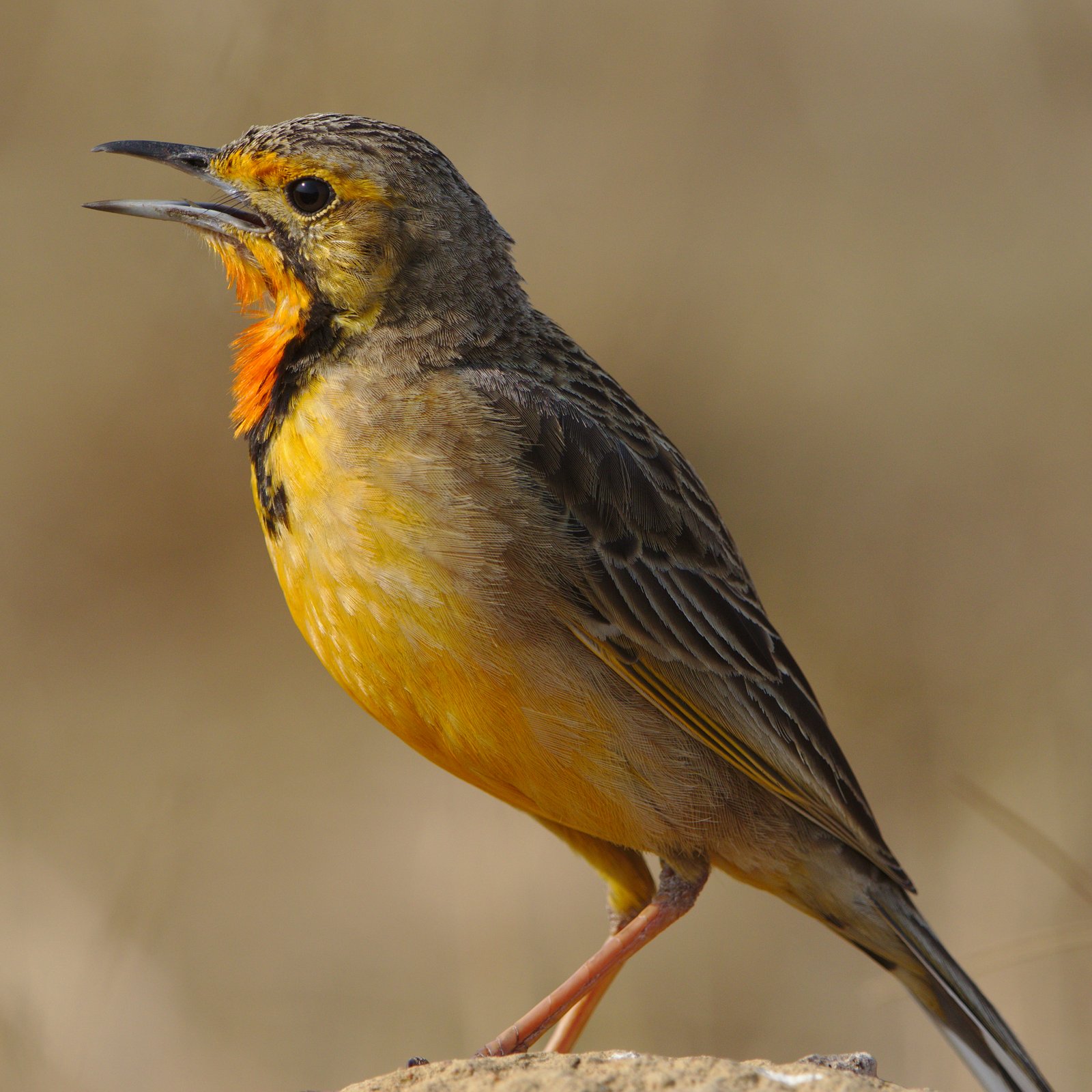
The Cape Longclaw is the characteristic longclaw of South African grassland, with an orange throat framed by a black necklace. It likes to perch upright on a grass tuft, a stone or a fence post, and gives its mewing call from there. It is endemic to southern Africa.
Voice
The best-known call is a loud, mewing meeew, often repeated in alarm, like a cat in the grass. There is also a clear whistled chuweet or tchoo-wee-oo, given from a lookout or in a short song flight on quivering wings. In flight a sharp tseet.
Recording: Dawie de Swardt — CC BY-NC-SA 4.0 · converted to mono · xeno-canto
Identification
A robust, pipit-like bird of 19 to 21 cm with a heavy bill, long legs and a strikingly long hind claw. The upperparts are warm brown with dark streaks. The adult has a vivid orange throat enclosed by a broad black necklace that runs across the breast, and a warm yellow-orange breast and belly; the flanks are streaked brownish. The tail is dark with white corners, visible on take-off. The female is slightly duller. The juvenile is quite different: buff to pale yellow below, with a vague or spotted necklace and an ochre-yellow rather than orange throat. The flight is distinctive: short bursts of stiff, rapid wingbeats alternating with glides.
Confusion species
Yellow-Throated Longclaw (Macronyx croceus) has a yellow instead of orange throat and perches in trees far more often; the two overlap in KwaZulu-Natal, Mpumalanga and eastern Zimbabwe. Juveniles are very similar: those of Cape Longclaw have a warmer ochre throat and underparts. Yellow-Breasted Pipit (Hemimacronyx chloris) is smaller and finer-billed, with a scaly back and no necklace. Cape Longclaw is also known in English as Orange-Throated Longclaw.
Habitat
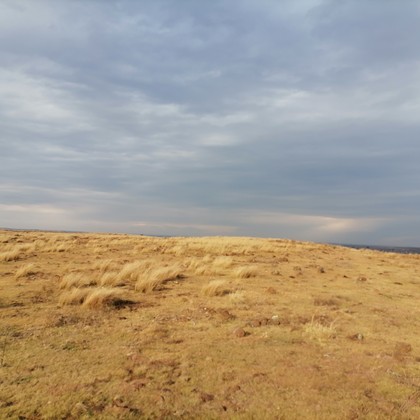
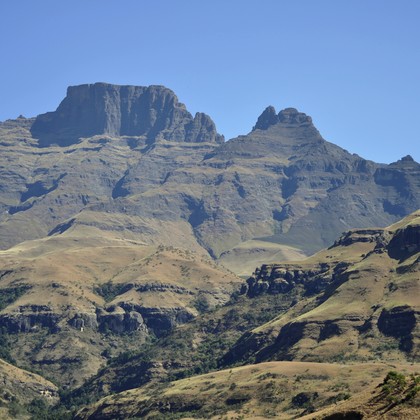
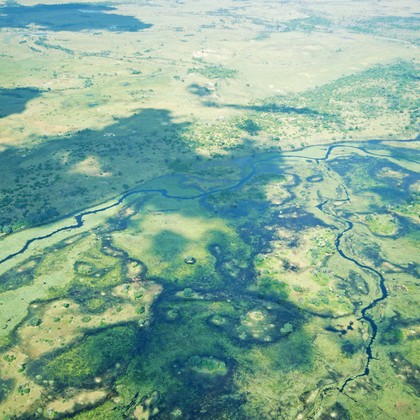
Open, short to medium grassland, moist grassland around vleis and marshes, coastal grassland, grazed pasture, sports fields and golf courses, and in the Western Cape also renosterveld and open fynbos. From sea level to over 2000 m. It forages on foot for insects; the nest is well hidden under a grass tuft.
Where the bird is most at home, classified by the vegetation units of southern Africa.
Range and movements
Endemic to southern Africa. Widespread in the eastern half of South Africa, from Limpopo and Mpumalanga through the Highveld, Free State and KwaZulu-Natal to the Eastern and Western Cape, and into Lesotho and Eswatini. A separate population lives in the eastern highlands of Zimbabwe and the adjacent border area of Mozambique. Absent from the dry Karoo and the west.
- Resident
- Summer visitor (c. Oct–Mar)
- Passage (Mar–Apr, Oct–Nov)
- dark = core range, pale = thinly spread
How and when to look
Drive slowly along grassland roads and watch for an upright bird on a grass tuft or post turning its orange throat towards you. The mewing alarm often gives the species away before it is seen; once learnt, it is heard everywhere on the Highveld. On take-off the white tail corners and the stiff flight are good features.
Conservation status
Not threatened. The species is common and widespread and adapts well to grazed grassland and golf courses. It disappears locally where grassland is converted to cropland or timber plantations, or where vleis are drained.
Scientific name
Macronyx capensis | (Linnaeus, 1766)
Linnaeus described the species in 1766 as Alauda capensis; because it was later moved to another genus, the author and year stand in brackets. The genus Macronyx was introduced in 1827 by Swainson. Macronyx comes from the Greek makros, 'long', and onux, 'claw' — for the very long hind claw of these birds. capensis means 'of the Cape', for the Cape of Good Hope. The specimen the first description was based on came from Cape of Good Hope.