All species › Passerines › Waxbills › Brown Firefinch
Brown Firefinch | Lagonosticta nitidula
Bruine amarant | Amaranta Parda
The Brown Firefinch is the dullest of the firefinches: a warm brown waxbill with only a reddish wash and fine white spots on face, throat and breast. It lives in dense waterside vegetation along the great rivers and swamps of the north of the region, with the Okavango Delta as its stronghold.

Voice
A soft, high tseet or tset as contact call, speeded up into a short rattling series when excited. The song is a quiet, whistled twitter of a few clear notes, often given from cover.
Recording: Dries Van de Loock — CC BY-NC-SA 4.0 · converted to mono · xeno-canto
Identification
About 10 cm. The male is mostly chocolate-brown, with red on lores, cheeks, throat and upper breast; the breast sides and flanks carry fine white spots. Unlike the other firefinches the rump is brown, not red; the tail is dark brown. The undertail coverts are pale brown to buff, not black. The bill is pink to red with a dark culmen, the eye-ring pale grey. The female shows less and duller red on face and breast. Juveniles are plain brown without red or spots, with a dark bill.
Confusion species
Female Red-Billed Firefinch (Lagonosticta senegala) is also brown with a red bill, but has only red lores, a red rump and a yellow eye-ring. African Firefinch (Lagonosticta rubricata) and Jameson's Firefinch (Lagonosticta rhodopareia) are much redder below, with a red rump, a blue-grey bill and black undertail coverts. The brown rump, pale undertail coverts and red bill together are decisive.
Habitat
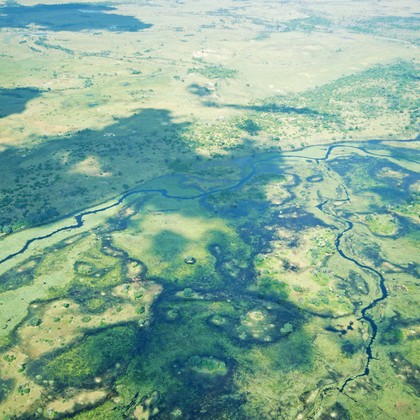
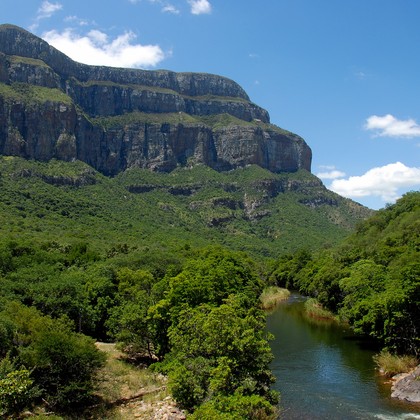
Dense scrub, rank grass, papyrus and reed edges along rivers, swamps and floodplains, and tangles around camps and villages close to water. It lives in pairs or small groups and picks small seeds from bare ground, usually close to cover; it also eats termites and small ants. It nests in dense bushes and also uses old weaver nests.
Where the bird is most at home, classified by the vegetation units of southern Africa.
Range and movements
Within the region in eastern and southern Angola, western and northern Zambia, northern Botswana (Okavango Delta, Moremi, Linyanti and Chobe), north-eastern Namibia (Kavango and the Zambezi Region) and the extreme north-west of Zimbabwe. Beyond the region only in southern DR Congo and south-western Tanzania.
- Resident
- Summer visitor (c. Oct–Mar)
- Winter visitor (c. Apr–Sep)
- Passage (Mar–Apr, Oct–Nov)
- dark = core range, pale = thinly spread
How and when to look
Most often seen in the camps and lodges of the Okavango Delta, Moremi and along the Chobe and Kavango, where it can become tame around bird baths and under bushes. Watch for the brown rump when a bird flies off: every other firefinch shows red. Where Red-Billed Firefinches are around, carefully rule out the females first.
Conservation status
Not threatened. Locally common within its limited range near water in the north of the region. Burning and clearing of riverside thickets may cost habitat locally, but no general decline is known.
Scientific name
Lagonosticta nitidula | Hartlaub, 1886
Hartlaub described the species in 1886 and placed it straight away in the genus where it still stands. The genus Lagonosticta was introduced in 1851 by Cabanis. Lagonosticta comes from the Greek lagōn, 'flank', and stiktos, 'spotted' — for the white spots on the flanks of firefinches. nitidula is a Latin diminutive of nitidus, 'shining, neat' — 'the neat little one'. The specimen the first description was based on came from Mpala, near Lake Tanganyika, DR Congo.