All species › Passerines › Waxbills › African Firefinch
African Firefinch | Lagonosticta rubricata
Donkerrode amarant | Amaranta Ocre
The African Firefinch is a deep crimson firefinch of dense tangles and forest edges in the east of the region. It lives secretively and is heard more often than seen, but in gardens with thick shrubbery it regularly comes close to the house.

Click a thumbnail to switch the photo above.
Voice
The call is a fast, dry rattling trrrrrr in alarm, and a loud, clear repeated wink-wink-wink or vit-vit-vit. The song consists of ringing notes repeated in random order, interspersed with squeaky whistles, trills and warbles.
Recording: Ranive — CC BY-NC-SA 4.0 · converted to mono · xeno-canto
Identification
10 to 11 cm. The male is deep wine-red to crimson below, with a few fine white spots on the breast sides; belly, undertail coverts and thighs are black. Back and wings are brown, contrasting sharply with the red underparts; rump and uppertail coverts are red, the tail blackish. In the nominate form of South Africa and southern Mozambique the crown is grey; in birds of Zimbabwe, Malawi and further north (haematocephala) it is almost wholly red. The bill is blue-grey to slate with a dark culmen. The female is paler and more orange-red, with a brown wash on the belly. Juveniles are brown with only a red rump.
Confusion species
Jameson's Firefinch (Lagonosticta rhodopareia) is very similar but paler and pinker, with a pink wash over crown and back instead of pure brown; it lives in drier, open thornveld. Red-Billed Firefinch (Lagonosticta senegala) has a pinkish-red bill, a yellow eye-ring, pale brown undertail coverts and, in the male, red extending over head and back. Brown Firefinch (Lagonosticta nitidula) is largely brown, without a red rump. Voice and habitat are often the quickest guides.
Habitat
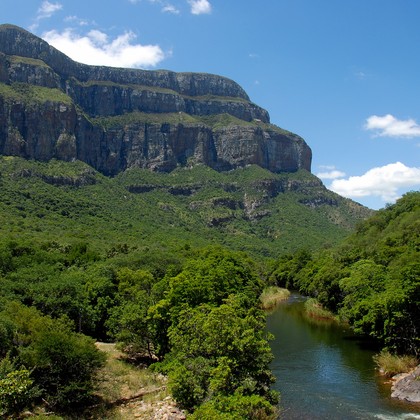
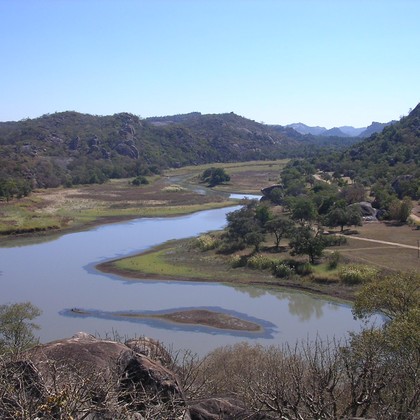
Dense, moist tangles: forest edges, bracken, bramble thickets, rank grass along streams and rivers, the dense understorey of woodland and well-planted gardens. It forages on the ground close to cover for small grass seeds, usually in pairs or family groups. It is the host of Dusky Indigobird (Vidua funerea), which lays its eggs in its nest.
Where the bird is most at home, classified by the vegetation units of southern Africa.
Range and movements
Within the region in eastern South Africa (Eastern Cape, KwaZulu-Natal, Mpumalanga and Limpopo), Eswatini, Mozambique, eastern and northern Zimbabwe, Malawi, Zambia and Angola; absent from the arid west. Beyond the region widespread south of the Sahara, from Senegal to Ethiopia and south through DR Congo and Tanzania.
- Resident
- Summer visitor (c. Oct–Mar)
- Winter visitor (c. Apr–Sep)
- Passage (Mar–Apr, Oct–Nov)
- dark = core range, pale = thinly spread
How and when to look
Listen along forest edges and streamside tangles for the rattling alarm and the clear vit-vit-vit; the birds then often pop up briefly onto a twig. When in doubt against Jameson's Firefinch, check the back colour: brown in this species, pinkish-grey in Jameson's. Well-watered, thickly planted gardens in KwaZulu-Natal and the Lowveld often give the best views.
Conservation status
Not threatened. Common to fairly common in suitable tangles. Loss of riverside thickets and forest edges to clearing and overgrazing costs habitat locally, while densely planted gardens may actually help the species.
Scientific name
Lagonosticta rubricata | (Lichtenstein, 1823)
Lichtenstein described the species in 1823 as F[ringilla] rubricata; because it was later moved to another genus, the author and year stand in brackets. The genus Lagonosticta was introduced in 1851 by Cabanis. Lagonosticta comes from the Greek lagōn, 'flank', and stiktos, 'spotted' — for the white spots on the flanks of firefinches. rubricata is Latin for 'coloured red', from rubrica, 'red ochre' — for the dark red plumage. The specimen the first description was based on came from Uitenhage, Eastern Cape, South Africa.