All species › Waders, gulls and terns › Gulls and terns › Bridled Tern
Bridled Tern | Onychoprion anaethetus
Brilstern | Charrán Embridado
The Bridled Tern is the smaller, greyer counterpart of the Sooty Tern, an oceanic tern of tropical seas with a white supercilium extending behind the eye. Off the east coast of southern Africa it is a scarce summer visitor.
Voice
A high, yapping wep-wep and a short nasal kerrr; more persistent at colonies than at sea.
Recording: David Darrell-Lambert — CC BY-NC-SA 4.0 · converted to mono · xeno-canto
Identification
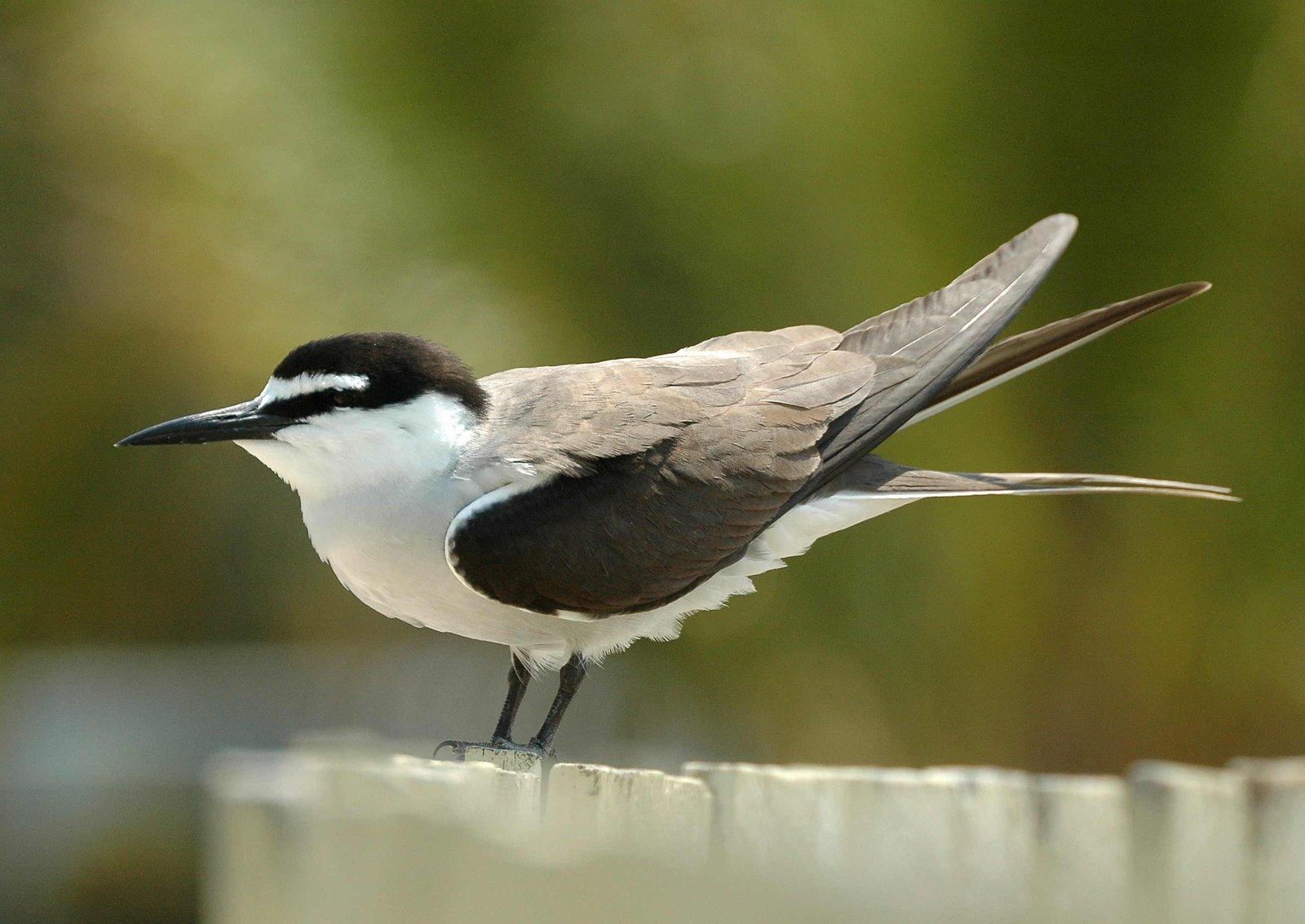
About 37 cm, slim, with long, narrow wings and a deeply forked tail with long white outer feathers. The cap and eye-stripe are black; a narrow white forehead runs as a supercilium to behind the eye. A pale grey hind collar separates the cap from the greyish-brown mantle and wings, which are clearly paler than the cap. The underparts are white, the underwing white with dark primaries. Bill and legs black. Juveniles have a streaked, paler crown, pale-fringed greyish-brown upperparts without white spots, and white underparts.
Confusion species
Sooty Tern (Onychoprion fuscatus) is larger and bulkier, with black rather than greyish-brown upperparts that do not contrast with the cap, no pale hind collar, and a broader white forehead that does not extend behind the eye. Juvenile Sooty Terns are wholly dark with white spots, juvenile Bridled Terns white below. Black Terns (Chlidonias niger) and other marsh terns are much smaller, with a short, barely forked tail.
Habitat
Warm tropical seas, often closer to the coast and to reefs than the Sooty Tern. It feeds alone or in small groups, picking prey from the surface, and likes to rest on floating weed, driftwood and buoys. It breeds on rocky and coral islands, hidden under rocks or in dense vegetation.
Where the bird is most at home, classified by the vegetation units of southern Africa.


Range and movements
In the region a scarce summer visitor off Mozambique and KwaZulu-Natal, mostly far offshore and sometimes along the coast after storms; elsewhere in the region a vagrant, with exceptional records off Angola and the south coast of South Africa. In the western Indian Ocean it breeds in the Seychelles and along the coasts of East Africa and the Red Sea, and further in the tropical Atlantic, Indian and Pacific Oceans.
- Passage (Mar–Apr, Oct–Nov)
- dark = core range, pale = thinly spread
How and when to look
The best chance is a summer pelagic trip from Ponta do Ouro or Shelly Beach, or a seawatch after an easterly storm. Look for a slim tern with a black cap and a clearly paler, greyish-brown back, often perched on a floating object.
Conservation status
Not threatened. The world population is large. Locally colonies are affected by introduced predators, disturbance and egg collecting, and oil pollution and overfishing pose risks.
Scientific name
Onychoprion anaethetus | (Scopoli, 1786)
Scopoli described the species in 1786 as Sterna Anaethetus; because it was later moved to another genus, the author and year stand in brackets. The genus Onychoprion was introduced in 1832 by Wagler. Onychoprion comes from Greek onux 'nail, claw' and prion 'saw'. anaethetus goes back to Greek anaisthētos and means 'senseless, stupid'. The specimen the first description was based on came from Panay, Philippines.