All species › Passerines › Cisticolas › Black-Necked Eremomela
Black-Necked Eremomela | Eremomela atricollis
Zwarthalseremomela | Eremomela Cuellinegra
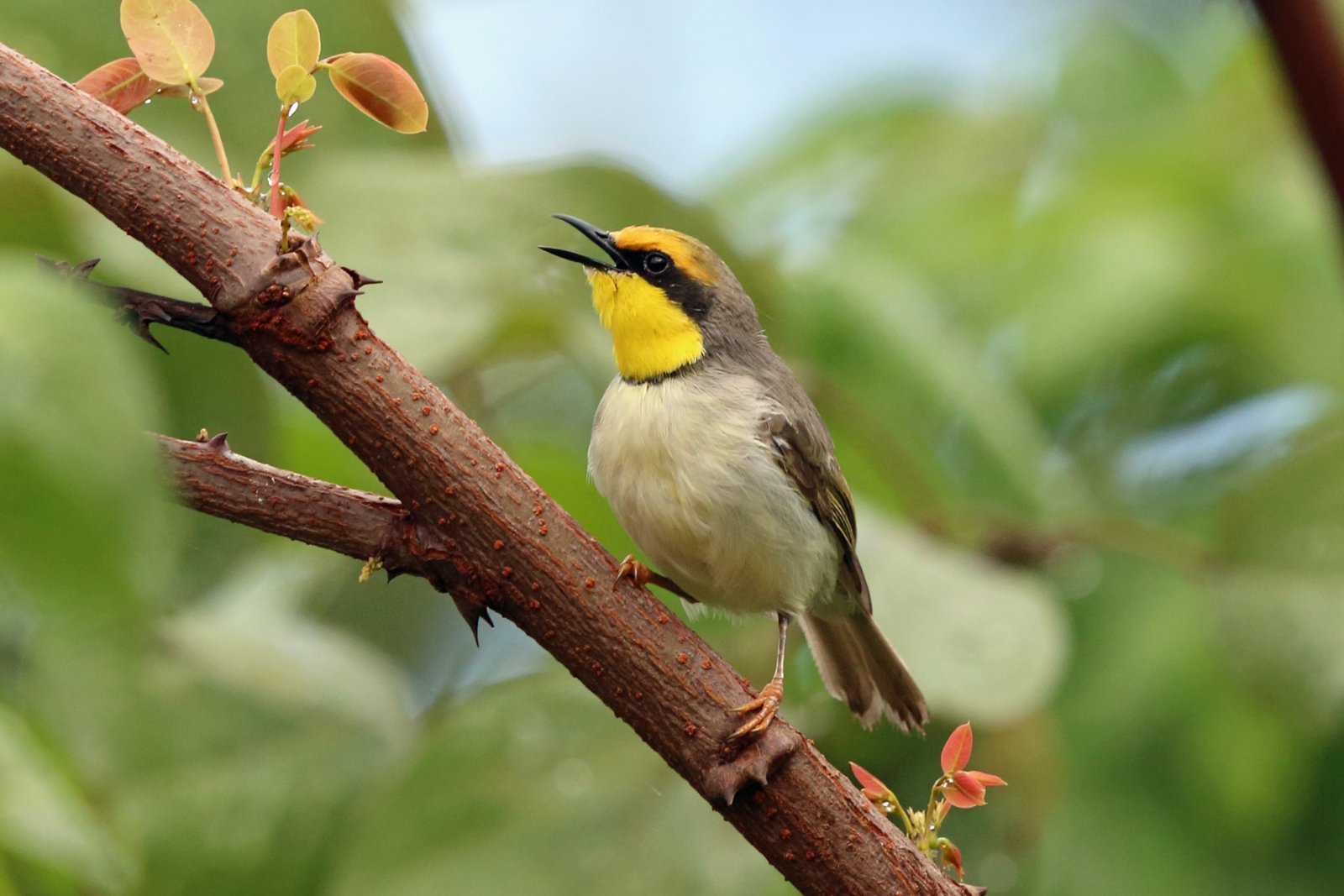
The Black-Necked Eremomela is a small, colourful eremomela of the miombo on the Angolan plateau and in north-western Zambia. A black eye-mask, a yellow throat and a fine black collar make it unmistakable with a good view. It moves in parties through the crowns of Brachystegia trees.
Voice
A dry, rasping dzrrt dzrrt, repeated for several seconds, and high, thin contact calls, tsee-tsee, that keep the party together. The rasping sound stands out among the other voices of a mixed foraging flock.
Recording: Dries Van de Loock — CC BY-NC-SA 4.0 · converted to mono · xeno-canto
Identification
10–11 cm. Forehead and forecrown are warm orange-yellow to rusty yellow, the hindcrown and back grey, the wings olive with darker flight feathers. A black mask runs from the lores through the eye to the ear-coverts. The throat is bright yellow and is bordered below by a narrow, sharp black collar; beneath this the breast and belly are white with a pale yellow wash on the flanks. The tail is short and grey. The sexes are alike; juveniles are duller, with a faint or missing collar. It moves quickly and acrobatically through the canopy foliage.
Confusion species
Green-Capped Eremomela Eremomela scotops shares the miombo and also moves in parties, but has a greenish crown, a pale iris, no black mask and no collar. Yellow-Bellied Eremomela Eremomela icteropygialis is grey with a yellow lower belly and a white throat, lacks mask and collar, and lives in drier, more open savanna. Red-Capped Crombec Sylvietta ruficapilla of the same woodland is larger, almost tailless, and has rufous ear-coverts and a grey breast-band.
Habitat
Miombo and other Brachystegia and Julbernardia woodland on the plateau, also woodland with a few tall trees in cultivated areas. It forages in the upper canopy for small insects and larvae, in pairs or parties of three to eight, almost always as part of a mixed flock with tits, crombecs and other eremomelas.
Where the bird is most at home, classified by the vegetation units of southern Africa.

Range and movements
Within the region in central and eastern Angola (especially the central plateau of Huambo, Bié and Malanje east to the Lunda provinces) and in north-western and northern Zambia, east to about the Copperbelt. Beyond the region only in southern DR Congo (Katanga and Kasaï). A species of the southern miombo belt with a small total range.
- Resident
- Summer visitor (c. Oct–Mar)
- Winter visitor (c. Apr–Sep)
- Passage (Mar–Apr, Oct–Nov)
- dark = core range, pale = thinly spread
How and when to look
Year-round; wait in miombo for a mixed foraging flock, announced by tits and drongos, and move with it until the eremomelas appear in the canopy. In Zambia the miombo around Mwinilunga and Solwezi is good; in Angola the woodland around Kalandula and on the plateau near Huambo. Listen for the dry dzrrt to pick the species out among Green-Capped Eremomelas.
Conservation status
Not threatened. Locally fairly common in intact miombo. Large-scale clearance for charcoal and agriculture in Angola and Zambia is reducing suitable woodland, but the species still occurs over large areas and there is no evidence of a steep decline.
Scientific name
Eremomela atricollis | Bocage, 1894
Bocage described the species in 1894 and placed it straight away in the genus where it still stands. The genus Eremomela was introduced in 1850 by Sundevall. Eremomela comes from the Greek erēmos, 'desert', and melos, 'song' — 'desert songster', for the arid regions where the first species were found. atricollis comes from the Latin ater, 'black', and collum, 'neck' — for the black collar. The specimen the first description was based on came from Galanga, Angola.