All species › Cranes, rails and allies › Rails and crakes › Black Crake
Black Crake | Zapornia flavirostra
Zwart porseleinhoen | Polluela Negra Africana
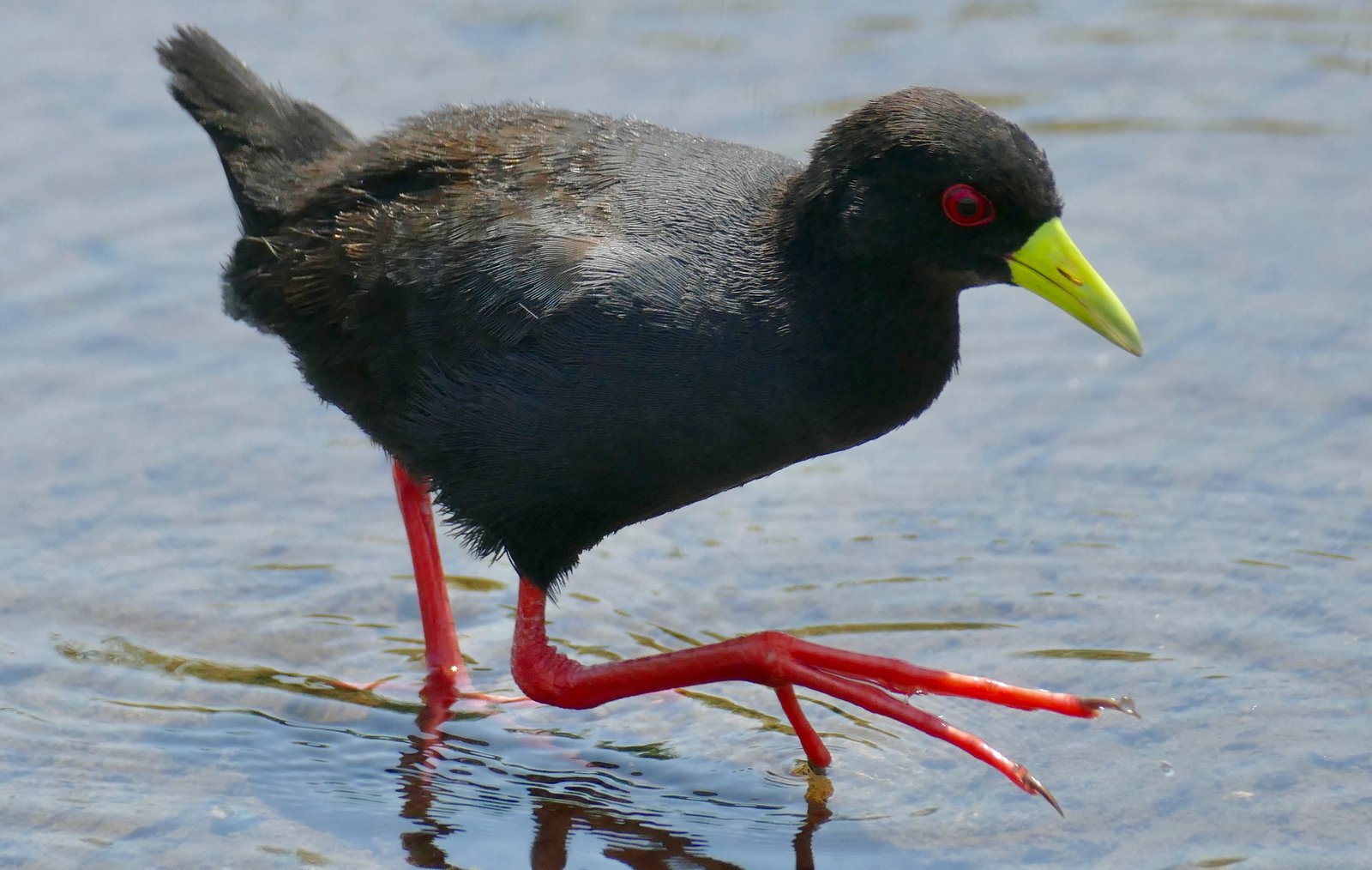
The Black Crake is the most frequently seen rail in southern Africa: an all-black little crake with a bright yellow bill and red legs that walks in the open over water lilies and along reed edges, sometimes even on the backs of hippos.
Voice
A loud, rasping duet by a pair or family group: a fast chatter and cackle that rises and falls, rrrr-krrr-krrr-kokoko, often ending in a croaking jabber. Also a sharp chek in alarm. Very often heard, also by day.
Recording: Kileo Jumah — CC0 · converted to mono · xeno-canto
Identification
About 21 cm. Adult plumage is uniform glossy black, slightly browner olive-black on the back and wings. The bill is bright greenish yellow to lemon-yellow, the eye and eye-ring red, and the long legs and toes bright coral red. The sexes are alike. Juveniles are dull olive-brown to grey-brown with a pale throat, a dark bill and brownish to dull pink legs, gradually acquiring black plumage. It constantly flicks its short tail.
Confusion species
Unmistakable given the black plumage, yellow bill and red legs. The Lesser Moorhen (Paragallinula angulata) also has a yellow bill, but with a red culmen and small shield, a grey head, an olive-brown back and greenish-yellow legs. The Common Moorhen (Gallinula chloropus) is larger, with a red bill and a white flank line. Juvenile Black Crakes can be confused with other young rails but are uniformly dark without streaks or barring.
Habitat
Almost any fresh water with dense fringing vegetation: reedbeds, papyrus, water-lily beds, riverbanks with overhanging shrubs, dams, vleis and sewage works. It walks over floating vegetation and feeds at the open edge. It eats aquatic insects, worms, snails, small fish, tadpoles, eggs and seeds, and picks parasites off hippos and warthogs.
Where the bird is most at home, classified by the vegetation units of southern Africa.

Range and movements
Common in the north and east of the region: Angola, Zambia, Malawi, Mozambique, Zimbabwe, northern Botswana and Namibia, Eswatini, and in South Africa mainly in the east, on the Highveld and along the south coast to the Western Cape; absent from the dry Karoo, the Kalahari and the Namib. Beyond the region across almost all of sub-Saharan Africa and along the Nile.
- Resident
- Summer visitor (c. Oct–Mar)
- Winter visitor (c. Apr–Sep)
- Passage (Mar–Apr, Oct–Nov)
- dark = core range, pale = thinly spread
How and when to look
All year at almost any lily pond or reed-fringed water in the east of the region; often the first rail a visitor sees. Wait at a hide by a lily pond or at riverside lodges in the Okavango and Kruger: the birds walk over the leaves right in front of the observer.
Conservation status
Not threatened and common. It adapts well to artificial waters. It declines locally where fringing vegetation disappears through grazing, mowing or the draining of marshes.
Scientific name
Zapornia flavirostra | (Swainson, 1837) (GBIF: Amaurornis flavirostra)
Swainson described the species in 1837 as Gallinula flavirostra; because it was later moved to another genus, the author and year stand in brackets. The genus Zapornia was introduced in 1816 by Leach. Zapornia is a near-anagram of Porzana, the genus of the French ornithologist Louis-Pierre Vieillot. flavirostra comes from the Latin flavus, 'yellow', and rostrum, 'bill' — for the bright yellow bill. The specimen the first description was based on came from Senegal.