All species › Passerines › Chats and flycatchers › Arnot's Chat
Arnot's Chat | Myrmecocichla arnotti
Arnots miertapuit | Zorzal Hormiguero de Arnot
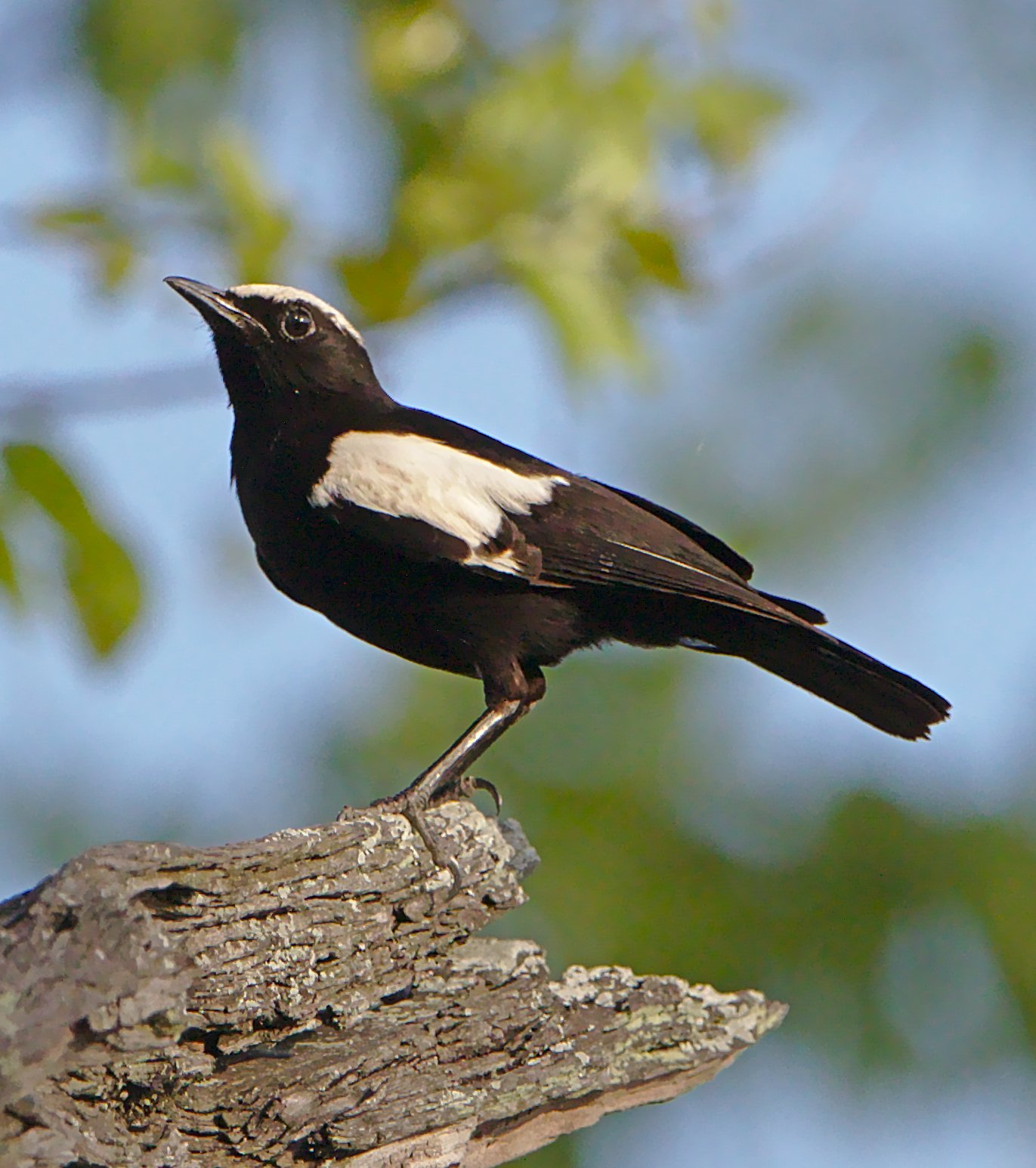
Arnot's Chat is the glossy black chat of mopane and miombo woodland, with a striking white crown in the male and a white throat in the female. Pairs forage on bare ground between the trees and fly up to a low branch or dead trunk when disturbed. It is one of the characteristic birds of mopane country.
Click a thumbnail to switch the photo above.
Voice
A soft, high whistled fweee and a short chik as a contact call. The song is a quiet series of clear whistles and squeaky notes, at times with mimicry, usually delivered from a branch or a termite mound.
Recording: Dries Van de Loock — CC BY-NC-SA 4.0 · shortened to the first 60 s, mono · xeno-canto
Identification
A compact chat of 16 to 18 cm. The male is glossy black with a pure white crown and forehead and a white patch on the lesser wing coverts, showing as a white shoulder bar in flight. The female has a black crown, but a white throat and upper breast, often spotted black on the lower edge, and the same white shoulder patch. Juveniles are duller black, sometimes with a few white feathers on the head or throat. There is no white in rump or tail. Bill and legs are black. It moves on the ground in short hops and flicks its wings on landing.
Confusion species
Male Sooty Chat (Myrmecocichla nigra) of Angola and Zambia has only a white shoulder patch and no white crown, and lives in open grassland, not woodland. Southern Anteater-Chat (Myrmecocichla formicivora) is brownish-black with no white on the head and shows white primary windows in flight. Mountain Chat (Myrmecocichla monticola) has a white rump and white tail sides and lives in rocky terrain. Southern Black Flycatcher (Melaenornis pammelaina) is slimmer, without any white, and hunts from a perch.
Habitat
Open mopane and miombo woodland with bare or sparsely vegetated ground, often after fire or where there is much fallen wood and many dead trees. Forages on the ground for ants, termites and other insects. Nests in a tree cavity, often an old woodpecker hole or a crack in a dead trunk.
Where the bird is most at home, classified by the vegetation units of southern Africa.


Range and movements
Within the region in north-eastern South Africa (Limpopo and northern Kruger National Park), Zimbabwe, eastern and northern Botswana, central and northern Mozambique, Zambia and southern Malawi; in Angola represented by the subspecies harterti in the interior. Beyond the region in southern DR Congo and in Tanzania, where the form collaris (Ruaha Chat) is sometimes treated as a separate species.
- Resident
- dark = core range, pale = thinly spread
How and when to look
Drive or walk through mopane woodland in northern Kruger, around Punda Maria and Pafuri, or in the Zambezi Valley in Zimbabwe, and watch for black birds flying up from the ground to a dead branch. A pair usually stays within the same patch of woodland; the male's white head is clearly visible at a distance.
Conservation status
Not threatened. The species declines locally where mopane and miombo woodland is cleared for charcoal and farming, and where dead trees with nest holes are removed. Numbers are stable in protected areas.
Scientific name
Myrmecocichla arnotti | (Tristram, 1869) (GBIF: Pentholaea arnotti)
Tristram described the species in 1869 as Saxicola arnotti; because it was later moved to another genus, the author and year stand in brackets. The genus Myrmecocichla was introduced in 1851 by Cabanis. Myrmecocichla comes from the Greek myrmex, 'ant', and kichle, 'thrush' — an 'ant-thrush', for foraging on ants and termites. arnotti honours the Cape lawyer and amateur naturalist David Arnot (1821–1894), agent to the Griqua; Tristram believed he had collected the type and spelled the name 'Arnott'. The specimen the first description was based on came from Victoria Falls, Zimbabwe.