All species › Birds of prey › Hawks, eagles and kites › African Fish Eagle
African Fish Eagle | Icthyophaga vocifer
Afrikaanse zeearend | Pigargo Vocinglero
With its white head and breast, chestnut belly and loud, ringing call, the African Fish Eagle is the image and sound of African waters. It is the national bird of Zambia, Zimbabwe, Namibia and South Sudan and appears on the coat of arms of several countries. Pairs hold a fixed territory along a stretch of river or lake shore all year.

Voice
The best-known bird call of Africa: a loud, ringing weee-ah, kyo-kyo-kyo, delivered with the head thrown far back, both perched and in flight. Pairs often call in duet; the female has a lower voice. Calls especially in the early morning.
No recording with a suitable Creative Commons licence is available for this species yet.
Identification
63–75 cm, wingspan 190–240 cm. A large, heavily built eagle with broad, rounded wings and a short white tail. Adults have a brilliant white head, neck, breast and tail, a chestnut belly and underwing coverts, and black flight feathers and back. Face and legs are yellow, the bill black with a yellow cere. The female is noticeably larger than the male and has more white on the breast. Juveniles are untidily mottled brown and white, with a dark breast band, a white tail with a dark terminal band and much white in the underwing; adult plumage is reached after four to five years.
Confusion species
Adults are unmistakable. Palm-Nut Vulture Gypohierax angolensis is white with black secondaries and scapulars, black-tipped white primaries, white (not chestnut) underparts, and has a bare red face. Juvenile fish eagles can be confused with juvenile Palm-Nut Vultures or with Osprey Pandion haliaetus, which is slimmer, has angled wings with a dark carpal patch and a dark eye-stripe on a white head.
Habitat
Large rivers, lakes, reservoirs, dams, floodplains, lagoons, estuaries and mangroves; wherever open water with plenty of fish and tall perches occurs. It catches fish of up to about 3 kg by grabbing them at the surface in a shallow stoop from a lookout. It also takes waterbirds, flamingos and heron chicks, and pirates fish from other birds. It nests in a large stick nest in a tall tree near water.
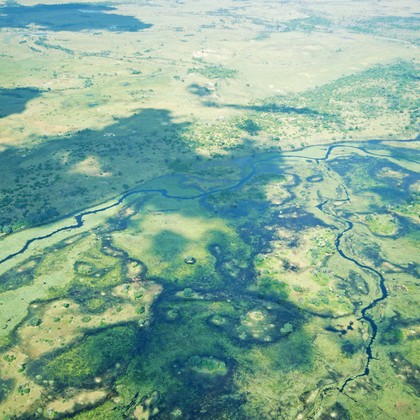
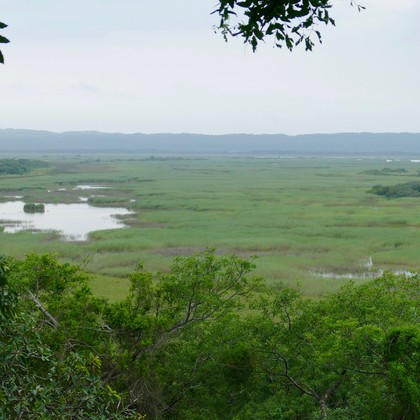
Where the bird is most at home, classified by the vegetation units of southern Africa.
Range and movements
Widespread across the whole region along large rivers and lakes: numerous in the Okavango Delta and along the Chobe and Zambezi, around Lake Kariba and Lake Malawi, along the Kafue and Luangwa, in Mozambique and eastern South Africa, and in Angola; locally also at dams in the interior of South Africa down to the Cape. Absent from the dry western Karoo and the Namib, except at rivers and coastal lagoons. Beyond the region it occurs in almost all of sub-Saharan Africa.
- Resident
- Summer visitor (c. Oct–Mar)
- Winter visitor (c. Apr–Sep)
- Passage (Mar–Apr, Oct–Nov)
- dark = core range, pale = thinly spread
How and when to look
Usually found by its call: listen at sunrise along a river and follow the ringing sound to a tall dead tree on the bank. Boat trips on the Chobe, on the Zambezi above Victoria Falls or on Lake Kariba give the best chance of seeing a catch at close range, sometimes after the guide has thrown a fish.
Conservation status
Not threatened on the Red List and common in many areas. Locally sensitive to water pollution with heavy metals and pesticides, poisoned baits, disturbance of nest trees and declining fish stocks; the construction of reservoirs has, by contrast, given the species new habitat elsewhere.
Scientific name
Icthyophaga vocifer | (Daudin, 1800) (GBIF: Haliaeetus vocifer)
Daudin described the species in 1800 as Falco vocifer; because it was later moved to another genus, the author and year stand in brackets. The genus Icthyophaga was introduced in 1843 by Lesson. Icthyophaga comes from the Greek ikhthys, 'fish', and -phagos, 'eating' — 'fish-eater'; the spelling without an h goes back to the original description. vocifer is Latin for 'loud-voiced' — for the famous, far-carrying call of African Fish Eagle. The specimen the first description was based on came from the Keurbooms River, Cape Province.