All species › Passerines › Chats and flycatchers › African Dusky Flycatcher
African Dusky Flycatcher | Muscicapa adusta
Kaapse vliegenvanger | Papamoscas Sombrío
The African Dusky Flycatcher is a small, dark and unobtrusive flycatcher of forest edges, riverine woodland and leafy gardens. It perches upright and motionless on a low, shaded branch and makes short sallies to catch insects in the air, often returning to the same perch.

Voice
Usually quiet. The call is a thin, high tseeep or tsst, sometimes followed by a dry tsirr. The song is a soft, high series of squeaky and twittering notes, tsi-tsi-tsirrit, which is often overlooked.
Recording: Walter Wallner — CC BY-NC-SA 4.0 · converted to mono · xeno-canto
Identification
12–13 cm, a stocky, short-tailed flycatcher with a round head and a broad, flat bill with a pale base to the lower mandible. The upperparts are dark greyish-brown, the underparts dirty white with a grey-brown, faintly mottled wash across the breast and flanks. A narrow pale eye-ring and a pale loral spot give the face a soft, ‘surprised’ look. The wings are short, with narrow pale edges to the coverts and tertials. The sexes are alike; juveniles are spotted pale above and scaled dark on the breast. It flicks its wings on landing.
Confusion species
Spotted Flycatcher Muscicapa striata is larger and slimmer, with long wings, a streaked crown and crisper breast streaking; it is present only from October to April and perches higher and more in the open. Ashy Flycatcher Fraseria caerulescens is blue-grey with a black loral line topped by a white stripe. Pale Flycatcher Agricola pallidus is larger, paler brown and plain, and lives in open woodland rather than forest edge. Within the region the plain dark tone, short tail and shaded perch are usually enough.
Habitat
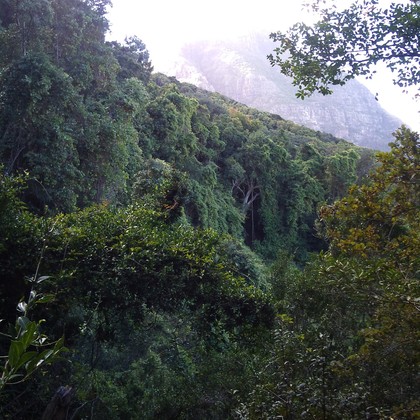
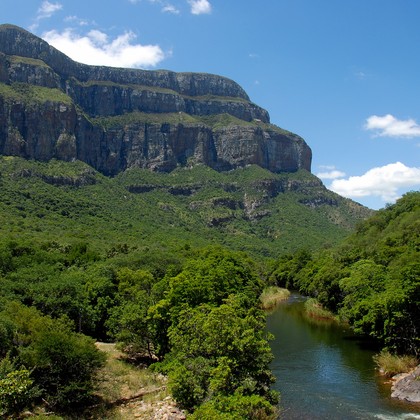
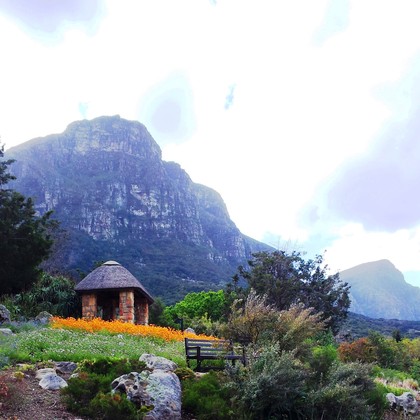
Edges and clearings of indigenous forest, from coastal to montane forest, riverine woodland along rivers and streams, dense thickets in kloofs, plantations of exotic trees, parks and gardens with tall trees. It hunts flying insects from low, shaded branches and sometimes takes prey from the ground. The nest is a small cup in a tree hole, a crack in bark, among ivy or on a wall ledge.
Where the bird is most at home, classified by the vegetation units of southern Africa.
Range and movements
In South Africa along the south and east coasts from the Western Cape to KwaZulu-Natal and in the eastern interior to Mpumalanga and the Limpopo escarpment, and further in Eswatini, locally in Lesotho and in the eastern highlands of Zimbabwe. In Mozambique mainly in the mountains and along the coast, and further in Malawi, northern and eastern Zambia and the western and central highlands of Angola; absent from the arid west and most of Botswana and Namibia. Beyond the region from Cameroon and East Africa to Ethiopia.
- Resident
- Summer visitor (c. Oct–Mar)
- Winter visitor (c. Apr–Sep)
- Passage (Mar–Apr, Oct–Nov)
- dark = core range, pale = thinly spread
How and when to look
Look in the shade along a forest edge or stream for a small, dark bird that keeps sallying from the same low branch. In gardens in the Cape and Natal it is often confiding. In winter highland birds partly move to lower, warmer forests, so it then also turns up in coastal forest and gardens where it is absent in summer.
Conservation status
Not threatened. Common and widespread, and in South Africa the species has benefited from gardens and rows of exotic trees. Habitat is lost locally through clearance of indigenous forest, but the species adapts well to secondary forest and plantations.
Scientific name
Muscicapa adusta | (Boie, 1828)
Boie described the species in 1828 as Butalis adusta; because it was later moved to another genus, the author and year stand in brackets. The genus Muscicapa was introduced in 1760 by Brisson. Muscicapa is Latin, from musca 'fly' and capere 'to catch'. adusta is Latin for 'scorched, burnt' — for the dull brownish-grey plumage. The specimen the first description was based on came from Knysna district, Western Cape, South Africa.