All species › Storks › Storks › Abdim's Stork
Abdim's Stork | Ciconia abdimii
Abdims ooievaar | Cigüeña de Abdim
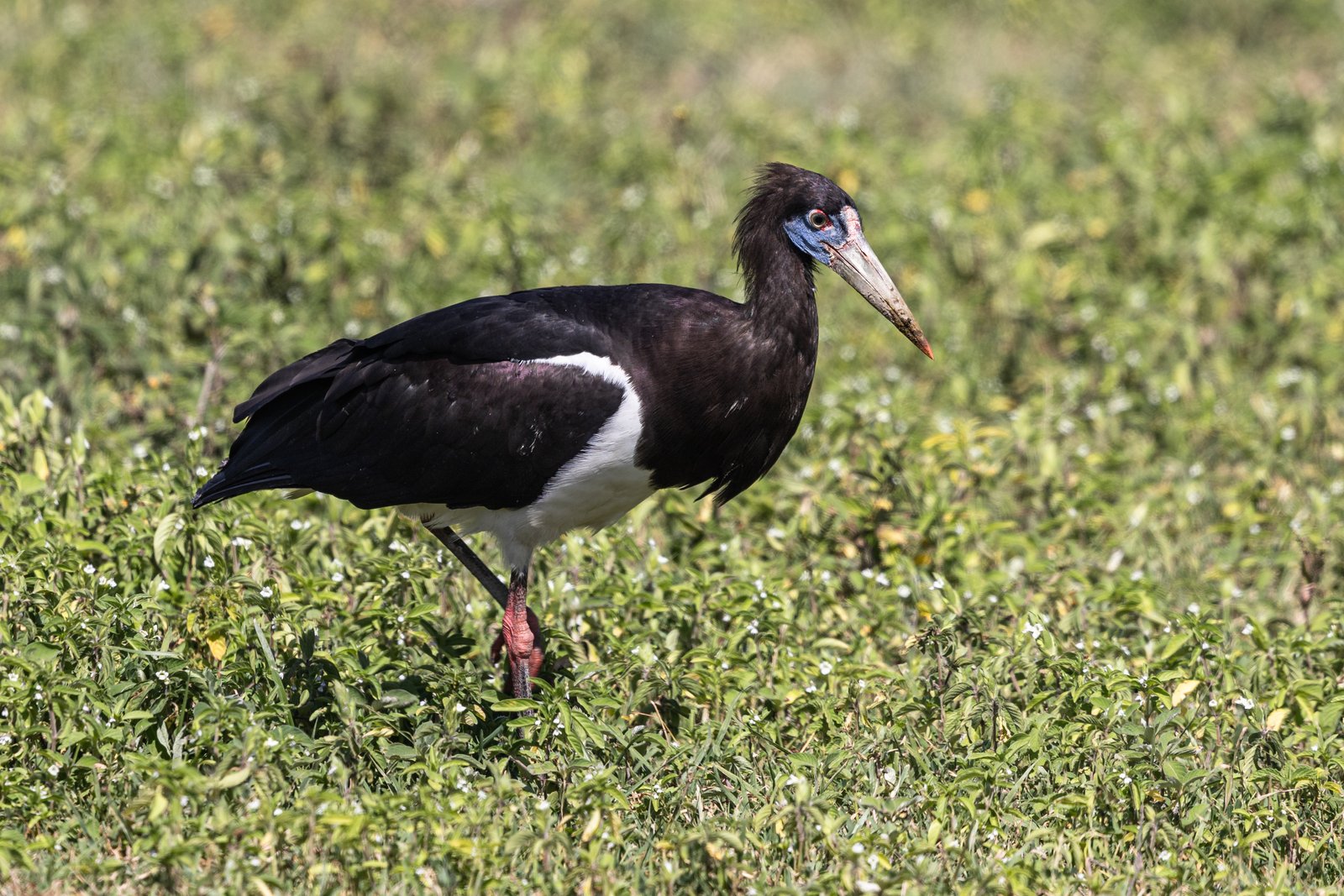
Abdim's Stork is the smallest stork of the region: dark and glossy, with a white belly and white back, a blue face and a short, grey-green bill. It breeds in the Sahel and arrives in the region in large flocks during the southern summer, together with the rains. Here it searches grasslands and farmland for grasshoppers, caterpillars and other insects.
Voice
Mostly silent. At roosts and in the breeding colony a soft, whistling two-note squeak and bill-clattering.
No recording with a suitable Creative Commons licence is available for this species yet.
Identification
75–81 cm, wingspan about 140 cm. Head, neck, breast, wings and tail are blackish-brown with a green and purple gloss; belly, lower back and rump are white. The bare face is blue, with a red patch in front of the eye and red throat skin, most pronounced in the breeding season. The bill is fairly short and grey-green with a red tip; the legs are duller greyish-pink with pink toes and heels. Juveniles are duller and browner, with a greyish face. In flight the white back and rump stand out, which Black Stork lacks; the bird soars in large, swirling flocks.
Confusion species
Black Stork Ciconia nigra is larger, has a red bill and red legs and a dark back, and usually flies alone or in pairs. African Woolly-Necked Stork Ciconia microscelis has a white, woolly neck and white undertail coverts. African Openbill Anastomus lamelligerus is entirely dark, with a gaping bill. In flight at a distance flocks can recall White Stork Ciconia ciconia, but that species is largely white.
Habitat
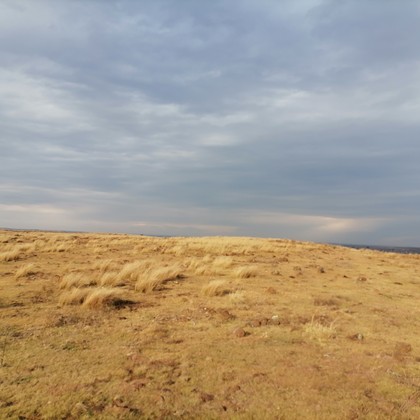
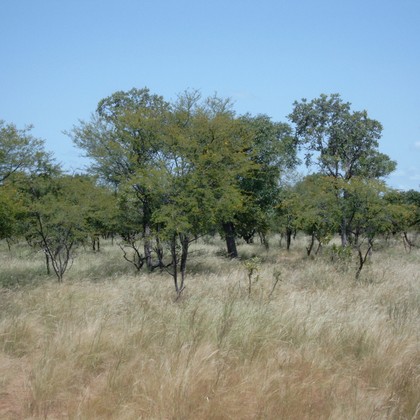
Open grassland, savanna, cropland, short-grazed pasture and pan edges, especially after rain. It walks in loose flocks and eats grasshoppers, locusts, armyworms, beetles, termites, frogs and small rodents; gathers at locust swarms and grass fires. Roosts in groups in trees or on electricity pylons.
Where the bird is most at home, classified by the vegetation units of southern Africa.

Range and movements
In summer over much of the region: Zambia, Malawi, Zimbabwe, Botswana, northern and eastern Namibia, Mozambique and Angola, and in South Africa mainly Limpopo, Mpumalanga, North West, Gauteng and the Free State; scarce in the south-west and in the Cape. Numbers vary strongly with rainfall. Beyond the region the species breeds in the Sahel from Senegal to Ethiopia and in south-western Arabia; its non-breeding range extends over East and southern Africa.
- Summer visitor (c. Oct–Mar)
- Passage (Mar–Apr, Oct–Nov)
- dark = core range, pale = thinly spread
How and when to look
The grasslands of Zimbabwe, Botswana and northern South Africa from December to February, often after a thunderstorm. Look for hundreds of dark storks walking in a field or swirling high in a thermal, sometimes with White Storks; the white back in flight is the best feature.
Conservation status
Not threatened; common, in large flocks. In the Sahel it is regarded as a bringer of good fortune and is protected. Poisoning during control of locusts and crop pests, and loss of grassland, are possible risks.
Scientific name
Ciconia abdimii | Lichtenstein, 1823
Lichtenstein described the species in 1823 and placed it straight away in the genus where it still stands. The genus Ciconia was introduced in 1760 by Brisson. Ciconia is the Latin word for 'stork'. abdimii honours Bey El-Arnaut Abdim (1780–1827), Ottoman Albanian governor of Wadi Halfa in Sudan. The specimen the first description was based on came from Dongola, Sudan.