All species › Pelicans, herons and ibises › Herons and bitterns › Yellow Bittern
Yellow Bittern | Botaurus sinensis
Chinese woudaap | Avetorillo chino
A small, sandy-brown bittern from South and East Asia that was discovered in the region only in 2012, when it turned out to be breeding in the mangroves of the southern Egyptian Red Sea coast. Elsewhere in the region it is a rare visitor to Dhofar and the Saudi Red Sea coast.
Voice
The song, heard by day and night in the breeding season, is a soft, repeated oo-oo or ooh, softer than that of Little Bittern; when flushed a dry kak-kak.
Recording: Ray Tsu 诸仁 — CC BY-NC-SA 4.0 · converted to mono · xeno-canto
Identification
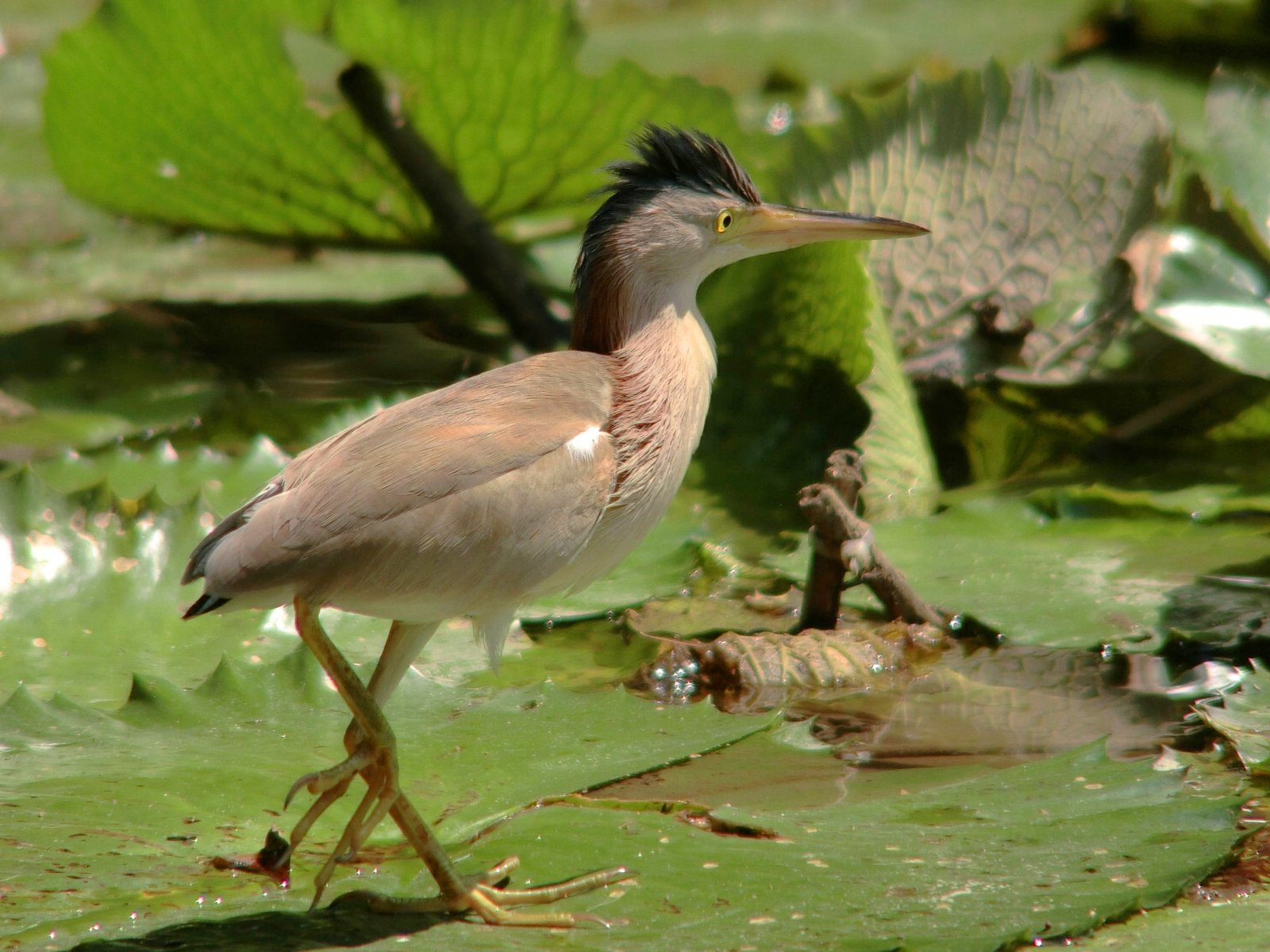
Slightly smaller and slimmer than Little Bittern. The male has a black crown, but a sandy to yellowish-brown back and mantle, a large pale buffy-yellow wing patch and plain pale underparts with a few faint streaks on the neck. The female has a brown crown and a faintly streaked back and neck. In flight the black primaries and black tail contrast strongly with the pale coverts and brown back. Bill and legs yellowish.
Confusion species
Little Bittern (Botaurus minutus), which also appears in the Red Sea mangroves on passage, is the main pitfall: the male has a black back and scapulars, the female a darker, more heavily streaked back, and in both the contrast between coverts and primaries in flight is weaker. Concentrate on the colour of the back. Striated Heron (Butorides striata) is larger and grey, with no pale wing patch.
Habitat
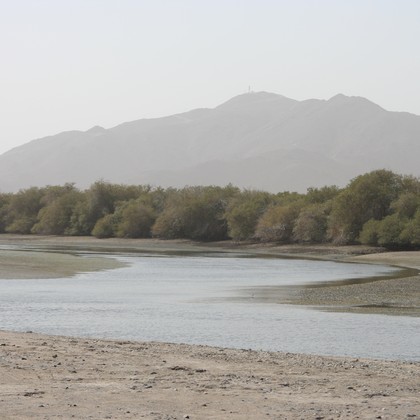
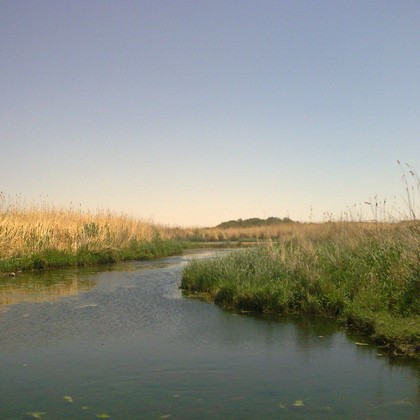
In the region almost exclusively in mangroves along the Red Sea coast, where it forages among the aerial roots and in the low canopy; outside the region also reedbeds, rice fields and marshes. The Omani records come from reeds and open water at the khawrs (coastal lagoons) of Dhofar.
Where the bird is most at home, classified by the habitats of North Africa and the Middle East.
Range and movements
In Egypt discovered in April 2012 at Wadi Lahami south of Marsa Alam, where singing birds were found in about twelve mangrove stands that spring; nests were found there in 2013, confirming breeding. In Saudi Arabia the first bird was photographed in August 2018 in the KAUST mangroves at Thuwal; a small population may be breeding unnoticed along that little-studied coast. In Oman a rare visitor to Dhofar, with November records (including Wadi Mughsayl 2014, Khawr Rawri 2017 and Dahariz near Salalah 2024); claims of breeding in southern Oman are poorly documented. Not reliably recorded elsewhere in the region. Beyond the region it breeds from Pakistan and India to Japan, the Philippines, Indonesia and Micronesia, and in the Seychelles; northern birds migrate to South-East Asia.
- Summer visitor (c. Apr–Sep)
- Winter visitor (c. Oct–Mar)
- dark = core range, pale = thinly spread
How and when to look
The mangroves at Wadi Lahami and Hamata are the only place in the region where the species can be found with any certainty: listen at dusk from April to July for singing birds and check the edges of the stands at low tide. Do not disturb this tiny population with prolonged playback.
Conservation status
Not globally threatened. The Egyptian population is tiny and entirely dependent on a handful of mangrove stands on a coast that is rapidly being built up with tourist resorts; any intervention in these stands could wipe it out.
Scientific name
Botaurus sinensis | (Gmelin, 1789)
Gmelin described the species in 1789 as Ardea Sinensis; because it was later moved to another genus, the author and year stand in brackets. The genus Botaurus was introduced in 1819 by Stephens. Botaurus is Medieval Latin for a bittern; the word combines Latin bos 'ox' with taurus 'bull', after the booming call (compare butire 'to boom'). sinensis is Latin for 'Chinese', after China. The specimen the first description was based on came from China.