All species › Passerines › Shrikes › Woodchat Shrike
Woodchat Shrike | Lanius senator
Roodkopklauwier | Alcaudón común
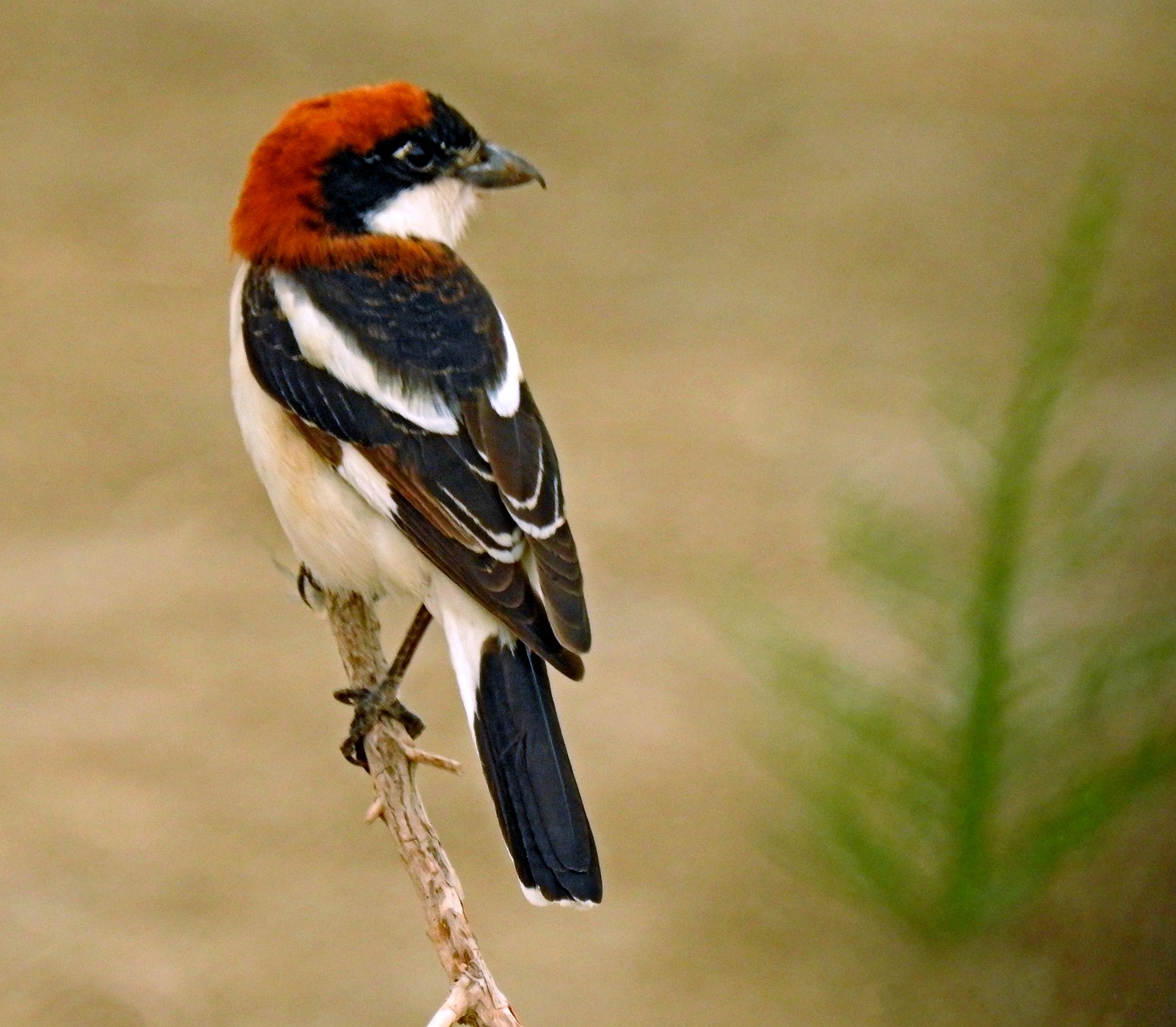
The Woodchat Shrike is the pied shrike of Mediterranean olive groves and scrub, with a chestnut head, a black mask and white shoulder patches. It breeds commonly in the Maghreb and the Levant and is one of the first migrants to return from the Sahel in March.
Voice
The call is a dry chek and a rattling krrr when alarmed. The song is a long, varied and rather musical warble with much mimicry of other birds, often from a treetop.
Recording: João Ferreira Tomás — CC BY-NC-SA 4.0 · shortened to the first 60 s, mono · xeno-canto
Identification
17–19 cm. The male has a chestnut crown and nape, a black forehead and mask, a black back and wings with large white scapular patches and a white primary patch, a white rump and a black tail with white sides; underparts white. The female is duller, with a paler rufous head, a brownish-black back and a small white spot at the base of the bill. The eastern form niloticus has a larger white primary patch and more white at the base of the tail. Juveniles are greyish-brown and scaly, with a pale scapular patch, a pale rump and a faint primary patch.
Confusion species
Masked Shrike (Lanius nubicus) also has white scapular patches, but has a black crown, white forehead, orange flanks and a longer tail without a white rump. Young Red-Backed Shrikes (Lanius collurio) are warmer brown and lack the pale scapular patch and pale rump. Black-crowned Tchagra (Tchagra senegalus) has a black crown and rufous wing and lives hidden in scrub.
Habitat
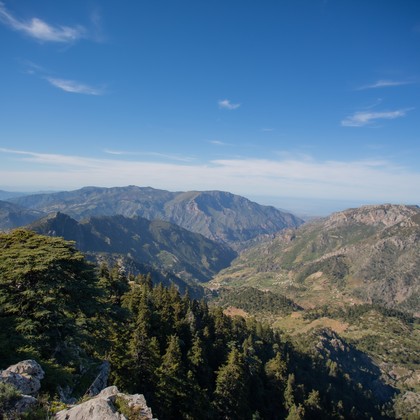
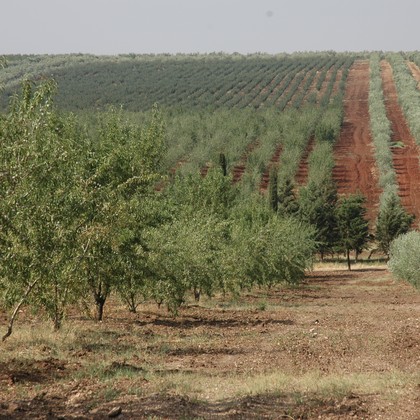
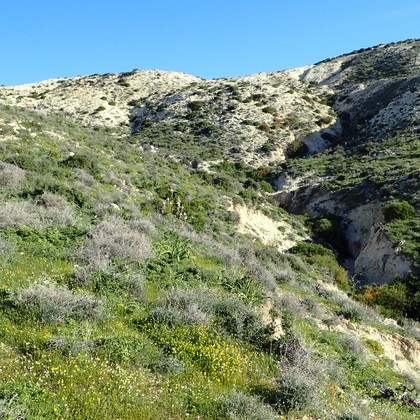
Warm, semi-open country with scattered trees and bushes: olive groves, old orchards, open oak woodland, maquis, argan woodland, hedges and scrub along fields and roads, also steppe with scattered trees. On migration in oases, gardens, acacia wadis and open ground with bushes.
Where the bird is most at home, classified by the habitats of North Africa and the Middle East.
Range and movements
Breeds in Morocco in the north, the Atlantic lowlands, the Souss and the Atlas, in northern Algeria and Tunisia to the northern edge of the Sahara, and in north-west Libya and Cyrenaica. In the east the form niloticus breeds in Israel, Jordan, Lebanon, Syria and northern Iraq. On migration throughout the region: from March to May numerous in the Saharan oases, Egypt and Sinai, and the Levant; niloticus passes through western and southern Arabia and Yemen to East Africa, more scarcely through the Gulf states and Oman. Beyond the region it breeds in southern Europe, Turkey and Iran and winters in the Sahel and savannas from West to East Africa.
- Resident
- Summer visitor (c. Apr–Sep)
- Winter visitor (c. Oct–Mar)
- Passage (Mar–Apr, Oct–Nov)
- dark = core range, pale = thinly spread
How and when to look
In April and May it is easy to see in Morocco in the olive groves and argan woodland around Taroudant and in the Middle Atlas, often in the open on a wire or bush top. In Israel the olive groves of Galilee and the Golan are good breeding sites; in early spring migrants fill the gardens of Eilat.
Conservation status
Near Threatened. The species has declined across much of Europe and North Africa through agricultural intensification, the felling of old orchards and hedges, the loss of large insects through pesticides and drought in its Sahel winter quarters. Trapping occurs on migration.
Scientific name
Lanius senator | Linnaeus, 1758
Linnaeus described the species in 1758 and placed it straight away in the genus where it still stands. He introduced the genus Lanius in that same work. Lanius is Latin for 'butcher', from shrikes' habit of impaling prey on thorns and barbed wire. senator is Latin for 'senator', the name usually taken to allude to the chestnut crown, likened to the purple of Roman senators. The specimen the first description was based on came from the Rhine.