All species › Swifts › Swifts › White-Rumped Swift
White-Rumped Swift | Apus caffer
Pijlstaartgierzwaluw | Vencejo cafre
A slim African swift with a narrow white crescent on the rump, which has bred in small numbers in Morocco since the late 1960s. It builds no nest of its own but takes over the flask-shaped mud nests of red-rumped swallows, often under bridges and overhanging rocks.
Voice
Rather quiet. A low, throaty trill, tsirrr, recalling a bat, mainly heard at the nest.
Recording: Lynette Rudman — CC BY-NC-SA 4.0 · converted to mono · xeno-canto
Identification
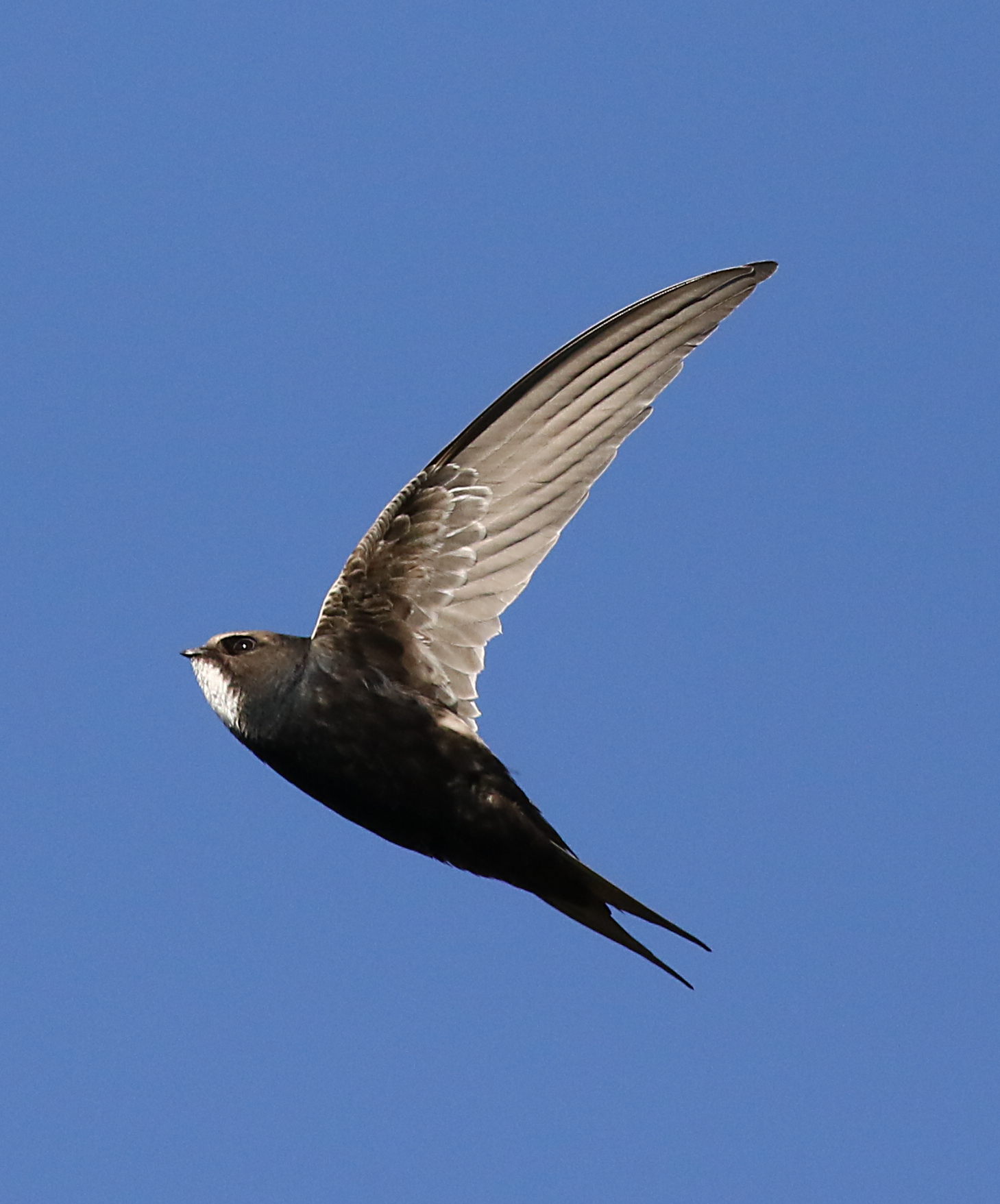
Slightly smaller than Common Swift and, with its narrow body and thin wings, much more pointed. Black-brown with a slight gloss, with a small, sharply defined white throat patch and a narrow white band across the rump that does not reach the flanks. Long, deeply forked tail usually held closed to a single point in flight; the fork shows only when turning. Fast flight with short turns, often single or in pairs among other swifts.
Confusion species
Little Swift (Apus affinis) is stockier, with a broad square white rump reaching far onto the flanks, a larger white throat and a square-cut tail. Common Swift (Apus apus) and Pallid Swift (Apus pallidus) are larger, with no white rump and a short tail fork. Common House-Martin (Delichon urbicum) also has a white rump, but white underparts and short, broad wings.
Habitat
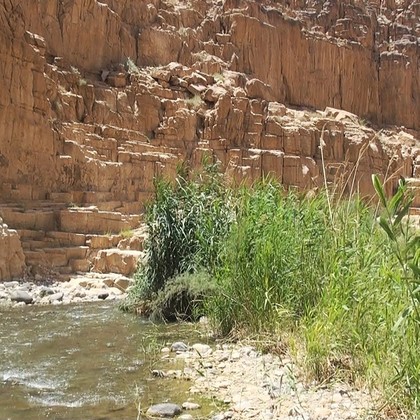
Rocky river valleys, gorges and hill country with bridges, culverts and overhanging rocks where red-rumped swallows breed; hunts over valleys, fields and open water, often with other swifts and swallows.
Where the bird is most at home, classified by the habitats of North Africa and the Middle East.

Range and movements
Morocco: a scarce and very local breeder, established since the late 1960s, with small numbers in the Middle and High Atlas and adjacent hill country, arriving in late April or May and leaving in October. Tunisia: in recent years a fairly regular autumn visitor, but breeding has not yet been proven despite targeted searches. Algeria: two birds seen in the north-east in August 2026 were the first for the country. There are no accepted records from Libya, Egypt, the Levant or Arabia. Beyond the region it breeds in south-west Iberia (since 1966), recently also in Calabria and Corsica, and widely in Africa south of the Sahara; Iberian and Moroccan birds winter in West Africa.
- Summer visitor (c. Apr–Sep)
- Passage (Mar–Apr, Oct–Nov)
- dark = core range, pale = thinly spread
How and when to look
In June and July, look in the Middle and High Atlas at bridges over rivers where red-rumped swallows breed and watch for birds disappearing into the flask nests. On passage or in autumn in Tunisia it mixes with flocks of swifts and swallows: look for a small black swift with a pointed tail and a thin white crescent.
Conservation status
Not globally threatened and common in Africa. In the region the population is small and depends on red-rumped swallow nests, but the species is slowly expanding at the northern edge of its range.
Scientific name
Apus caffer | (Lichtenstein, 1823)
Lichtenstein described the species in 1823 as Cypselus Caffer; because it was later moved to another genus, the author and year stand in brackets. The genus Apus was introduced in 1777 by Scopoli. Apus is Latin for a swift, from Greek a- 'without' and pous 'foot', the ancients taking it for a kind of swallow without feet. caffer is modern Latin for 'of South Africa', after the Cape region where the type specimen was collected. The specimen the first description was based on came from the eastern Cape Province.