All species › Passerines › Bulbuls › White-Eared Bulbul
White-Eared Bulbul | Pycnonotus leucotis
Witoorbuulbuul | Bulbul orejiblanco
The White-eared Bulbul is the bulbul of Mesopotamia and the head of the Persian Gulf: in Baghdad, Basra, Kuwait City and Bahrain it sits in every garden and date palm. From there, partly with human help, it has spread over the eastern side of the Arabian Peninsula.
Voice
More chattering than singing: a short, rapidly repeated whistled phrase, roughly wichee-joo or quitcher-weet, with one note jumping high. Also short, tinny contact calls within a group and a rasping chrr in alarm. Most vocal in the early morning and the last hour before dark.
Recording: David Darrell-Lambert — CC BY-NC-SA 4.0 · converted to mono · xeno-canto
Identification
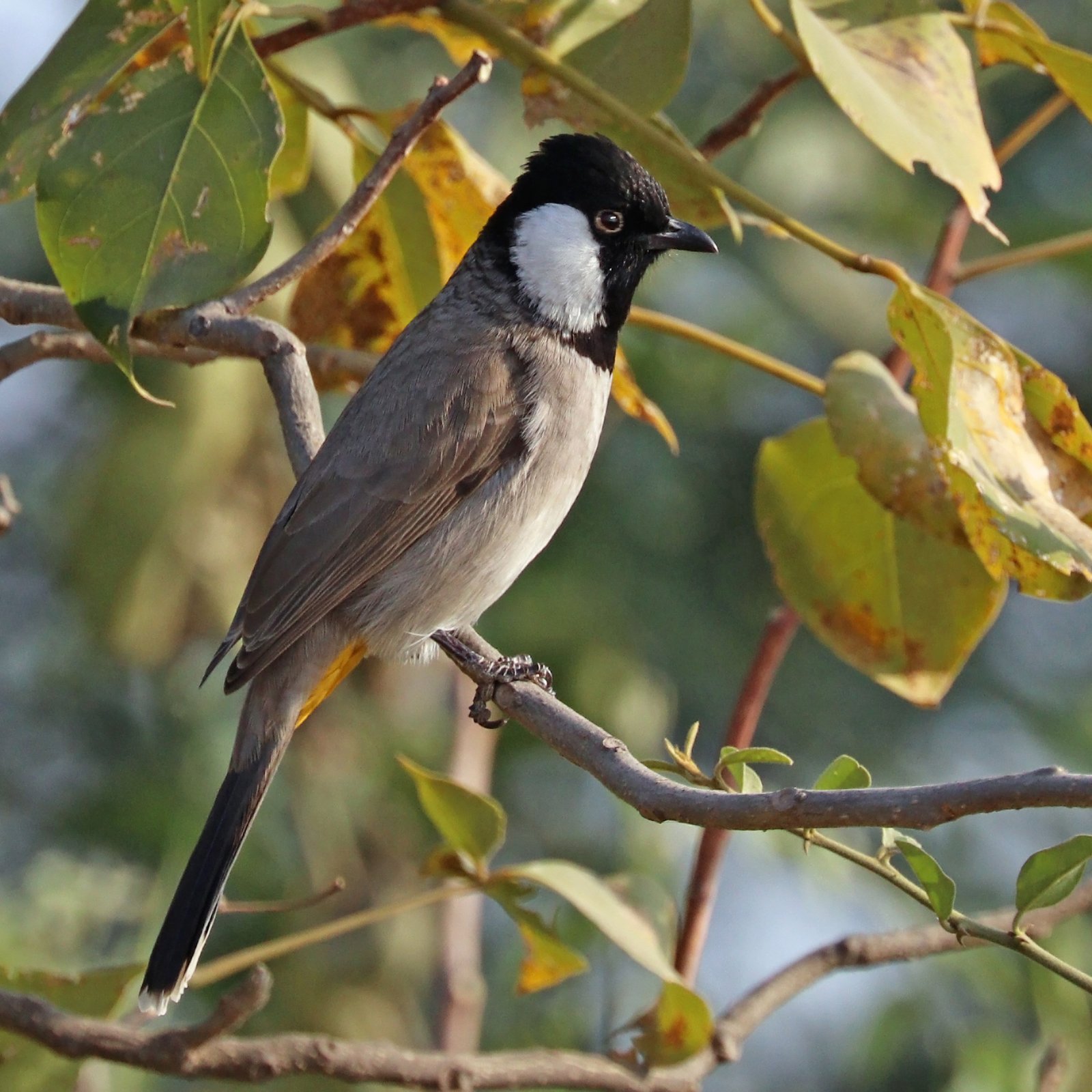
18–19 cm. A small, compact bulbul without a crest. Head and throat are glossy black, set with a large, oval, pure white cheek patch: the feature on which everything rests. There is no white eye-ring. Upperparts plain greyish-brown, underparts pale beige-grey, undertail coverts bright yellow to orange-yellow. The tail is blackish-brown with white tips to the outer feathers, conspicuous especially in flight. The sexes are alike; juveniles have a browner head, a dingier cheek patch and paler yellow under the tail.
Confusion species
White-spectacled Bulbul (Pycnonotus xanthopygos) is slightly larger and longer-tailed, with a duller, sooty-brown head without a white cheek patch and a conspicuous white eye-ring; where the two meet, as around Riyadh and in northern Oman, hybrids occur. Red-vented Bulbul (Pycnonotus cafer) has a small crest, no white cheek patch, a scaly breast, a white rump and red undertail coverts; hybrids between the two, with an orange vent and a small cheek patch, are regular in the Gulf states. Red-whiskered Bulbul (Pycnonotus jocosus), an escaped cage bird, has a tall crest, a red patch behind the eye and red undertail coverts.
Habitat
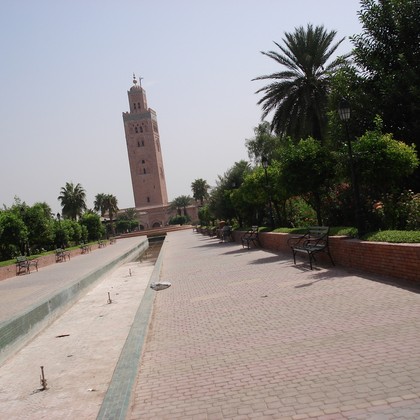
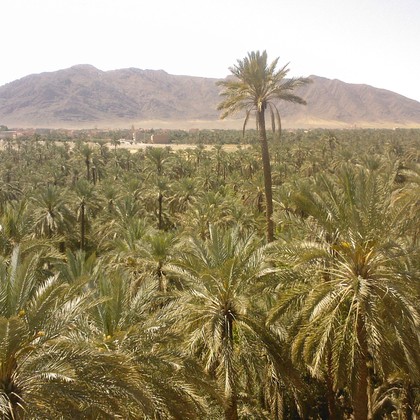
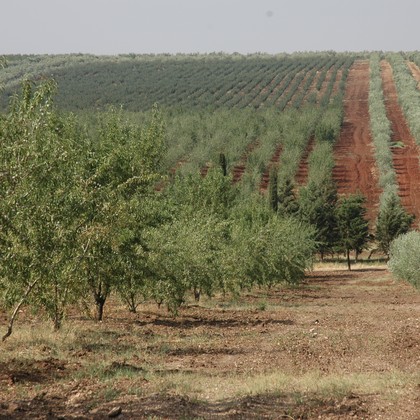
Shrubs and trees in an otherwise dry land: town gardens and parks, date gardens, citrus and pomegranate plantings, tamarisk and oleander scrub along canals and rivers, field edges and the reed fringes of the Mesopotamian marshes; also in mangroves along the Gulf coast and in semi-desert where there is water and scrub. Eats fruit, blossom, nectar and insects. The nest is a cup of twigs and plant fibres in a shrub or date palm at one to three metres.
Where the bird is most at home, classified by the habitats of North Africa and the Middle East.
Range and movements
Native to the Euphrates–Tigris basin in Iraq, from Baghdad south through the Mesopotamian marshes to Basra, and further in Kuwait (present only since the 1950s, now a very common breeder) and on Bahrain. In eastern Saudi Arabia it is one of the commonest urban birds of the Eastern Province (already reported near Hofuf in 1923); whether the birds there are native or introduced is uncertain. Elsewhere in Saudi Arabia established in Riyadh (since 1981) and locally in places such as Jeddah, Tabuk and Al-Jawf. Introduced by man and now established in Qatar, the United Arab Emirates and northern Oman. Beyond the region the range continues along the Iranian Gulf coast and southern Iran, southern Afghanistan and Pakistan to north-west India.
- Resident
- Winter visitor (c. Oct–Mar)
- Passage (Mar–Apr, Oct–Nov)
- dark = core range, pale = thinly spread
How and when to look
Any city park or hotel garden in Kuwait, Bahrain or Basra produces the species within a quarter of an hour; watch for noisy groups moving from bush to bush. At a drip irrigation line or garden fountain they come to drink and bathe in the midday heat, showing the white cheek patch and the yellow vent in one view.
Conservation status
Not globally threatened and on the increase in the Gulf, helped by planting, irrigation and urban greenery. At the same time it is heavily trapped for the cage-bird trade in Iraq and Kuwait, and this trapping, together with the loss of gardens and scrub, depresses numbers locally. In the Gulf states it is becoming mixed through hybridisation with the introduced Red-vented Bulbul.
Scientific name
Pycnonotus leucotis | (Gould, 1836)
Gould described the species in 1836 as Ixos leucotis; because it was later moved to another genus, the author and year stand in brackets. The genus Pycnonotus was introduced in 1826 by Boie. Pycnonotus is Greek, from puknos 'thick, compact' and -nōtos '-backed', from nōton 'back', after the dense plumage of the back. leucotis is Greek for 'white-eared', from leukos 'white' and ous, ōtos 'ear', after the white cheek patch. The specimen the first description was based on came from Karachi, Pakistan.