All species › Waders, gulls and terns › Sandpipers and snipes › Whimbrel
Whimbrel | Numenius phaeopus
Regenwulp | Zarapito trinador
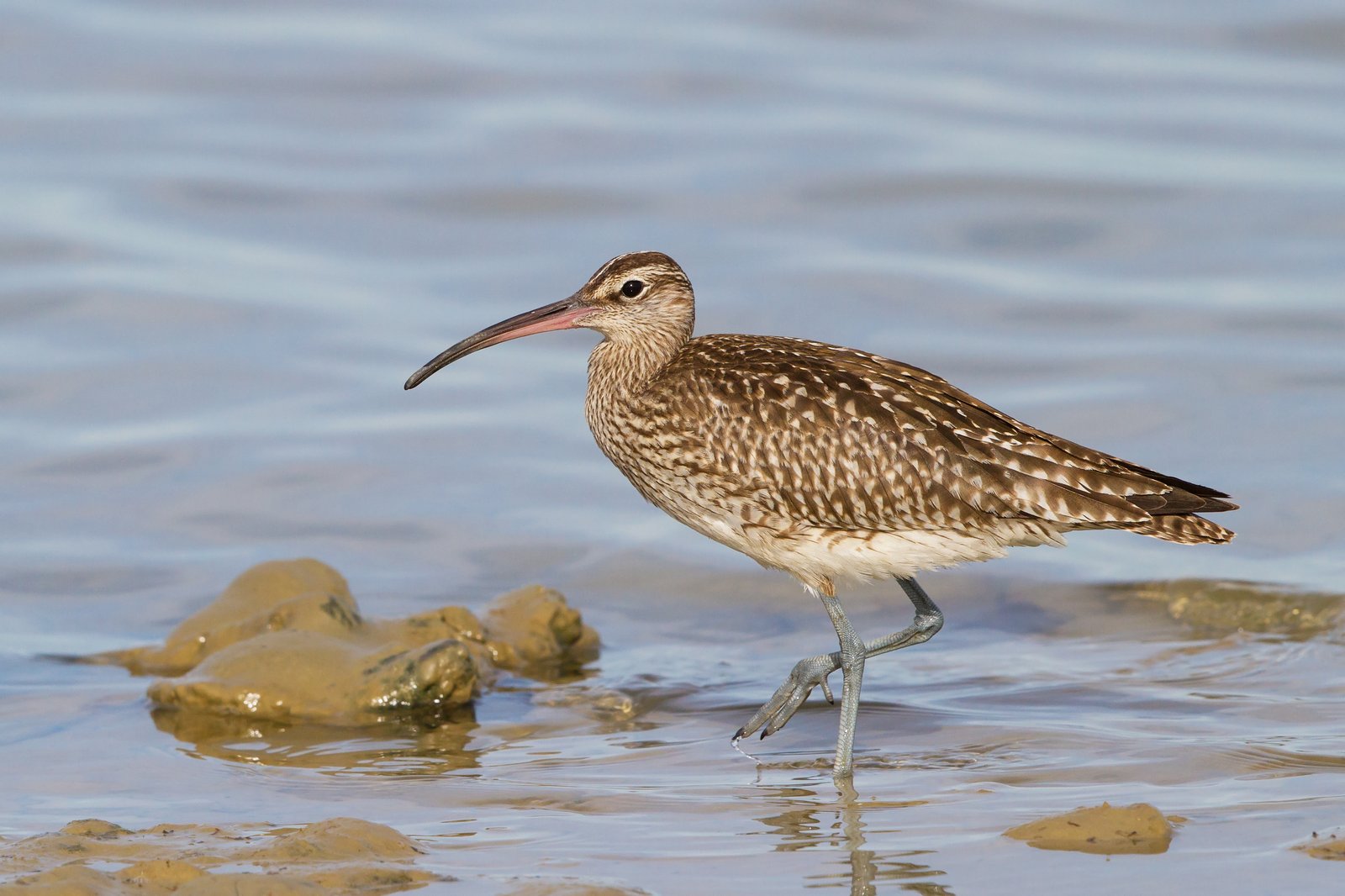
A medium-sized curlew with a striped head and a curved bill, known in the region mainly as a passage migrant and winter visitor to rocky shores, mangroves and tidal flats. On the Red Sea, the Arabian Sea and the Persian Gulf it can be seen year-round; its distinctive trill gives it away from afar.
Voice
The well-known call is a rapid, even trill of seven notes, bibibibibibi, often given in flight and on take-off; also a short klee. At roosts also a bubbling call.
Recording: Mark James Pearson — CC BY-NC-SA 4.0 · converted to mono · xeno-canto
Identification
Brown-mottled, with a dark crown split by a pale central stripe and a pale supercilium above a dark eye-stripe. The bill is about one and a half times the length of the head and curved mainly towards the tip. Breast streaked, flanks lightly barred, belly white. In flight a white wedge on back and rump; the thin legs barely project beyond the tail. Sexes alike; juveniles have more pale-spotted coverts.
Confusion species
Eurasian Curlew (Numenius arquata) is larger, with a much longer, evenly curved bill and an almost plain head without crown stripes; its call is a mournful coor-lee. Little Curlew (Numenius minutus), a vagrant, is much smaller with a short bill and a brown back. Young Eurasian Curlews with a short bill can confuse; then check the head.
Habitat
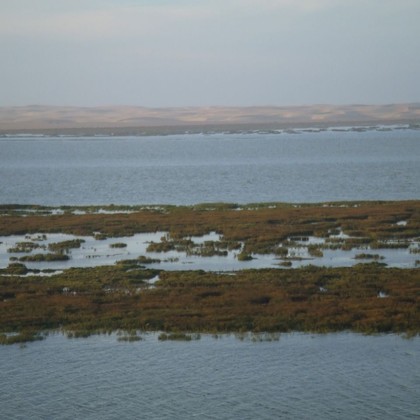
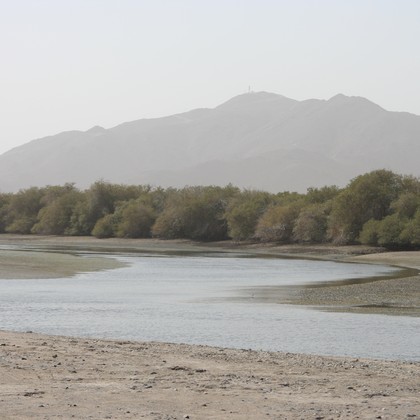
Rocky shores, coral reefs at low tide, mangroves, tidal flats, beaches and coastal lagoons; on migration also along the Nile, at salt lakes and sometimes on grassland and farmland inland. Often feeds alone or in loose groups, on crabs and other invertebrates.
Where the bird is most at home, classified by the habitats of North Africa and the Middle East.
Range and movements
In North Africa a common passage migrant along the Atlantic coast of Morocco and Western Sahara, with wintering birds south to Dakhla, and a scarcer passage migrant and winter visitor along the Mediterranean from Algeria to Egypt. Along the Red Sea (Egypt, Saudi Arabia, Yemen) and the coasts of Oman, Socotra and the Emirates numerous in winter and on passage, with summering birds; in Kuwait, Bahrain and Qatar mainly a passage migrant, partly wintering. In Israel and Jordan a migrant along the coast and at Eilat and Aqaba. Western birds belong to the nominate form; on Arabian coasts the eastern alboaxillaris also occurs. Beyond the region it breeds in the subarctic zone from Iceland to Siberia and winters on the coasts of Africa, South Asia and Australasia.
- Resident
- Summer visitor (c. Apr–Sep)
- Winter visitor (c. Oct–Mar)
- Passage (Mar–Apr, Oct–Nov)
- dark = core range, pale = thinly spread
How and when to look
The mangroves and lagoons of Oman (Khawr Ruri, Barr al Hikman) and the beaches of the Emirates hold Whimbrels almost year-round. In Egypt they are common on the Red Sea coast at Hurghada and Marsa Alam on coral platforms at low tide. In spring flocks pass calling over Sinai and Morocco's Atlantic coast in April and May.
Conservation status
Not globally threatened, although some populations are declining. In the region threatened by coastal development, in particular the loss of mangroves and mudflats in the Gulf states, and locally by disturbance and hunting.
Scientific name
Numenius phaeopus | (Linnaeus, 1758)
Linnaeus described the species in 1758 as Scolopax Phaeopus; because it was later moved to another genus, the author and year stand in brackets. The genus Numenius was introduced in 1760 by Brisson. Numenius is Greek, from neos 'new' and mēnē 'moon', after the bill that recalls a crescent moon; noumēnios is the name of a bird in Hesychius. phaeopus is the Medieval Latin name for this bird, from Greek phaios 'dusky' and pous 'foot'. The specimen the first description was based on came from Sweden.