All species › Waders, gulls and terns › Jacanas › Pheasant-Tailed Jacana
Pheasant-Tailed Jacana | Hydrophasianus chirurgus
Fazantstaartjacana | Jacana colilarga
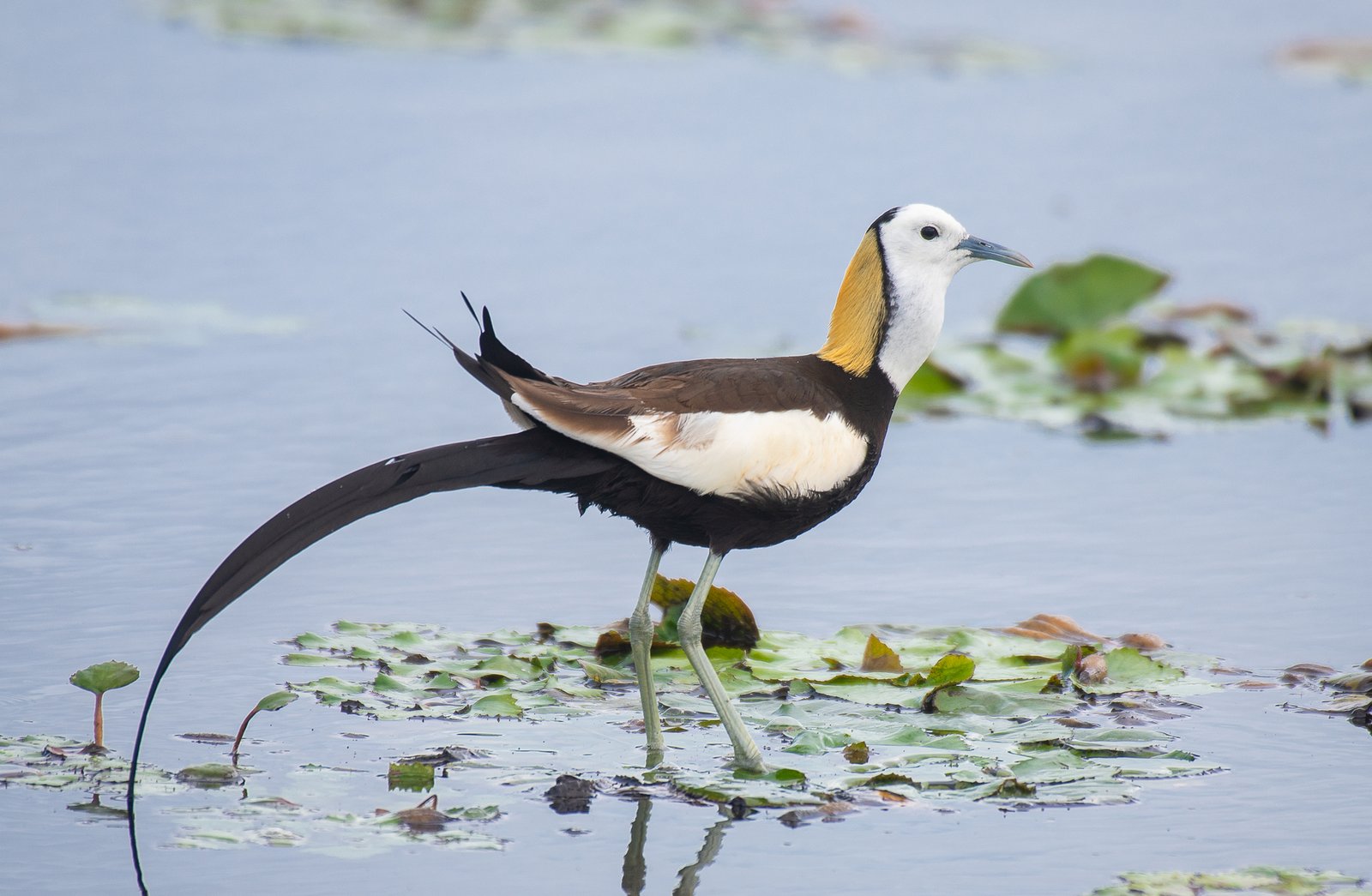
A slender, long-toed waterbird that walks across floating vegetation as if it were solid ground. In the region it is almost confined to Oman: in the khawrs and pools of Dhofar it is a locally fairly common winter visitor that has even bred there twice. Elsewhere in Arabia it turns up only rarely.
Voice
Mostly silent in winter. Sometimes gives a nasal, mewing me-ou or tewee; in the breeding season a repeated, wailing me-onk.
Recording: Junning Wang — CC BY-NC-SA 4.0 · converted to mono · xeno-canto
Identification
In breeding plumage unmistakable: blackish-brown body, white wings, white head and foreneck with a glossy golden-yellow hindneck bordered by a black line, and a very long, curved black tail of some 25 cm. Outside the breeding season, when most birds are seen in Oman, it is far more subdued: brown above, white below, with a dark eye-stripe that runs down the neck side into a dark breast band, a yellowish neck side and a shorter tail. The very long toes and, in flight, the largely white wings with black tips are always striking.
Confusion species
There is no other jacana in the region; the long toes and walking on floating leaves are diagnostic. In winter plumage a bird in waterside vegetation can recall a Eurasian Moorhen (Gallinula chloropus) or a small rail, but those lack the white face with the dark neck stripe and the large white wing patches. In flight the extensive white can briefly suggest a small lapwing or another wader.
Habitat
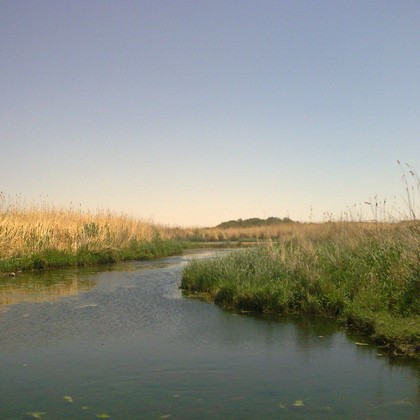
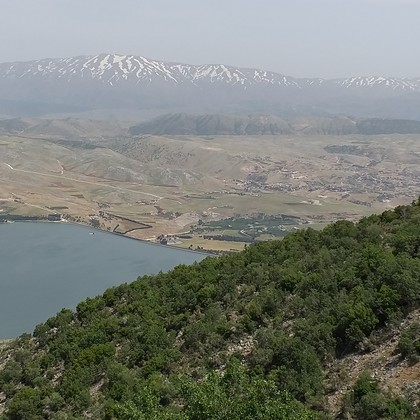
Freshwater pools, khawrs and lagoons with floating and emergent vegetation such as water lilies, duckweed and reed fringes; also sewage settling ponds, small reservoirs and flooded fields. In Dhofar mainly on the less saline parts of the khawrs behind the dunes.
Where the bird is most at home, classified by the habitats of North Africa and the Middle East.
Range and movements
Almost only in Oman, where it is a locally fairly common winter visitor in Dhofar (including Khawr Rawri and East Khawr at Salalah), from early November to late May; a few birds over-summer and there are two breeding records from the south. Much rarer in northern Oman, the last record being in 2005. Elsewhere a vagrant: in the Emirates first in 2013 (Wamm farms near Dibba and Zakher near Al Ain), since then a few times in November at Dubai, Ajman, Abu Dhabi and Ras al-Khaimah; in Yemen a handful of records, including Socotra and Hadramawt; in Saudi Arabia two records (1990 and 2014); in Qatar two birds that wintered in 2006. Beyond the region it breeds from Pakistan and India to southern China, Taiwan and the Philippines; northern birds move south in winter.
- Winter visitor (c. Oct–Mar)
- dark = core range, pale = thinly spread
How and when to look
In winter, scan the edges of Khawr Rawri and East Khawr at Salalah, where it walks among the water plants; the birds are often fairly tame. In early spring a few may already be partly in breeding plumage, with the long tail.
Conservation status
Not globally threatened. The Omani wintering birds depend on a small number of khawrs and settling ponds in Dhofar, which are vulnerable to disturbance, water abstraction and coastal development.
Scientific name
Hydrophasianus chirurgus | (Scopoli, 1786)
Scopoli described the species in 1786 as Tringa Chirurgus; because it was later moved to another genus, the author and year stand in brackets. The genus Hydrophasianus was introduced in 1832 by Wagler. Hydrophasianus means 'water pheasant', from Greek hudro- 'water' and Latin phasianus 'pheasant'. chirurgus is Latin for 'surgeon', after 'le Chirurgien', the name Sonnerat gave this bird. The specimen the first description was based on came from Luzon, Philippines.