All species › Cranes, rails and allies › Rails and crakes › Watercock
Watercock | Gallicrex cinerea
Waterhaan | Gallineta crestada
A large, shy rail of rice fields and marshes in South and East Asia that reaches the region only as a vagrant. The handful of records come almost entirely from Oman and the United Arab Emirates, at the western edge of the species' migratory range.
Voice
On the breeding grounds the male gives a series of deep, hollow, pumping notes, kok-kok-kok followed by a hollow oomp-oomp-oomp, mainly at dusk. Vagrants away from the breeding range are almost always silent.
Recording: Chi-Hsuan Shao — CC BY-NC-SA 4.0 · converted to mono · xeno-canto
Identification
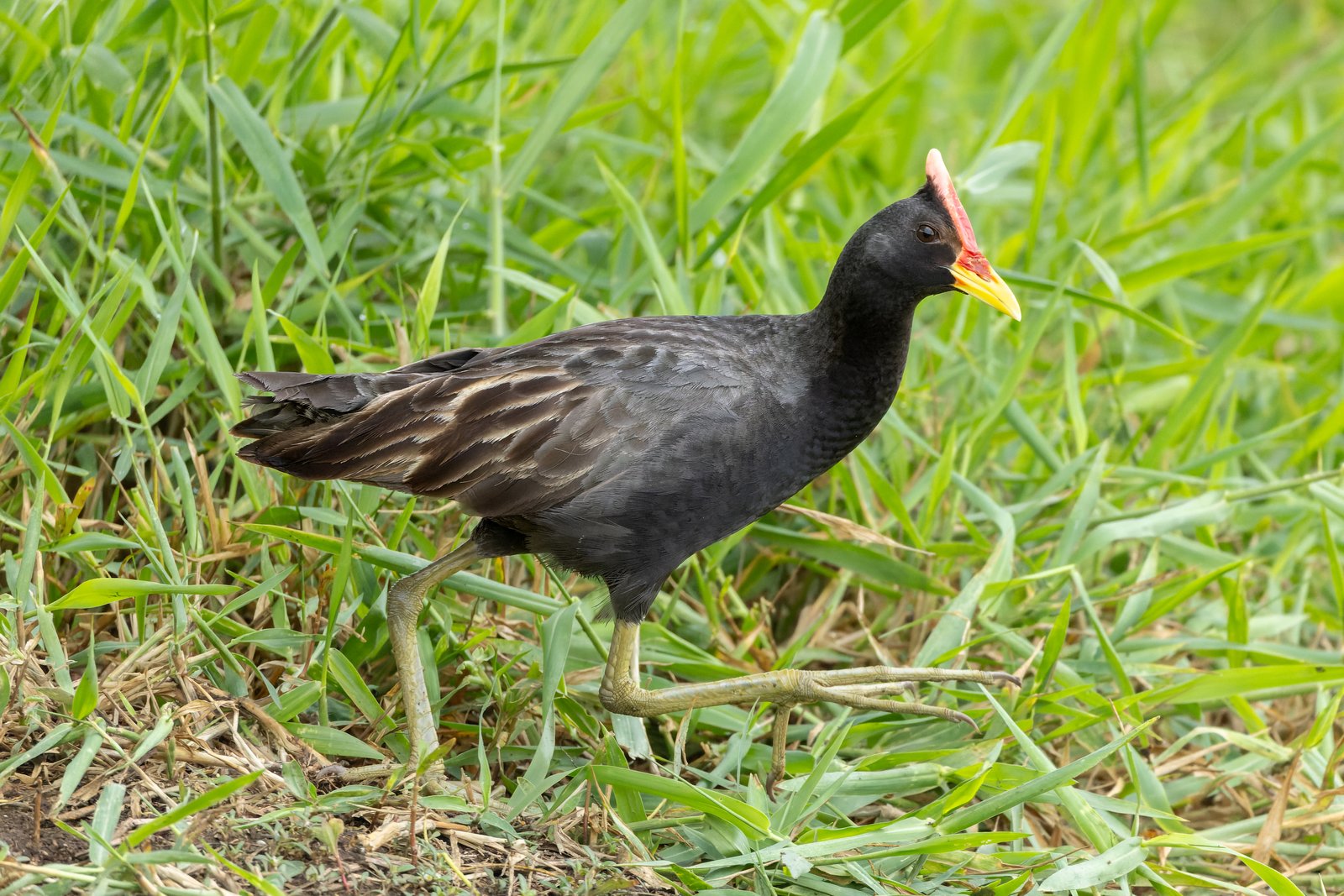
Bulky and long-legged, with a long neck and fairly short tail; the male is clearly larger than the female. The breeding male is slate-grey to black with pale fringes on the back and has a bright red, erect frontal shield projecting like a small horn above the head, with red legs. In the region, however, it is hardly ever seen like that: vagrants are almost always females, immatures or males in non-breeding plumage. These are warm buff-brown with dark, pale-fringed feathers on the upperparts, finely barred ochre underparts, a yellowish bill without a shield and greenish-grey legs. In flight the fairly long neck and the pale ochre leading edge of the wing stand out.
Confusion species
A female or young bird resembles a large, warm-toned Eurasian Moorhen (Gallinula chloropus) or young Western Swamphen (Porphyrio porphyrio), but has fine wavy barring over all the underparts and a scaly back without a white flank line. Spotted Crake (Porzana porzana) and Corn Crake (Crex crex) are much smaller and shorter-necked. White-breasted Waterhen (Amaurornis phoenicurus) has a white face and breast and a rufous undertail.
Habitat
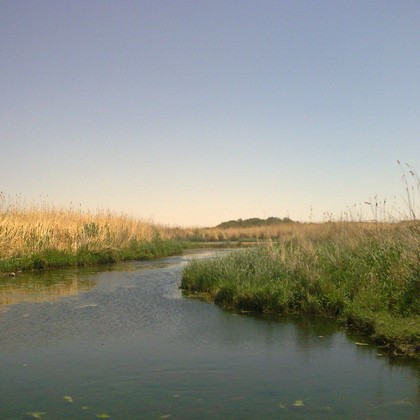
Rice fields, flooded grassland, reed marshes and banks with dense vegetation. In Arabia it has turned up at sewage works, irrigated areas and ponds with reed fringes, sometimes also in unexpected places where exhausted migrants come down.
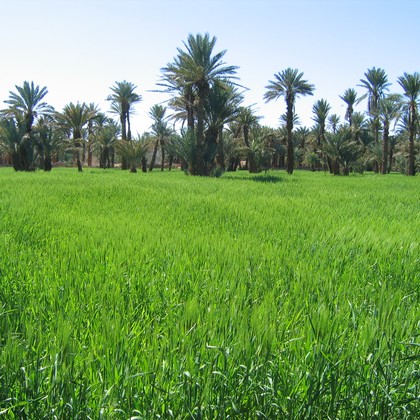
Where the bird is most at home, classified by the habitats of North Africa and the Middle East.
Range and movements
In the region only a vagrant. Oman had five accepted records by around 2014; in November 2014 came the first for the United Arab Emirates, a bird in Dubai found at Nad Al Shiba and released at Al Warsan Lakes. Not reliably recorded elsewhere in the region. The species breeds from Pakistan and India to southern China, Korea and Japan, and south to the Philippines and Indonesia; northern birds migrate to South-East Asia. Also recorded in Djibouti, the first for Africa.
How and when to look
Seeing one is a matter of luck. The best chance is in autumn and early winter at the sewage works, irrigation pools and reedbeds of Oman and the Emirates, where other Asian vagrants also turn up. Scan the edges of reed fringes in the early morning; a bird that leaves cover often walks slowly across open mud, flicking its tail.
Conservation status
Not globally threatened and fairly common in much of Asia, although it is hunted locally and declines where rice farming intensifies. In the region a very rare vagrant with no established foothold; every record merits submission to the national rarities committee.
Scientific name
Gallicrex cinerea | (Gmelin, 1789)
Gmelin described the species in 1789 as Fulica cinerea; because it was later moved to another genus, the author and year stand in brackets. The genus Gallicrex was introduced in 1852 by Blyth. Gallicrex is Latin, from gallus 'cock' and crex 'crake'. cinerea is Latin for 'ash-grey', from cinis 'ash'. The specimen the first description was based on came from China.