All species › Birds of prey › Hawks, eagles and kites › Verreaux's Eagle
Verreaux's Eagle | Aquila verreauxii
Zwarte arend | Águila de Verreaux
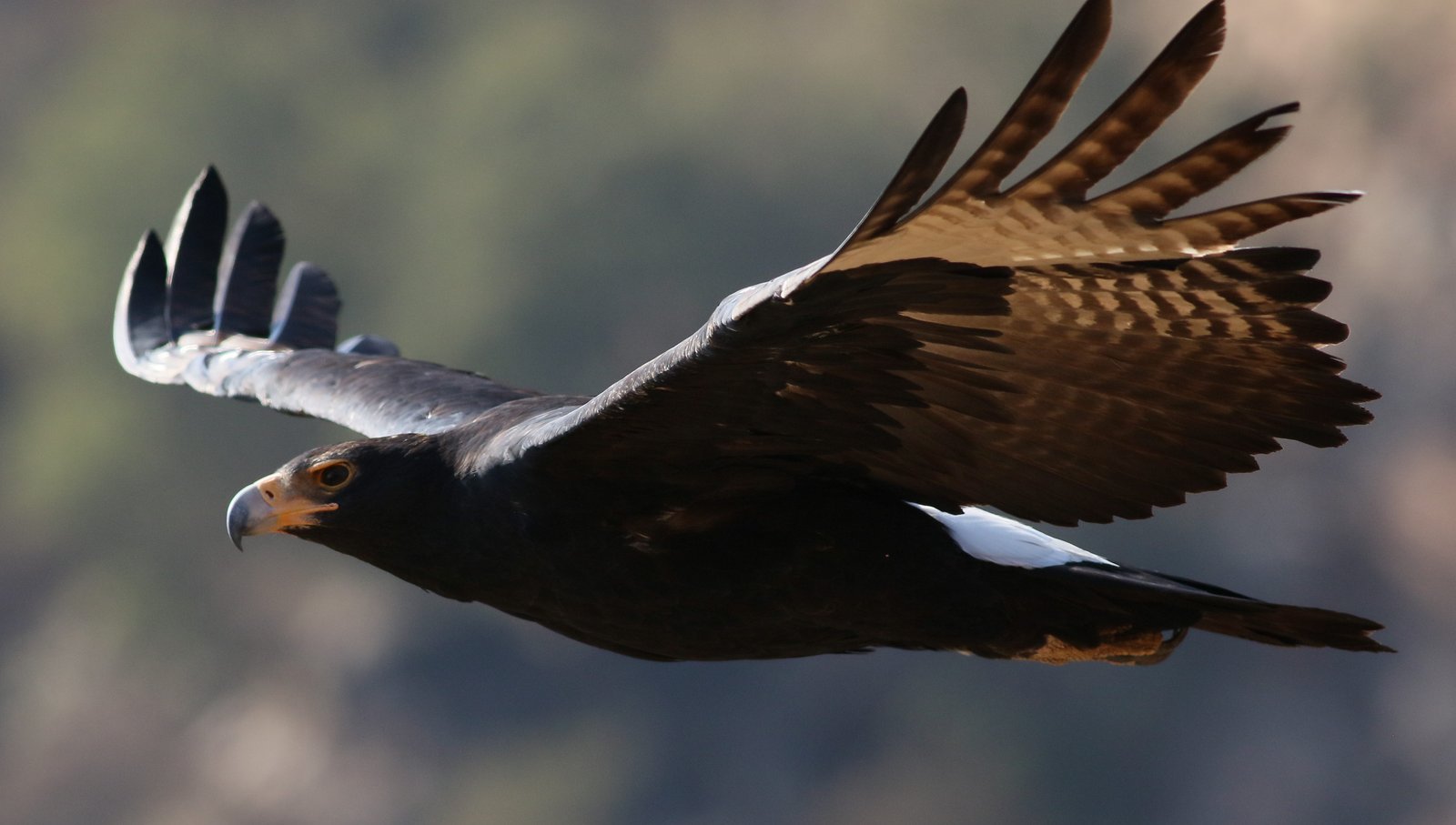
Verreaux's Eagle is a very large, jet-black eagle with a white back, which lives almost entirely on rock hyraxes and is therefore tied to steep rocky mountains. In the region a small population lives in the mountains of western and southern Arabia, with outposts in Sinai, the Egyptian Red Sea mountains and Jordan.
Voice
Usually silent. At the nest and in display a high, whistled kee-ah and soft, melodious calls.
No recording with a suitable Creative Commons licence is available for this species yet.
Identification
80–95 cm, wingspan 190–230 cm. The adult is deep black with a white V across the back and rump, white edges along the scapulars, a yellow cere, eye-ring and feet and a powerful bill. In flight unmistakable by its shape: the wings are narrow at the base and broad in the middle, like a paddle, with a white patch at the base of the primaries and a fairly long tail. The juvenile is brown with a rufous-buff crown and nape, a blackish cheek and pale-scaled upperparts; it already has the typical wing shape and becomes adult in four to five years.
Confusion species
Golden Eagle (Aquila chrysaetos) is brown with a golden nape, and the juvenile has white patches in wing and tail; the wing base is not pinched. Bonelli's Eagle (Aquila fasciata) is much smaller and has pale underparts. At long range Fan-tailed Raven (Corvus rhipidurus) may cause confusion, but lacks the white on the back and is much smaller; ravens like to keep Verreaux's Eagles company by mobbing them. The juvenile can resemble a young Golden Eagle, but has the rufous crown and paddle-shaped wings.
Habitat
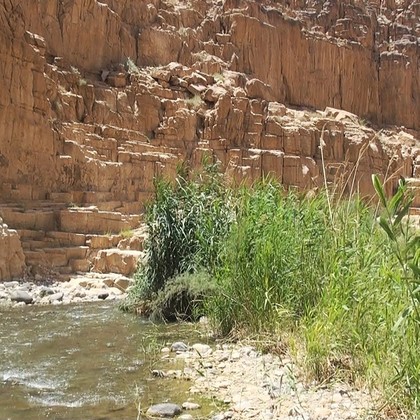
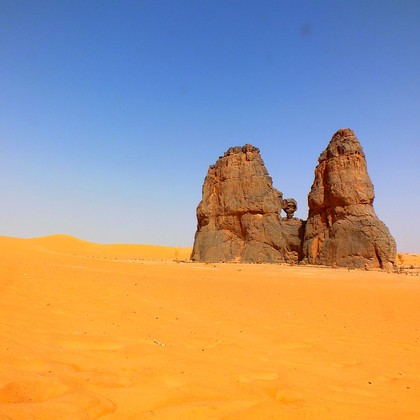
Steep gorges, cliffs and bare granite mountains with rock hyraxes, from sea level high into the mountains, in Arabia also escarpments and deep wadis. Pairs often hunt together low along the cliffs and surprise hyraxes away from cover. The nest is a large stick platform on a ledge or in a crevice in a cliff.
Where the bird is most at home, classified by the habitats of North Africa and the Middle East.
Range and movements
In Arabia an estimated sixty pairs in the mountains and wadis of western Saudi Arabia and Yemen and in the Dhofar mountains of Oman, where more than fifty birds have been counted in about 250 km². In Sinai the species breeds near Taba; a pair was present near Mount Sinai from 1978 to 2005 and in 2010, but there has been little reliable news since. A few territories in the mountains along Egypt's Red Sea coast (Wadi al-Gimal, Gebel Elba area). In Jordan a pair bred in Wadi Rum in 1990–1999 and a pair was seen there again in 2023; in Dana reserve a pair is probably present every year. In Israel a few pairs bred in Upper Galilee in the 1960s, but the species has been gone since the early 1970s; now a wandering bird turns up every few years in the Eilat Mountains, the Arava, the Negev or the Judean Desert, such as a pair near Eilat in late 2022. Only unconfirmed reports from Lebanon. Beyond the region in East and southern Africa.
- Resident
- Winter visitor (c. Oct–Mar)
- Passage (Mar–Apr, Oct–Nov)
- dark = core range, pale = thinly spread
How and when to look
In Dhofar search the cliffs of Jebel Samhan and the deep wadis of the escarpment, or in Jordan Wadi Rum and Dana. Watch for pairs gliding low along cliffs and for mobbing ravens; a black eagle with a white back can be identified at great range.
Conservation status
Not threatened and widespread in Africa. In the region very scarce and vulnerable: the population depends on rock hyraxes, which decline in dry years, and some birds have been shot, as in 2000 in Wadi Rum. Disturbance and poisoning are also threats.
Scientific name
Aquila verreauxii | Lesson, 1831
Lesson described the species in 1831 and placed it straight away in the genus where it still stands. The genus Aquila was introduced in 1760 by Brisson. Aquila is Latin for 'eagle', possibly from aquilus 'dark in colour'. verreauxii honours the French naturalist and natural-history dealer Jules Verreaux (1807–1873), who collected in South Africa for several years. The specimen the first description was based on came from the interior of the Cape, South Africa.