All species › Birds of prey › Hawks, eagles and kites › Tawny Eagle
Tawny Eagle | Aquila rapax
Savannearend | Águila rapaz
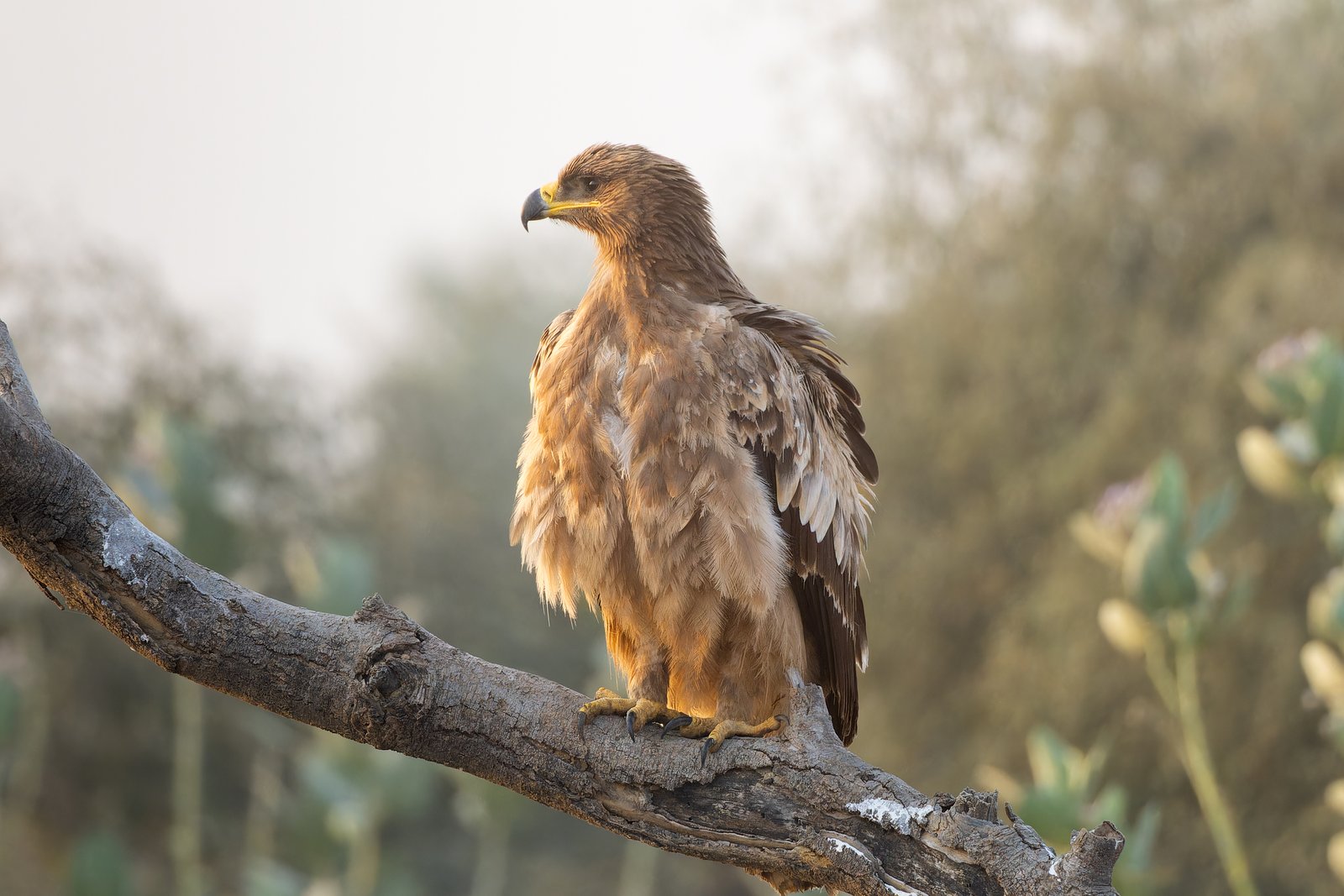
The Tawny Eagle is a medium-sized, compact brown eagle of dry open country with scattered trees, highly variable from pale cream to dark rufous-brown. In the region a small population lives in the highlands and foothills of south-western Arabia; the North African form belisarius formerly bred in Morocco, but has not been reliably recorded there for more than thirty years.
Voice
Usually silent. In display and at the nest a barking kow-kow-kow and a harsh, crow-like kyaa.
Recording: Oliver Fowler — CC BY-NC-SA 4.0 · converted to mono · xeno-canto
Identification
62–72 cm, wingspan 160–185 cm. The plumage varies from pale sandy or creamy-buff to warm rufous and dark brown, often somewhat blotchy; the flight feathers are darker. The gape reaches to about below the centre of the eye, the nostril is oval and the adult's iris is pale yellow. The legs are feathered to the toes. In flight fairly long, broad wings with seven fingers, held flat or with the hand slightly lowered; on pale birds the dark flight feathers and tail contrast with the pale underwing coverts, and the inner primaries form a pale window. The tail is medium-long and rounded. The juvenile is evenly pale rusty-brown to sandy, with at most a narrow pale wingbar and a pale trailing edge.
Confusion species
Steppe Eagle (Aquila nipalensis) is larger and longer-winged, with a gape extending behind the eye, a dark iris and, in young birds, a broad white band across the underwing. Lesser Spotted Eagle (Clanga pomarina) and Greater Spotted Eagle (Clanga clanga) have a round nostril and shorter, less baggy trousers. A pale Long-legged Buzzard (Buteo rufinus) is smaller, with a pale, unbarred tail and black carpal patches. In Morocco young Spanish Eagles (Aquila adalberti) may be mistaken for this species; they are larger, with pale wingbars and a pale rump.
Habitat
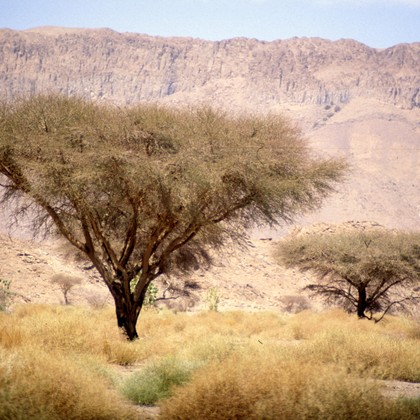
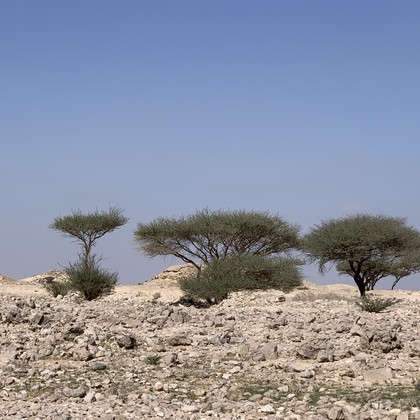
Dry open country with scattered trees: acacia savanna, thorn scrub, broad wadis and high plateaus with terracing, up to about 2500 m. Also near villages, slaughterhouses and rubbish dumps, where it takes carrion and refuse and steals prey from other raptors. The nest is a flat stick platform at the top of an acacia or other tree.
Where the bird is most at home, classified by the habitats of North Africa and the Middle East.
Range and movements
In Arabia a scarce resident in the highlands, escarpments and foothills of Yemen and south-western Saudi Arabia (Asir, southern Hejaz and the edge of the Tihama); rare in Dhofar (Oman). In Morocco the species formerly bred over much of the country outside the desert; the last known nests were found in 1992 in argan trees in the Souss, the western High Atlas and the Anti-Atlas, and despite targeted searches there have been no reliable records since. No recent data from Algeria. Beyond the region in the Sahel and much of East and southern Africa, and on the Indian subcontinent.
- Resident
- Summer visitor (c. Apr–Sep)
- Winter visitor (c. Oct–Mar)
- Passage (Mar–Apr, Oct–Nov)
- dark = core range, pale = thinly spread
How and when to look
In south-western Saudi Arabia and Yemen check the escarpments and the rubbish dumps and slaughterhouses on the edge of villages, where eagles sit on poles and treetops. On every brown eagle look at the gape: ending below the eye points to Tawny Eagle, extending behind the eye to Steppe Eagle.
Conservation status
Vulnerable. The species has declined steeply over much of Africa through poisoning, electrocution, persecution and habitat loss. The North African population has almost certainly been lost to poaching, hunting and poison; the small Arabian population is poorly studied.
Scientific name
Aquila rapax | (Temminck, 1828)
Temminck described the species in 1828 as Falco rapax; because it was later moved to another genus, the author and year stand in brackets. The genus Aquila was introduced in 1760 by Brisson. Aquila is Latin for 'eagle', possibly from aquilus 'dark in colour'. rapax is Latin for 'grasping, rapacious' — for its habit of also stealing prey from other raptors. The specimen the first description was based on came from South Africa.